• Air Traffic Control
  • Annual Highway Report
  • Open Enrollment
  • Events
  • Reason facebook
  • Reason twitter
  • Reason youtube
Reason Foundation
  • About
    • About Us
    • Contact Us
    • Email Newsletters
    • Events
    • FAQs
    • Jobs & Internships
    • Savas Award
    • Shop
    • Staff
    • Trustees & Officers
  • Experts

      Browse Our Experts

      • Aaron Smith
        Director of Education Reform
      • Adrian Moore
        Vice President, Policy
      • Baruch Feigenbaum
        Senior Managing Director, Transportation Policy
      • Geoff Lawrence
        Research Director
      • Guy Bentley
        Director of Consumer Freedom
      • Leonard Gilroy
        Vice President, Government Reform
      • Robert Poole
        Director of Transportation Policy
      • Vittorio Nastasi
        Director of Criminal Justice Policy
      • View All Experts
  • Topics

      Browse Our Topics

      • Air Traffic Control
      • Annual Highway Report
      • Consumer Freedom
      • Criminal Justice Reform
      • Drug Policy
      • Education
      • Gov’t Financial Transparency
      • Pension Reform
      • Technology
      • Transportation
      • Urban Growth and Land Use
      • View All Topics
  • Publications
    • Latest
    • Annual Highway Report
    • Annual Pension Report
    • Annual Privatization Report
    • Aviation Newsletter
    • Backgrounders
    • Commentaries
    • Data Visualization
    • Education Newsletter
    • Email Newsletters
    • Government Financial Project
    • Pension Reform Newsletter
    • Policy Studies
    • Psychedelics Newsletter
    • Public Schools Without Boundaries
    • Testimony
    • Transportation Newsletter
    • Amicus Briefs
  • Reason.com
  • Donate
    • Donate Online
    • Donate Crypto
    • Ways To Give
    • Torchbearer Society
    • Planned Giving

Policy Studies

  • By Topic
  • By Author
  • By Date
Clear Filters

  • North Carolina Teachers & State Employees Retirement System Solvency Analysis
    North Carolina Teachers & State Employees Retirement System Solvency Analysis

    Investment performance falling short of return assumptions has been the largest contributor to the public pension plan's growing debt, adding $7.6 billion in unfunded liabilities since 2008.

    Policy Study by Jen Sidorova and Leonard Gilroy September 11, 2020

  • Montana Public Employee Retirement System (MPERS) Pension Solvency Analysis
    Montana Public Employee Retirement System (MPERS) Pension Solvency Analysis

    The Montana Public Employee Retirement System public pension plan is only 74 percent funded.

    Policy Study by Jen Sidorova, Swaroop Bhagavatula, Steven Gassenberger and Leonard Gilroy February 25, 2021

  • Working Paper: How shifting to a defined contribution retirement plan impacted teacher retention in Alaska
    Working Paper: How shifting to a defined contribution retirement plan impacted teacher retention in Alaska

    Using individual-level data for all Alaska teachers in the Teacher Retirement System before and after the retirement benefit change, we assess the effects of pension reform on teacher mobility out of employment with the Alaska K-12 system.

    Working Paper by Jen Sidorova, Evgenia Gorina, Anil Niraula and Marc Joffe March 1, 2022

  • Frequently asked questions about the States Reform Act, a proposed marijuana bill
    Frequently asked questions about the States Reform Act, a proposed marijuana bill

    Rep. Nancy Mace (R-SC) unveiled the States Reform Act, a proposal to remove marijuana from the auspices of the federal Controlled Substances Act.

    FAQ by Geoffrey Lawrence November 15, 2021

  • A Conceptual Framework for State Efforts to Legalize and Regulate Cannabis
    A Conceptual Framework for State Efforts to Legalize and Regulate Cannabis

    Best practices that policymakers should use for improving their existing marijuana markets or establishing new ones.

    Policy Brief by Geoffrey Lawrence and Matt Harrison March 1, 2019

  • A Historical Review of State Efforts and Authority To Regulate Cannabis
    A Historical Review of State Efforts and Authority To Regulate Cannabis

    The history of cannabis regulation begins largely in California during the Gold Rush.

    Policy Brief by Geoffrey Lawrence April 12, 2019

  • Marijuana Industry Financial Services: The Obstacles and the Policy Solutions
    Marijuana Industry Financial Services: The Obstacles and the Policy Solutions

    Denying marijuana-related businesses the legitimate financial services available to other businesses prevents oversight, facilitates illegal sales, and may allow these businesses to conceal tax liabilities.

    Policy Brief by Geoffrey Lawrence September 17, 2019

  • How to reform the FDA
    How to reform the FDA

    Reimagining pharmaceutical regulation, so it better serves society’s needs by encouraging widespread availability of life-saving drugs at lower prices.

    Policy Brief by Geoffrey Lawrence August 30, 2022

  • The case for interstate marijuana commerce right now
    The case for interstate marijuana commerce right now

    Pathways to establishing an interstate marketplace for marijuana.

    Policy Brief by Geoffrey Lawrence and Michelle Minton January 23, 2024

  • Marijuana Taxation and Black Market Crowd-Out
    Marijuana Taxation and Black Market Crowd-Out

    Tax rates that elevate the price of legal marijuana significantly above black market prices prolong the presence of illegal markets and reduce government tax receipts.

    Policy Study by Geoffrey Lawrence and Spence Purnell January 31, 2020

  • The impact of California’s cannabis taxes on participation within the legal market
    The impact of California’s cannabis taxes on participation within the legal market

    This analysis develops an empirical model to estimate the degree to which California’s tax regime affects participation within its commercial cannabis market, and how participation may change through different approaches to taxation.

    Policy Study by Geoffrey Lawrence May 4, 2022

  • Social equity programs in marijuana legalization laws aren’t achieving goals of helping victims of the drug war
    Social equity programs in marijuana legalization laws aren’t achieving goals of helping victims of the drug war

    State efforts to promote social equity within legal cannabis markets have unintentionally created new versions of the war on drugs.

    Policy Study by Geoffrey Lawrence April 12, 2023

  • Drug Legalization Handbook
    Drug Legalization Handbook

    "America needs to recognize that we will not see a reduction in violent crimes until we legalize drugs. All drugs."

    Policy Study by Geoffrey Lawrence, Jacob James Rich, Michelle Minton, Veronica Wright, Jeffrey A. Singer, Jeffrey Miron, Erin Partin, Neill Franklin, Michael Galipeau and Howard Woolridge October 31, 2023

  • Study: Fort Bend (TX) and Gwinnett County (GA) are the most fiscally stressed school districts in the nation
    Study: Fort Bend (TX) and Gwinnett County (GA) are the most fiscally stressed school districts in the nation

    School districts in Chicago, Denver, Frisco, and Omaha also have significant fiscal red flags.

    Policy Study by Geoffrey Lawrence and Carter Langofer August 20, 2026

  • Study: Nassau County and Miami-Dade are the nation’s most fiscally-stressed counties
    Study: Nassau County and Miami-Dade are the nation’s most fiscally-stressed counties

    Westchester County (NY), Prince George’s County (MD), Jefferson County (AL), Denton County (TX), and Baltimore County (MD) also have significant fiscal red flags.

    Policy Study by Geoffrey Lawrence and Carter Langofer August 20, 2026

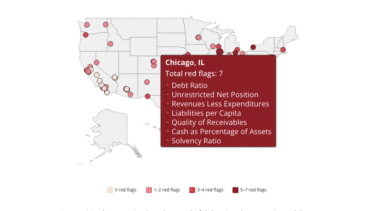
  • Study: Chicago and New York City are the most fiscally stressed cities in the nation
    Study: Chicago and New York City are the most fiscally stressed cities in the nation

    While Chicago and New York face extreme pressure on nearly every metric, 42 of the 100 most populous cities trigger one or fewer red flags.

    Policy Study by Geoffrey Lawrence and Carter Langofer August 20, 2026

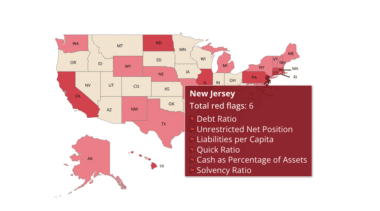
  • Study: New Jersey and Connecticut are the most financially distressed states
    Study: New Jersey and Connecticut are the most financially distressed states

    New Jersey has the most financial red flags, followed by Connecticut, California, Hawaii, Illinois, Massachusetts, North Dakota and Pennsylvania. Twenty-three states have zero red flags.

    Policy Study by Geoffrey Lawrence and Carter Langofer August 20, 2026

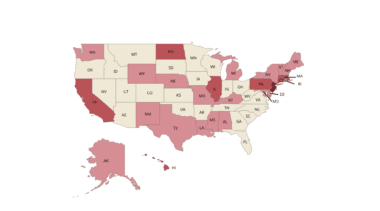
  • State and local government finances in America: A comprehensive analysis of debt and liquidity
    State and local government finances in America: A comprehensive analysis of debt and liquidity

    Based on audited financial reports from more than 20,000 government entities, this study uses eight objective indicators to identify emerging fiscal risks.

    Policy Study by Geoffrey Lawrence and Carter Langofer August 20, 2026

  • First
  • Prev
  • 49
  • 50
  • 51
  • 52
  • 53
  • 54
  • 55
  • ...
  • 59
  • Next

Follow

  • Facebook
  • Twitter
  • LinkedIn
  • YouTube
  • RSS

Email Updates

Get weekly updates from Reason.

This field is for validation purposes and should be left unchanged.

More About Reason Foundation

  • About
  • Contact
  • Donate
  • Email Newsletters
  • Events
  • Jobs and Internships
  • Policy Research
  • Reason magazine
  • Shop

Contact

Reason Foundation
5737 Mesmer Ave.
Los Angeles, CA 90230
(310) 391-2245

1630 Connecticut Ave NW
Suite 600
Washington, DC 20009
(202) 986-0916

Privacy Policy
Accessibility

This site is protected by reCAPTCHA and the Google Privacy Policy and Terms of Service apply.


Copyright © 2026 Reason Foundation