
Vittorio Nastasi
Director of Criminal Justice Policy, Reason Foundation
Vittorio Nastasi is the director of criminal justice policy at Reason Foundation, where he provides research and technical assistance to lawmakers and stakeholders across the country.
His work focuses on removing barriers to employment, housing, and education for individuals with criminal records; curbing excessive criminal fines and fees; and reducing system overreach through policy research and legislative engagement. His research and commentary have appeared in The Wall Street Journal, Orange County Register, Atlanta Journal–Constitution, Palm Beach Post, and Tallahassee Democrat, among others.
Before joining Reason, he worked with the James Madison Institute and the DeVoe L. Moore Center, researching land-use regulation, occupational licensing, and criminal justice policy. Nastasi holds bachelor’s degrees in economics and political science and is currently a doctoral candidate at Florida State University’s Askew School of Public Administration and Policy. He is based in Tallahassee, Florida.
-
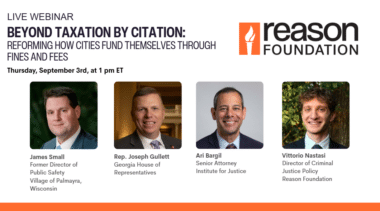
Webinar: Reforming how cities fund themselves through fines and fees
A recent Reason Foundation webinar explored how local governments across the country raise billions of dollars a year through court fines, fees, and forfeitures.
-

Automated license plate readers require scrutiny—and due process
A response to Charles Fain Lehman’s “In Defense of Flock” article.
-
Utah can do more to prevent “taxation by citation”
Utah adopted reforms intended to prevent local government from using law enforcement and courts to raise revenue, but opportunities for improvement remain.
-
Texas can do more to prevent “taxation by citation”
Texas has adopted reforms intended to prevent local government from using law enforcement and courts to raise revenue, but opportunities for improvement remain.
-
Loopholes in Florida laws allow law enforcement to collect excessive fines
Florida has laws meant to discourage local governments from relying on ticket revenue, but significant gaps remain in how those laws are enforced.
-
Louisiana adopts reforms to provide released inmates with identification documents
House Bill 167 codifies a clearer role for the Department of Public Safety and Corrections in helping inmates obtain necessary documents before they leave prison.
-
Maryland reduces uncertainty in occupational licensing decisions for applicants with criminal records
House Bill 557 creates a predetermination review process so citizens with disqualifying criminal records don’t waste time and money training for a license.
-
Taxation by citation: A 50-state data and policy report on local government fines and forfeitures
This report maps the scope of local governments' dependence on fines and forfeitures to fund basic operations and why decades of reform efforts have fallen short.
-
Report: Fine revenue exceeds 50% of general revenue in 42 cities across the country
Eleven cities collected more revenue from fines than from taxes and other general revenue sources, and seven of the 10 most reliant cities are in Louisiana.
-
Maryland’s new law protecting artistic expression should be a model for other states
Other states and Congress should follow Maryland’s lead in protecting freedom of expression.
-
Standardized tracking could help states improve pregnancy care in prisons and jails
The Reporting on Incarceration Pregnancy and Postpartum Outcomes Act would establish a consistent set of standards so that data is comparable across jurisdictions.
-
Legislation could end Pennsylvania’s expensive and unreliable capital punishment system
House Bill 888 repeals capital punishment from Pennsylvania statutes, replacing the maximum sentence for relevant offenses to life imprisonment.
-
How Georgia bureaucrats undermine a law meant to help poor drivers
After Georgia lawmakers passed House Bill 926, making driver's license reinstatement easier, the Georgia Department of Driver Services added new restrictions.
-
Colorado becomes the first state to address wrongful arrests and convictions caused by unreliable field drug tests
More than half of the roughly 1.5 million drug arrests conducted in the United States each year involve notoriously unreliable colorimetric field drug tests.
-
Maryland’s S.B. 475 and H.B. 687 would protect free expression and artistic freedom
Freedom of expression and due process of law are essential elements of a free society.
-
West Virginia House Bill 4819 reduces licensing barriers for people with criminal records
The bill would strengthen licensing reforms and give people with criminal records clearer access to stable employment.
-
Kentucky House Bill 185 expands job opportunities and reduces licensing barriers for people with criminal records
The bill would let people find out in advance whether their criminal record disqualifies them from a license while strengthening transparency.
-
Tennessee’s Senate Bill 2099 would reduce costly failures to appear and improve efficiency
States and localities should implement evidence-based court reminder systems as a cost-effective way to reduce unnecessary license suspensions, warrants, and jail admissions while improving court efficiency.