-
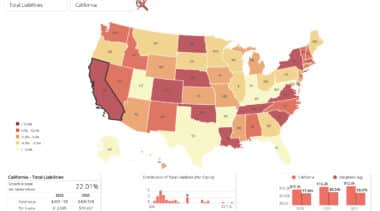
Debt trends for state and local governments 2020-2022
This tool provides debt and spending insights for the 100 largest municipalities, counties and school districts in America and all 50 states for fiscal years 2020, 2021 and 2022.
-

City debt: New York has more than four times the liabilities of Chicago, Los Angeles, Houston and other cities
New York City, the District of Columbia, Chicago, Atlanta, Yonkers and Austin have the most per capita liabilities.
-

County debt: Los Angeles, Miami-Dade and Cook counties among worst in nation
Los Angeles County had $54 billion in liabilities at the end of 2022. Miami-Dade County had $29 billion in total liabilities.
-
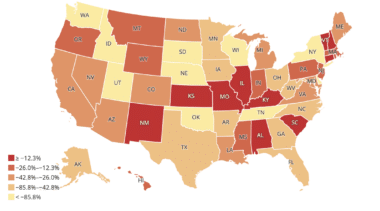
State debt: California, Illinois, New York, New Jersey and Texas each have over $200 billion in total liabilities
On a per capita basis, Connecticut's $27,031 total liabilities per capita are worst in the nation, followed by New Jersey.
-
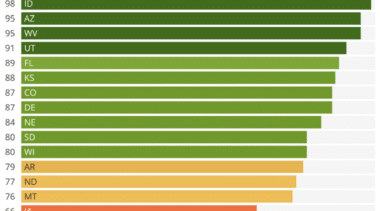
Public schools without boundaries 2024: Ranking every state’s open enrollment laws
Study finds Arizona, Idaho, Oklahoma, Utah, and West Virginia have the best public school transfer and open enrollment laws.
-

Best practices in optional defined contribution plans for public workers
Governments expanding their retirement options can offer better benefits to employees and slow the growing costs caused by unfunded public pension liabilities.
-

Vision Zero and Complete Streets: Do they make roads safer?
In the wake of rising traffic fatalities, municipalities have been looking for a comprehensive solution to reduce or eliminate traffic fatalities.
-
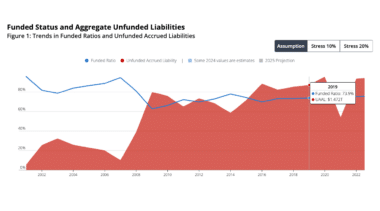
Annual pension solvency and performance report
At the end of the 2023 fiscal year, the nation's public pension systems had $1.59 trillion in total unfunded liabilities.
-

Working paper: Best practices in optional defined contribution plans
With the proliferation of unfunded pension liabilities among U.S. governments, optional defined contribution plans can serve as valuable risk mitigation solutions.
-

The case for Connecticut’s fiscal guardrails
The “fiscal guardrails” have saved Connecticut more than $170 million and could save $7 billion over the next 25 years.
-

A framework for federal and state hemp-derived cannabinoid regulation
The growing popularity of hemp-derived products has stimulated significant legislative attention in recent years, with over 90 regulatory proposals introduced in state legislatures in 2024 alone.
-

Transparent K-12 open enrollment data matters to parents, policymakers and taxpayers
A total of 16 states have strong statewide cross-district open enrollment laws, while 13 states have strong statewide within-district open enrollment laws.
-

The cost of state hold harmless policies in K-12 education
With widespread public school enrollment losses in the wake of the COVID-19 pandemic, the financial costs of some hold harmless policies have increased exponentially.
-

Reforming environmental litigation
There is growing bipartisan support that the NEPA process, as it has evolved since the legislation’s enactment in 1970, has gone too far, placing obstacles and delays in the way of needed energy and transportation infrastructure projects.
-

Is private equity a public financial hazard?
Private equity funds lack clear return and risk metrics, making it hard to assess performance before investments are redeemed, often a decade or more after the initial investment.
-

Getting cannabis legalization right in Hawaii
Hawaii may be poised to become the 25th state to legalize the recreational use of cannabis for adults aged 21 and over.
-

How to modernize and properly fund the inland waterway system
There's an $800 million backlog of current inland waterway system projects and another $6 billion worth of projects planned, but not yet started.
-

Ibogaine treatment for opioid use disorder
Policymakers should consider ibogaine as a potential alternative treatment for opioid use disorder.