Jordan Campbell
Managing Director, Government Finance, Reason Foundation
Jordan Campbell is managing director of government finance and senior quantitative analyst at Reason Foundation.
Prior to joining Reason, Campbell worked at a marketing analytics firm building econometric models. Before starting his analytics career, he was a policy and research assistant at the Charles Koch Institute.
Campbell’s work has been published by The Press-Enterprise and the Platte Institute. His quantitative work on educational policy has been cited by The Thomas B. Fordham Institute.
Recently, Campbell appeared on a panel entitled “Don’t Fence Me In: Texans Crossing School Boundaries” sponsored by the Texas Public Policy Foundation.
Campbell received his bachelor’s degree from Portland State University and a master’s degree in quantitative economics from California Lutheran University.
He lives with his wife in Los Angeles.
-

State debt: California, Illinois, New York, New Jersey and Texas each have over $200 billion in total liabilities
On a per capita basis, Connecticut's $27,031 total liabilities per capita are worst in the nation, followed by New Jersey.
-
Annual pension solvency and performance report
At the end of the 2023 fiscal year, the nation's public pension systems had $1.59 trillion in total unfunded liabilities.
-
How Connecticut pensions can save $7 billion in interest costs over the next 30 years
The Connecticut Pensions Dashboard explores various economic scenarios that could impact the state's public pension debt.
-
The case for Connecticut’s fiscal guardrails
The “fiscal guardrails” have saved Connecticut more than $170 million and could save $7 billion over the next 25 years.
-
Four takeaways from the U.S. Census Bureau’s latest school finance data
With federal data from the 2022 school year now available, policymakers can better grasp how the COVID-19 pandemic affected public school budgets.
-
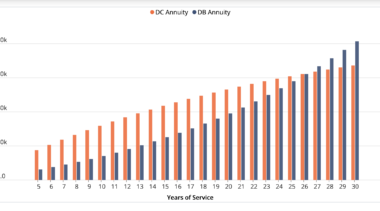
For most workers, the value of Alaska’s defined contribution plan surpasses that of a traditional pension
The following tool created by the Pension Integrity Project displays the year-by-year accrual of retirement benefits for a wide variety of Alaska workers in different fields and starting at different ages.
-
Public education at a crossroads: A comprehensive look at K-12 resources and outcomes
Examining key education spending, enrollment, staffing, and student performance data over the past two decades in all 50 states.
-
Public education at a crossroads: K-12 education revenue and expenditure trends 2002-2020
Nationwide, inflation-adjusted public school revenues grew from $12,852 per student in 2002 to $16,065 per student in 2020.
-
Public education at a crossroads: Enrollment, staffing, and teacher salary trends 2002-2020
Nationwide, inflation-adjusted average teacher salaries fell by 0.6% between 2002 and 2020 with a total of 26 states seeing declines.
-
Public education at a crossroads: Math and reading outcomes (low-income students only)
Between 2003 and 2019, the average U.S. 4th grade NAEP math score for free and reduced-price lunch eligible students increased by seven points.
-
Public education at a crossroads: Math and reading outcomes (all students)
Between 2003 and 2019, the average U.S. 8th-grade NAEP reading score was flat. The average 8th-grade NAEP math score increased by four points.
-
Public education at a crossroads: Education spending data for all 50 states 2002-2020
Examining every state's K-12 public education spending, staffing and enrollment levels, teacher salaries and more.
-
-
Public pension systems continue to support ESG proposals
The public should be able to view proxy votes well before they are cast and access annual reports showing all of a pension plan’s proxy votes.
-
Calls for public pension systems to divest from energy sector are shortsighted
Public pension systems have a fiduciary duty to make investment decisions in the best financial interest of their members.
-
Homeschooling is on the rise, even as the pandemic recedes
As of May 2023, 85% of students are enrolled in public schools, 9.6% attend private schools, and 5.4% are homeschooled.
-
Vanguard’s shift away from ESG fits with its focus on low fees
“Our research indicates that ESG investing does not have any advantage over broad-based investing.”
-
Comparing Alaska’s defined benefit and defined contribution retirement plans
Most of Alaska’s public employees would be better served in the existing defined contribution plan.