Latest
-

What do public-private partnerships add to priced managed lanes?
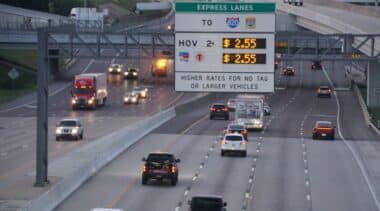
Comparing the attributes of government ownership and public-private partnership ownership of managed lanes.
-
Key considerations for states developing mileage-based user fee pilot programs
States considering replacing gas taxes with mileage-based user fees can learn from pilot programs in Hawaii, Michigan, California, and Texas.
-
Concession fees for express toll lanes
Plus: The future of the Highway Trust Fund, new findings on truck user fees, and more.
-
Webinar: Reforming how cities fund themselves through fines and fees
A recent Reason Foundation webinar explored how local governments across the country raise billions of dollars a year through court fines, fees, and forfeitures.
-
Automated license plate readers require scrutiny—and due process
A response to Charles Fain Lehman’s “In Defense of Flock” article.
-
California undermines pension reforms with benefit boost for first responders
If signed by Gov. Newsom, a new bill will undermine progress made on reducing the state’s massive pension debt and put taxpayers on the hook for over $11 billion in new costs.
-
Texas property tax relief won’t last unless local governments rein in spending
Recent exemptions may lower tax bills temporarily, but durable relief requires limits on local spending, borrowing, and costs.
-
Depoliticizing public employee pension plans: Building robust legal and structural guardrails for sustainability
Many political vulnerabilities that threaten sound design and funding of public pensions can be addressed with apolitical guardrails.
-
Probation and parole rules haven’t caught up with medical marijuana legalization
In many states, people on probation and parole are forbidden to use medical marijuana, even when legally recommended by a physician.
-
Fiscal red flags reveal growing problems in California governments and school districts
California has the largest total debt of any state in the nation, nearly $497 billion in state liabilities.
-
Organized labor takes aim at California’s driverless truck rules
Today, most states already allow autonomous trucks to be tested and deployed on public roads, but California has by far the most onerous regulations.
-
Texas should collect more data before evaluating its autonomous vehicle program
With Texas’ autonomous vehicle regulatory program just three months old, lawmakers should focus on collecting the data needed to evaluate it in the future.
-

Survivor justice acts bring common sense to sentencing
These laws allow full and adequate consideration of abuse and the role it can play in offenses.
-

International transit systems show practical lessons to improve US transit
States and local governments can adapt proven practices using their existing authority over transit agencies, funding, and oversight.
-
Debtor Nation 2026: The $40 trillion national debt
President Trump has already surpassed Obama as the president who has overseen the largest real increase in federal debt.
-
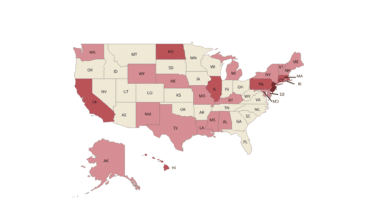
State and local government finances in America: A comprehensive analysis of debt and liquidity
Based on audited financial reports from more than 20,000 government entities, this study uses eight objective indicators to identify emerging fiscal risks.
-
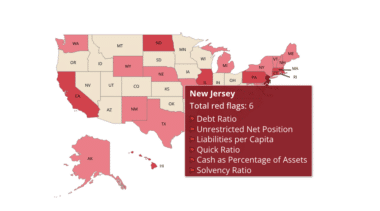
Study: New Jersey and Connecticut are the most financially distressed states
New Jersey has the most financial red flags, followed by Connecticut, California, Hawaii, Illinois, Massachusetts, North Dakota and Pennsylvania. Twenty-three states have zero red flags.
-
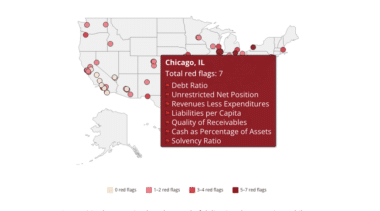
Study: Chicago and New York City are the most fiscally stressed cities in the nation
While Chicago and New York face extreme pressure on nearly every metric, 42 of the 100 most populous cities trigger one or fewer red flags.