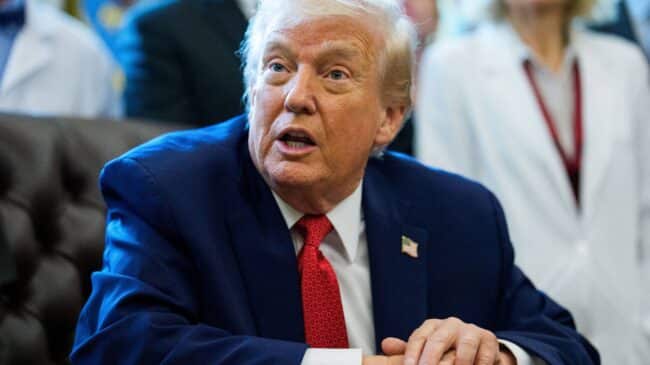

Following a historic move to reduce federal restrictions on medical marijuana use, the Trump administration is now calling on Congress to take action to protect hemp-derived cannabidiol (CBD) products, consumers, and farmers, from an impending federal ban.
In a Truth Social post on April 23rd, President Donald Trump said he was “calling on Congress to update the Law to ensure that Americans can continue to access the full-spectrum CBD products they have come to rely on, and that help them, while preserving Congress’s intent to restrict the sale of products that pose Health risks.”
CBD and other hemp-derived products are at risk because of a November 2025 spending bill that Congress passed and the president signed to end a 43-day government shutdown and fund the government through January 2026. Among its provisions was Section 781, which amended the federal definition of legal hemp, limiting products to no more than 0.4 milligrams of total THC per container.
The U.S. Hemp Roundtable argues that the new definition, set to take effect on Nov. 13, 2026, would eliminate 95% of the hemp industry. The industry group claims that “more than 90% of non-intoxicating hemp-derived products contain levels of THC that are greater than the proposed cap.” Even products that primarily contain CBD often contain trace amounts of THC, and it’s not economically viable to remove these trace amounts.
Prior to this change, the 2018 Farm Bill had defined legal hemp as cannabis with less than 0.3 percent delta-9 THC on a dry-weight basis. This classification allowed the consumer hemp market to blossom into a $28.4 billion industry that supports more than 300,000 jobs, according to the U.S. Hemp Roundtable.
Hemp products can contain a mix of cannabinoids, including non-intoxicating CBD or intoxicating variants of tetrahydrocannabinol (THC). CBD is the primary cannabinoid produced within a hemp plant. CBD has anti-inflammatory properties and has been approved by the Food and Drug Administration (FDA) as a safe and effective pharmaceutical for the treatment of certain forms of epilepsy. Many consumers purchase pills, lotions, and other products containing CBD primarily for medical or therapeutic benefits.
However, once the natural CBD in hemp is extracted, it can also be chemically converted into various isomers of THC that are intoxicating. Federal courts have ruled these intoxicating products are federally legal because the source material is federally legal hemp. The emergent industry of intoxicating hemp products alarmed key congressional leaders, which inspired the redefinition of hemp last November.
Though Trump signed the redefinition of hemp into law, his administration issued Executive Order 14370 the following month, directing various agencies to work with Congress to “update the statutory definition of final hemp-derived cannabinoid products” to allow consumers to continue benefiting from access to full-spectrum CBD products “while preserving the Congress’s intent to restrict the sale of products that pose serious health risks.” The order also promised that seniors could eventually seek Medicare reimbursements for CBD products. A model program covering up to $500 per year for eligible Medicare patients, with up to 3 milligrams of THC per serving allowed, launched earlier this month.
Following this order, hemp advocates successfully pushed to insert language into the January spending bill that would have delayed the implementation of the new hemp definition and the ban by one or two years. But Republican House leadership quashed the effort, according to MJBIZDaily. House Freedom Caucus members, led by Rep. Andy Harris (R-MD), who authored the original ban language, had the delay provision stripped from the spending bill, which passed without it.
With the November 2026 deadline looming and farmers making planting decisions, Trump is leaning on Congress to act now. Numerous members of Congress have already introduced measures that would stop or delay the hemp ban, with some proposing a broader federal regulatory scheme for hemp products. Key examples include:
The American Hemp Protection Act (H.R. 6209), introduced by Rep. Nancy Mace (R-SC), would repeal the new federal hemp language, reverting to the definition in the 2018 Farm Bill.
The Hemp Planting Predictability Act (H.R. 7024), introduced by Reps. Jim Baird (R-IN) and Angie Craig (D-MN), would delay the ban for two years, a move House Oversight and Accountability Chair and bill co-sponsor Rep. Jamie Comer (R-KY) described as a “commonsense extension.” Comer urged bipartisan support for this bill, and Sens. Amy Klobuchar (D-MN), Rand Paul (R-KY), and Jeff Merkley (D-OR) introduced an identical measure in the Senate.
The Cannabinoid Safety and Regulation Act (S. 3474), reintroduced last December by Sen. Ron Wyden (D-OR), would establish manufacturing, testing, and labeling requirements for hemp products, as well as a national minimum purchasing age of 21.
The Hemp Enforcement, Modernization, and Protection Act (H.R. 7212), introduced in January by House Energy and Commerce Subcommittee on Health Chairman Morgan Griffith (R-VA) and Rep. Marc Veasey (D-TX), would federally authorize the sale of consumable hemp products to adults 21 years of age and older and institute a range of manufacturing, labeling, and packaging rules.
The Hemp Safety Enforcement Act, introduced earlier this week by Sens. Rand Paul (R-KY), Amy Klobuchar (D-MN), and Joni Ernst (R-IA), would allow states to opt out of the federal recriminalization of intoxicating hemp products. However, Ernst withdrew her name as a cosponsor days after the measure was introduced.
On the same day as Trump’s Truth Social post, multiple Republican lawmakers also filed amendments to the latest version of the Farm Bill—the Farm, Food, and National Security Act of 2026 (H.R. 7567)—to address the pending hemp ban.
Rep. James Comer (R-KY), Chairman of the House Oversight and Government Reform Committee, proposed an amendment to delay the ban for one year, until November 2027. Rep. Andy Barr (R-KY) proposed a separate amendment that, according to a sponsor’s summary, “amends the definition of ‘Hemp’ to preserve the lawful hemp market while creating a regulatory framework that protects children, bans synthetic cannabinoids, and ensures that any products on the market place are of American origin.” However, the Barr amendment was withdrawn on April 22, 2026, for unknown reasons, and it’s uncertain if he will file a revised version.
The House Rules Committee is expected to consider the submitted amendments the week of April 27th, deciding which of these amendments, if any, will receive votes on the House floor.
The hemp industry faces a hard deadline with the ban set to take effect this November. Farmers need to know what to plant this spring, manufacturers need supply chain certainty, and consumers need assurances that the hemp products they have access to are safely manufactured and accurately labeled.
In states without vibrant medical marijuana programs, hemp products are the primary means for many people to access cannabinoids for therapeutic purposes. If these products become unavailable, many consumers will resort to illicit and potentially dangerous alternatives.
Congress should heed the president’s urging by delaying or eliminating the new federal hemp definition. Then they should work to establish reasonable federal rules that ensure hemp producers comply with minimum standards for safe manufacturing practices and accurately label their products. Prohibition does nothing to protect consumers. It will only eliminate thousands of jobs, deprive consumers of valuable therapeutic products, and drive a billion-dollar market into the illicit economy.