


In This Issue:
Articles, Research & Spotlights
- Proposal Would Add $14 Billion in Pension Costs in California
- Alaska’s Teachers Need an Adequate Replacement for Social Security
- The Flexibility of DC Plans Can Benefit Women Working in the Government
News in Brief
Quotable Quotes on Pension Reform
Data Highlight
Reason Foundation in the News
Contact the Pension Reform Help Desk
Articles, Research & Spotlights
Reason’s CalPERS Monitor Warns Proposed Pension Bill Would Add $14 Billion in Costs
The nation’s largest government pension plan, the California Public Employees’ Retirement System (CalPERS), has a $179 billion funding shortfall, contributing to a growing burden on already-strained taxpayers. Reason Foundation’s new CalPERS Monitor is an interactive data visualization tracing the system’s history, including the granting of unfunded benefits to government workers and the ongoing funding challenges stemming from these ill-advised decisions. The analysis also examines state legislation currently under consideration, Assembly Bill 1383, which would repeat past mistakes by granting benefit sweeteners to public safety workers while the system is still grappling with debt. Reason Foundation’s analysis finds the proposed bill could add over $14 billion in new pension costs over 30 years.
Alaska Senate Bill 55 Would Complete Retirement Benefits for Alaska Teachers
Alaska’s teachers do not participate in Social Security, but unlike the rest of the state’s government employees, they do not have access to a retirement benefit that fills this gap. Lawmakers are currently considering Senate Bill 55, which would make the successful Alaska Supplemental Annuity Plan (SBS-AP) available to teachers through their employers. Reason Foundation’s analysis indicates that an educator starting employment at age 30 could see an additional $56,280 in annual retirement benefits if this proposal were to pass, bringing teachers up to the same level as other public employees and ensuring they build adequate savings for a secure retirement.
How to Help Working Moms in the Public Sector? Flexible Retirement Benefits
Women in the workforce tend to prioritize flexible career paths and take more breaks for caregiving, both in the private and public sectors. Reason Foundation’s Mariana Trujillo asserts that this creates a unique challenge for women government employees seeking adequate, consistent retirement benefits, because pensions (the retirement plan predominantly offered in the public sector) tend to favor long, uninterrupted tenures. Rather than applying a one-size-fits-all approach to a cohort with diverse needs and circumstances, policymakers should consider adding more flexible retirement options, including defined contribution (DC) plans.
News in Brief
What share of government spending goes to public pensions?
An issue brief from the National Association of State Retirement Administrators (NASRA) investigates trends in public pension contributions as a share of state and local government spending. Using Census data, the brief projects employer pension contributions in 2024 to total $232 billion, representing 5.16% of general spending. This share of spending has consistently risen for the past few decades, up from a historical low of 2.3% in 2002.
Spending levels vary dramatically by state, ranging from 1.75% in South Dakota to 13.3% in Illinois. Drivers of this variation include differences in benefit levels, the size of unfunded liabilities, and Social Security coverage (25-30% of public employees don’t participate).
Several states made extraordinary above-actuarial contributions in recent years, notably Arizona, California, Connecticut, and Virginia, which helped stabilize aggregate pension spending as a share of government budgets. You can read NASRA’s full brief here.
Quotable Pension Quotes
“Pensions are sort of like New Year’s resolutions. Policymakers always promise, to themselves and to their constituents, that this will be the year they’ll finally get their financial house in order and bolster their pensions. But inevitably, something shiny comes along and distracts them.”
––Chad Aldeman, school finance and labor market expert, in “Oklahoma Has Led the Way on Teacher Pension Funding. Can It Keep It Up?” The 74, March 23, 2026.
“[Boosting pensions] would do something [to keep workers] but it’s not clear to me that it is the most or even a mildly efficient method for doing so.”
––David Schleicher, Yale Law School professor, in “A Pension Battle Is Heating Up in Albany. Here’s What to Know,” New York Focus, March 23, 2026.
“This hasn’t been a comfortable experience, and it will continue to be an uncomfortable experience […] We are making uncomfortable decisions.”
–– Mississippi State Sen. Daniel Sparks in “Sparks, Senate attempt to revive chambers’ PERS reforms,” Magnolia Tribune, March 20, 2026.
Data Highlight
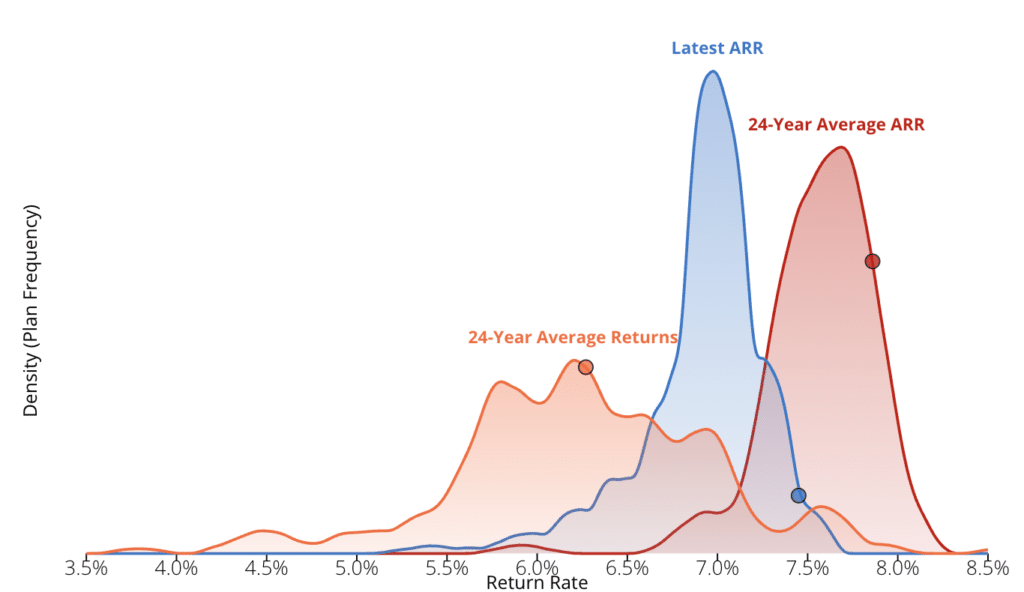
Using the Reason Foundation’s 2025 Pension Solvency and Performance Report, Brayden Myers examines the Retirement Systems of Alabama’s assumed rate of return, showing the system’s return expectations have been consistently higher than most other public pensions, while results have been around the median among other state and local government plans.
Alabama’s Position in the Distribution of Pension Plan Assumed and Experienced Returns
Reason Foundation in the News
“As it stands, California’s state and local governments have the most public pension debt in the country, with total unfunded pension liabilities of more than $265 billion, according to a new report from the Reason Foundation. That’s over $6,000 in pension debt for every state resident. CalPERS has $166 billion in debt, and CalSTRS has $39 billion in unfunded liabilities.”
—Reason Foundation’s Zachary Christensen quoted in “Trump Signs the (Dollar) Bill,” National Review, March 27, 2026.
“Pension funds across the country already have some ‘exposure to cryptocurrencies through public equities such as MicroStrategy and Coinbase, which are part of major stock indices,’ according to the Reason Foundation.”
—Reason Foundation’s U.S. Public Pension and Trust Fund Investment in Digital Assets policy brief cited in “With Millions in Donations From the Industry, Ramaswamy Backs Ohio Crypto Gamble,” The American Prospect, April 4, 2026.