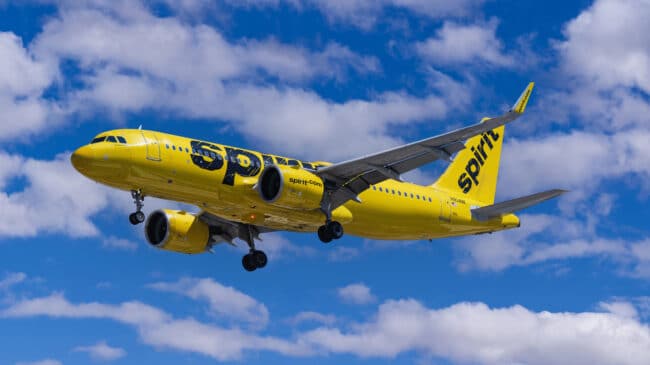

This week, The Wall Street Journal and others are reporting that the Trump administration is in advanced negotiations to provide up to $500 million in government financing to troubled Spirit Airlines. According to the reporting, this taxpayer-backed loan would be secured by warrants that give the U.S. government the option to purchase an equity stake in the company at a fixed price.
Bloomberg reported that exercising these warrants could allow the government to own up to 90% of the air carrier when it emerges from bankruptcy.
Bailing out Spirit, or any other failing budget airline, is a tremendously bad deal for taxpayers.
Spirit Airlines has twice filed for bankruptcy in recent years and is weighed down by low customer demand, high debt, and a tarnished public reputation. As a private company, Spirit should bear these risks, since only its shareholders and private lenders stand to benefit if Spirit is able to revitalize itself and avoid liquidation, which appears unlikely. A government loan, or even worse, government ownership, merely transfers these risks to taxpayers.
While noncommittal to the bailout at the time, White House spokesman Kush Desai argued that Spirit “would be on a much firmer financial footing had the Biden administration not recklessly blocked the airline’s merger with JetBlue,” another troubled budget airline. This is a fair point, but actions have consequences, and this does not justify a bailout that harms taxpayers in a futile attempt to alter the past.
The day before this news leaked, Transportation Secretary Sean Duffy told Reuters, “What we don’t want to do is put good money after bad, and there’s been a lot of money thrown at Spirit, and they haven’t found their way into profitability. And so would we just forestall the inevitable and then own that?”
Secretary Duffy is right, and it is good that a senior administrative official is there to provide clear thinking, but it is little solace to taxpayers if the move goes ahead. What is the benefit of perpetuating a financial zombie like Spirit Airlines? There’s certainly none for taxpayers, who would ultimately be responsible for this bad investment.
“This is an absolutely terrible idea,” and the “government doesn’t know a damn thing about running a failed budget airline,” Sen. Ted Cruz (R-TX), chairman of the Senate Committee on Commerce, Science, and Transportation, tweeted.
The airline industry has long been characterized by low profit margins and volatility. For these reasons, legendary investor Warren Buffett has notably avoided purchasing airline stocks. Former American Airlines CEO Bob Crandall famously told his employees not to invest their money in the airline industry.
Low-cost carriers (LCCs) and ultra low-cost carriers (ULCCs) had bucked that trend in recent decades, earning steady operating profits even when their legacy competitors were in the red. This was due to the lean, agile business models of LCCs, and especially ULCCs like Spirit.
The ultra low-cost carriers bet that cutting out creature comforts to trim costs would attract a large volume of bargain-hunting leisure travelers willing to sacrifice convenience for the lowest possible airfares. This worked until it didn’t.
When air travel came roaring back after the COVID-19 pandemic, customers tended to demand more premium options. Demand for first- and business-class seating on legacy network carriers surged, as those carriers continued to see major gains from their diversified financial products, such as co-branded credit cards.
The no-frills airlines were poorly suited for this sudden change in customer taste. This may well prove temporary, as the next economic recession is bound to cause consumers to tighten their belts. Adapting to market trends is the job of airline management hired by shareholders, who bear the risks of these decisions. LCCs and ULCCs have responded by offering better bundled amenities at higher prices to varying degrees of success. Bailing out those that fail to succeed is both bad policy and bad business.
The unique features of LCCs and ULCCs make a bailout of these types of airlines especially troubling. The main value of budget airlines stems from their strategy of rapidly entering and exiting routes.
In 1992, the Department of Transportation dubbed the results of this new competition “the Southwest Effect,” where entry by an LCC would significantly reduce average airfares while increasing capacity, thereby benefiting all travelers regardless of the airline they chose. Economists such as Goolsbee & Syverson (2008), Resul Aydemir (2012), and Ethiraj & Zhou (2019) have found the mere perceived threat of entry by an LLC or ULCC can cause incumbent network carriers to substantially reduce their prices and adjust service quality to make their offerings more attractive to customers.
Bailing out a failing ultra-low-cost carrier risks short-circuiting these pro-competitive dynamics.
If the White House’s Spirit financing deal goes through, there are two troubling potential impacts.
First, Spirit could raise prices in an attempt to limp along and repay its new creditors. This would dilute the competitive benefits of ULCC competition in the airline market.
Second, and worse, if the government takes a substantial stake in Spirit Airlines and decides to run it at a perpetual loss, as it does with Amtrak, it would undercut Spirit’s private LCC and ULCC competitors and put this entire pro-competitive segment of the airline industry at risk.
Rather than aggressively intervening in the air travel market, federal policymakers have better options to enhance airline competition and consumer choice. As I discussed in my 2023 Reason Foundation report, Airline deregulation: Past experience and future reforms, existing federal policy imposes substantial barriers to airline entry. Its airport financing restrictions protect incumbent airlines’ preferential-use gates and limit airport access.
Likewise, slot controls at the busiest airports encourage incumbent carriers to hoard and underuse scarce airport capacity. And finally, and most significantly, longstanding federal law has prohibited non-U.S. air carriers from serving domestic routes or even launching majority-owned U.S.-based subsidiaries. More competition in the airline industry would benefit travelers, but the barriers are largely due to misguided federal laws.
Bailing out Spirit Airlines would not help taxpayers, travelers or the airline industry. Instead of making this problem worse by undermining the airlines most responsible for the competition that does exist and exposing taxpayers to large financial risk, the White House should call on Congress to pass real reforms that would benefit both consumers and taxpayers.