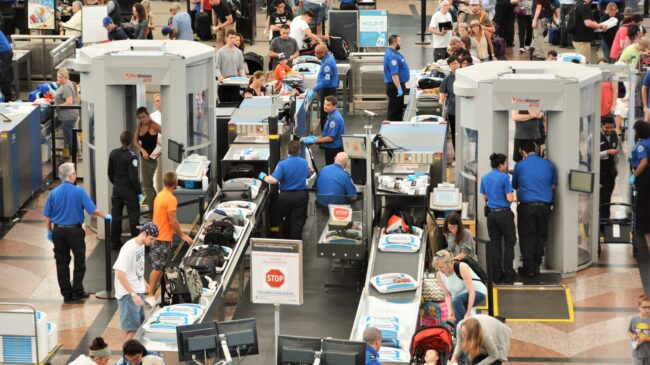

Americans waited for hours in lines at airport security checkpoints when the shutdown of the Department of Homeland Security led some unpaid Transportation Security Administration (TSA) officers to stop showing up for work. Wait times have eased since President Trump ordered TSA officers to be paid, but the episode exposed a major flaw in how America handles airport security screening. Without sensible reform, the long lines are likely to return.
Congress nationalized passenger and baggage screening at airports two months after the 9/11 terrorist attacks. Airlines had been responsible for airport screening and were all too happy to be relieved of this unfunded mandate. The frantic response after 9/11 blinded Congress to the inherent conflict of interest in tasking a monopoly provider to regulate itself and created a single point of failure.
In establishing TSA, Congress simultaneously authorized a pilot program to test the use of contract screeners at airports. This evolved into the permanent Screening Partnership Program (SPP) in 2004, which exists today with 20 enrolled airports. These airports, the largest being San Francisco International, were spared the 2026 shutdown chaos because contract screeners continued to be paid outside the federal payroll system.
In its recent fiscal 2027 budget request, the White House proposed requiring small airports to participate in the SPP. TSA estimated this would reduce its workforce by about 4,500 screening employees and save $52 million a year on net. Some advocates of screening privatization cheered this development. But they failed to ask why only 20 airports—less than 5% of U.S. commercial service airports—have chosen to enroll in the SPP over the past two decades.
The SPP’s unpopularity stems from its poor design. To enter the SPP, an airport must first submit a detailed application to TSA. If it is approved, TSA then puts a contract out for competitive bid by preapproved companies and assigns the winning company to the airport.
Airports have almost no say in this process. TSA has no obligation to award contracts to private providers that airports prefer. Airports can’t hire, fire, or negotiate contracts on pay and performance. Once an airport expresses interest in the SPP, the most airport management can do is hope TSA does its job in selecting a competent contractor on the airport’s behalf.
The White House proposal to require all small airports to participate in the SPP will undoubtedly spark backlash from the federal employee union that represents TSA screeners. The airport industry—which is well aware of the flaws of the SPP—will also likely oppose the change. Contract screening has benefits, but alienating airports is a poor strategy to advance needed reform.
A better approach would address the serious flaws of both TSA’s governance and the SPP’s design. TSA should be converted into a stand-alone security regulator, with legal responsibility for screening assigned to airports. This model works well around the world, including in the European Union and Japan. It would eliminate TSA’s conflict of interest in regulating the security it provides and align with global best practices.
Airports could then choose to provide security screening themselves or contract with private providers, which would be overseen by TSA. Airports would run their own procurement and negotiate contracts with TSA-certified screening providers, rather than being assigned screening companies. Airports could terminate contracts with companies that fail to provide good service, and TSA could revoke certification of companies that fail to adhere to federal screening requirements.
To ensure that airports aren’t stuck with the unfunded mandate that led airlines to lobby for security nationalization after the 9/11 attacks, the longstanding September 11 Security Fee assessed on airline tickets should be converted into a local airport user fee. Airlines would continue to collect the money, but instead of remitting the revenue to the Treasury—where much of it is diverted for nonsecurity purposes—it would be paid directly to airports to fund TSA-approved security projects and operations.
The TSA’s defective design is one of many errors made by elected officials in response to 9/11—and American travelers are paying the price. Congress limiting TSA’s role is the only way to insulate airport security from dysfunctional Washington politics.
A version of this column first appeared at The Wall Street Journal.