
- Getting to yes on ADS-B/In
- Terminate NASA’s SLS rocket
- TSA’s remote terminal experiment
- Private planes want protection from landing fees
- European airspace—progress and delays
- TSA’s new Gold+ program
- News Notes
- Quotable Quotes
Getting to Yes on ADS-B/In Will Exempt Some Aircraft
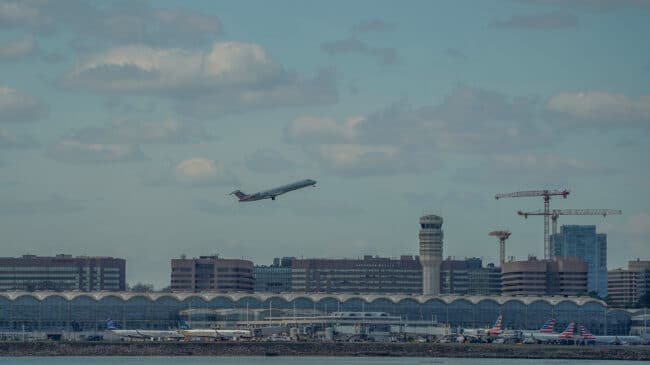
In its report on the Jan. 2025 collision between a regional jet and an Army helicopter, the National Transportation Safety Board (NTSB) noted that if the helicopter had flown with its ADS-B/Out device turned on, its flight path would have appeared on the Reagan National Airport control tower’s displays. And if the regional jet had been equipped with a device to receive the copter’s ADS/Out signals, the deadly collision could have been avoided.
All this spring, the debate has gone on in Congress and among aviation organizations. The Senate’s air traffic control (ATC) bill, called the ROTOR Act (Rotorcraft Operations Transparency and Oversight Reform Act), passed unanimously, would require ADS-B/In (the receiving device) on all aircraft already required to have the sending device—ADS-B/Out.
By contrast, the House bill, the ALERT Act (Airspace Location and Enhanced Risk Transparency Act), would require ADS-B/In only for larger turbine-powered aircraft and also exempts some airspace. And it includes what some would consider weasel words requiring some aircraft to merely be “capable of” having ADS-B/In.
Federal Aviation Administration (FAA) Administrator Bryan Bedford has pointed out that his agency cannot impose a costly new regulation without congressional approval. Hence, for aviation to obtain the ADS-B/In safety benefits that NTSB has been calling for since 2008, Congress needs to come up with a workable compromise between House and Senate bills.
First, it’s clear that large commercial airlines are underway in upgrading their cockpits with ADS-B/In. But regional airlines and low-cost carriers represented by the Association of Value Airlines are resisting the cost burden of adding both the ADS-B/In equipment and a built-in cockpit display of information.
The Regional Airlines Association (RAA) has suggested what I think is a realistic compromise for smaller airliners. Require the receiving technology but allow cockpit crew to use their “electronic flight bag” gear, such as tablets, in place of a built-in hardwired display screen. FAA Administrator Bedford is supportive of this approach. The House’s ALERT Act already includes all turbine-powered aircraft, which means business jets are included.
Perhaps one or more of the companies that develop high-tech equipment for smaller planes will come up with an “affordable” cockpit retrofit, including an ADS-B/In display screen. But for now, aviation needs a workable compromise along the lines of what RAA has proposed.
The Case for Terminating NASA’s Space Launch System
A devastating report was released last month by the Space Frontier Foundation: “The Economics of Ending SLS.” Its author is public finance expert Michael Faulkender, a former deputy Treasury secretary. In brief, it makes the case that the Space Launch System, often jokingly dubbed the Senate Launch System since it was basically designed by key members of the Senate to re-create the glory days of the Apollo and Space Shuttle programs, should be terminated.
The core take-away is a table comparing SLS with three other launch vehicles: the original Saturn V from the Apollo program of the 1960s and the two most promising commercial space launchers: New Glenn and Starship. Here is that table, which is based on getting the payload to Trans-Lunar Injection (TLI).
| Vehicle | $/kg | Payload | Launches/Year |
| SLS | $80,882 | 27.2 tons | 1 |
| New Glenn | $11,000 | 20 tons | 12 |
| Starship | $ 2,400 | 150 tons | 41 |
| Saturn V | $36,782 | 45 tons | 2 |
As the table makes clear, SLS costs far more than its ancient predecessor (Saturn V), while the two commercial vehicles are far more productive and at much lower cost. And on a full mission basis (including the Orion capsule, the European Service Module, and operations), SLS costs 63 times as much as Starship and 14 times more than New Glenn. The SLS Orion/ESM crew stack masses 26.5 metric tons (empty), but SLS can only deliver 27.2 metric tons, so there is “no room for cargo, no room for redundancy, and no room for future lunar infrastructure.” He sums up the Starship vs. SLS choice as follows:
- $2,400 per kilogram compared with $82,882 per kg;
- 6,150 metric tons/year compared with 27.2 metric tons.
NASA, under new Administrator Jared Isaacman, fully understands this, which is why the program will rely more and more on commercial launch services for both people and cargo. New Glenn and Starship are signed up to be the actual lunar landers, and a greatly increased number of commercial cargo flights is planned over the next decade, as discussed in last month’s issue of this newsletter.
The White House and NASA are in agreement on these plans, but some in Congress want to see continued SLS use beyond Artemis III, IV, and V. Faulkender is OK with the planned three more SLS launches, but stresses that there should be no further SLS contracts of any kind—and no more cost-plus NASA contracts. My hope (like Faulkender’s) is that Isaacman and the White House, aided by the numbers in this new Space Frontier Foundation paper, can persuade Congress not to continue SLS beyond those three remaining Artemis missions.
TSA’s Remote Terminal Experiment
The Transportation Security Administration (TSA) has opened an experimental remote check-in site for Boston’s Logan International Airport. It’s located in Framingham, a Boston suburb, about 23 miles east of Logan. Air travelers can check their luggage and go through regular TSA screening at this site. They and their checked bags then board a secure Logan Express bus for $9. The bus “takes travelers directly to their terminal at Logan, past airport security.” The new remote terminal has 400 parking spaces at $7/day, compared with $46/day at a Logan garage. At the airport, airline staff will meet the shuttles and transfer their checked luggage to the loading crew.
Fortunately, this is only a pilot project, because it is far from clear how well this will work. In this start-up phase, it is available only to people flying Delta or JetBlue, but when Congress authorized this pilot project, it allowed for eight locations, per The Wall Street Journal, including private luxury terminals at Los Angeles International and Hartsfield-Jackson Atlanta International Airport. The Logan pilot project schedules Logan Express buses every hour from 4 am to 1 pm.
Here are some questions about the project. What happens if more travelers check in at Framingham than the Logan Express bus can accommodate? Will they have backup buses available if there are, say, three people more than the bus can carry? The plan calls for only one bus per hour.
Secondly, with travelers booked on flights by several airlines, the bus must make stops at more than one boarding area. At Logan, Delta and JetBlue are in separate terminals (A and C, respectively). So the 9 am bus will have to stop and unload passengers and bags at each of them, meaning additional wait time for those needing to depart from the second terminal.
The idea sounds good on first hearing, but as with most things, the devil is in the details. Logan Airport customers and the company trying this out—Landline—will learn a lot from this pilot project.
General Aviation Seeks PAPA’s Protection from Landing Fees
A battle is underway in Congress between “general aviation” (i.e., business jets and other private planes) over airports using ADS-B signals to identify aircraft landing at airports that charge landing fees. All commercial airports, of course, charge landing fees to all users. Such fees are also charged at some of the larger and busier general aviation (GA) airports.
Airliners are readily identified for landing fee purposes, but GA aircraft are more difficult to charge. The control tower may try to obtain the aircraft’s tail number via photography, but that is costly and hardly foolproof. On the other hand, ADS-B (which is required on nearly all powered aircraft) identifies the aircraft. So what we now hear from GA groups is that it’s wrong to use this information to link landing fees to specific aircraft. Jim Coon, senior government affairs vice president at the Aircraft Owners and Pilots Association, says “ADS-B is a safety tool to prevent mid-air collisions and that’s what it should be used for. [Using it to help collect landing fees] is a mis-use of a safety tool.”
General aviation groups have succeeded in getting this idea into the current House FAA legislation, as the PAPA Act (Pilot and Aircraft Privacy Act). There is no such provision in the Senate bill, the ROTOR Act, which will have to be reconciled with the House’s ALERT Act, which includes PAPA.
ADS-B is an information tool, as well as a safety tool. It identifies every aircraft, which is why it is the fairest way to avoid private planes evading landing fees. The PAPA Act is basically a “skip paying landing fees” measure. I have not seen any commentary on this from American Association of Airport Executives (AAAE). Its members should be educating the media and members of Congress on the vital role of landing fees as an airport revenue source.
But the politics are against taking on GA over this subject. The House General Aviation Caucus has over 200 members (out of 435) and the Senate GA Caucus has 40 members (out of 100).That is considerable clout on behalf of this sector of aviation.
Progress and Delays in European Airspace Modernization
Unlike the United States, where a single air navigation service provider (ANSP) manages the entire airspace, Europe has an ANSP for every country. But redesigning European airspace is moving forward, as Thierry Dubois reported in Aviation Week. A coordinating role is played by Eurocontrol, while it also manages a portion of the airspace in northern Europe. But individual ANSPs, sometimes working together, are making progress in several important changes.
One of these is “free route airspace,” in which aircraft operators can select their optimal high-altitude flight path. DSNA, the French ANSP, is among the leaders on this front. Since March, flights above 30,500 ft. (referred to as FL305) are now in French free-route airspace, joining the adjacent free-route FABEC airspace at that altitude, covering 772,000 square miles. DSNA plans to expand free-route airspace in 2028 for FL195 (19,500 ft.) and above. Pilots love free-route, because they can generally fly shorter, faster routes. And airlines appreciate the savings in both time and fuel. Needless to say, getting Europe’s several dozen other ANSPs to do likewise is not a near-term prospect.
Another important European program is digital communications between pilots and air traffic controllers. This one has not gotten very far. Nearly all controller/pilot communication in Europe is by voice and is plagued by “communications congestion.” A program called Iris was begun some years ago to implement high-speed digital communications, with its first satellite launched in 2024. The program is managed by a relatively new European Satellite Services Provider (ESSP).
For several years, the data communications service was offered at no charge, but that changed in Jan. 2026. The bad news is that hardly anyone is using the Iris system. A total of only 29 aircraft are currently equipped for Iris. ESSP’s near-term plans aim to have Iris digital units installed on aircraft handling 30% of flights by 2035. That’s not very aggressive, but given the history of this project, it’s probably realistic or even optimistic.
TSA’s New Gold+ Reforms Screening Partnership Program
By Marc Scribner
When Congress nationalized airport security screening under the Transportation Security Administration (TSA) in 2001, it also included a pilot program allowing select airports to use private screening contractors. This pilot program evolved into the permanent Screening Partnership Program (SPP), which allows airports to apply to TSA for permission to use TSA-approved and assigned security contractors. The well-known limitations of SPP are why only 20 airports currently participate. In May, TSA announced plans to make private screening more attractive to airports by leveraging SPP and its “innovation authorities” to deliver an enhanced public-private partnership it is calling TSA Gold+.
In Aug. 2025, TSA observers noticed an interesting request for information posted to the federal government’s procurement portal titled, “TSA Screening Partnership Program – Creating the TSA Checkpoint of the Future Integrated Turnkey Solutions.” The market research document spelled out that while TSA believes “SPP has demonstrated operational flexibility and performance parity,” it was seeking improvements that “leverage innovative technology, modern operational models, and process design.”
Last month, TSA posted a Performance Work Statement to the procurement portal that provides more detail on how the agency seeks to improve the SPP. The high-level goal of the TSA Gold+ program is to “redefine the relationship between TSA, airports, and industry by transitioning TSA’s role from both operator and regulator to security regulator providing oversight at the selected airports.”
The agency’s Performance Work Statement explained the six objectives of the TSA Gold+ program:
- Elevate Customer Experience: Deliver a seamless, efficient, and user-friendly journey for travelers by integrating advanced technologies, increasing capacity and throughput, and providing personalized services that enhance overall satisfaction and confidence in aviation security.
- Accelerate Innovation: Enable rapid deployment of cutting-edge technologies to enhance security effectiveness and passenger throughput.
- Drive Investment: Attract private-sector funding to modernize security infrastructure, reduce taxpayer burden and unlock new market opportunities for aviation security innovation.
- Enhance Security: Ensure that operators meet or exceed the same outcome-based security metrics used by TSA through robust oversight of screening operations, including oversight of threat detection, cybersecurity and operational resilience.
- Enable Airport Choice: Empower airports to actively participate in designing and informing operational requirements through a flexible public-private partnership framework, ensuring solutions are tailored to local needs and security priorities.
- Improve Flexibility: Allow airports to customize their operations, fostering greater collaboration between TSA, industry, and local communities.
A key innovation is TSA’s encouragement that contractors “propose innovative and modern technology solutions and process improvements.” Contractors could bring their own technology to bear, subject to TSA approval. Under the status quo, contractors are provided with TSA-owned equipment and must follow strict TSA-dictated processes.
The inflexible status quo is in large part why most airports have not found the SPP attractive enough to apply. While the agency expects that TSA Gold+ contractors would initially rely on TSA-owned equipment and existing processes, this new innovation-oriented posture aims to facilitate superior approaches to airport security screening in the future.
Aviation Week’s Aaron Karp reported that TSA Deputy Administrator Adam Stahl told attendees at the May 27 Global Airport Development Americas conference in Charleston, SC, that TSA Gold+ will launch at four unnamed airports. We can expect that these first four will be drawn from the 20 existing SPP-participating airports.
These are welcome improvements to the moribund Screening Partnership Program. As we at Reason Foundation have repeatedly documented, the SPP’s design is fundamentally flawed because airports have little say in how SPP screening would be implemented. Under the status quo, airports apply to SPP. If TSA decides to grant the airport entry into the program, it will then assign a pre-approved contractor to the airport. The airport has no say in which contractor is assigned apart from a minor advisory role. The TSA then enters into a contract with the private provider and makes payment, rather than the airport. The airport cannot cancel or negotiate a contract modification with an underperforming provider.
While TSA Gold+ may make the SPP more attractive to airport applicants and agency leadership deserves credit for this initiative, these improvements could be undone by a future administration. Ultimately, the only way to ensure the highest quality airport security is for Congress to amend the TSA’s enabling statute. Specifically, Congress should convert TSA into a standalone regulator, assign security screening responsibility to individual airports, and allow airports to collect revenue from the 9/11 Security Fee assessed on airline tickets to fund eligible security operations and capital projects.
Note: The history of TSA screening and the shortcomings of SPP are discussed in detail in a new Reason policy brief, “Fixing TSA’s Conflict of Interest,” by Robert Poole.
Congress Boosts FAA Facility Consolidation
Last year’s budget reconciliation gave the FAA extra funding for facility consolidation, Politico reminded us. It includes $1.9 billion for consolidating three high-altitude control centers into a single new ARTCC facility. Another $100 million is for closing or merging at least 10 ARTCCs, and still another $1 billion is for consolidating TRACONs. For an early proposal on where and how to consolidate facilities, download Reason’s 2013 policy study, “Air Traffic Control from Anywhere to Anywhere: The Case for ATC Facility Consolidation.”
Airports Lobby for More Borrowed Federal Money
In an open letter to House and Senate transportation leaders, 117 U.S. passenger airports have called on Congress to continue the airport subsidies that were included in the Infrastructure Investment and Jobs Act (IIJA), which is about to expire. The massive IIJA bill was largely based on money borrowed from future generations, thereby increasing annual federal budget deficits and the already out-of-control national debt. At least half of the signatory airports are basically self-supporting from various fees and charges paid by their airlines and passengers. Airports make good use of the tax-exempt bond market to finance major improvements. The only portion of this request that makes sense is to modernize the Passenger Facility Charge (PFC), which is a local airport user fee that requires federal approval.
FAA to Equip Ground Vehicles with Transponders
In mid-May, the FAA announced that it would provide transponders for 1,900 airport ground vehicles at the 44 airports that have ASDE-X or equivalent collision-avoidance systems. The agency will use $16.5 million from the 2025 GOP mega-law for this project. Since the FAA is primarily the aviation safety regulator, it could have long ago required those airports to equip their ground vehicles at their own expense.
Canadian Government Again Considering Airport Privatization
The major airports in Canada are owned by Transport Canada but operated by local nonprofit airport authorities, which pay rent to the national government. The current review includes the Calgary, Edmonton, Montreal Trudeau, Toronto Pearson, and Vancouver airports. In its Spring Economic Update document, the national government said it is exploring options “to unlock the full value of airports . . . including alternative models of ownership.” The two principal alternatives are sale to investors (e.g., the U.K model) or long-term public-private partnership leases. The latter is far more common worldwide.
House 2027 Spending Bill Hurts Air Traffic Control
Politico reported that House Republicans’ FY 2021 spending bill for DOT contains several foolish provisions. It would prevent the FAA from building a second controller training facility (which could expand the pipeline for getting more certified controllers), prevent the FAA from spending anything on “privatizing” air traffic control, or even separating the Air Traffic Organization from the FAA. On the latter point, see my recent backgrounder “Fixing FAA’s Safety Conflict.”
FAA Does NOT Plan to Hire 2,300 Controllers
The Reuters headline on April 6 claimed that the FAA plans to “hire 2,300 controllers” in its current budget request. Those who read my article last month, “Understanding Air Traffic Controller Hiring and Training,” will understand that a number like 2,300 people is the start of a many-step process in which people drop out or are rejected at numerous points along the way. The article walked the reader through the steps from an initial hiring of 3,400 would-be controllers, and ends up several years later with 228 who make it to their first assignment to an ATC facility, and after resignations and terminations, finally yields only 139 certified controllers. The comparable output from 2,300 recruits is just 94 certified controllers. The FAA and the aviation media should educate non-aviation media on this process.
SpaceX Wins $2.29 Billion Space Force Contract
The world’s top launch-vehicle provider won the contract to build and launch the Space Force’s planned Space Data Network, per Aerospace Daily & Defense Report. The new satellite system will be in low Earth orbit (LEO), providing high-capacity, low-latency data transport. It will be built upon and alongside a separate constellation being developed by the Space Development Agency.
Bankrupt Spirit Airlines Slots to be Auctioned
One asset Spirit still has is 22 “slots” at LaGuardia Airport (LGA). Needless to say, its creditors want slots to go to the highest bidder. The FAA wants Spirit to sell the slots to another low-cost carrier. As of early June, the auction is planned for July 9. The bankruptcy court must approve the process, which may take precedence over FAA policy preferences. FAA Administrator Bedford told the Wall Street Journal he would prefer to see the slots “retired” in order to ease congestion at LGA.
Virgin Galactic Building New Spaceplane
Aviation Week reported that suborbital space company Virgin Galactic is developing a new fleet of suborbital space planes. A photo of the first one, Delta 1, accompanied the article. The company is building two of the Delta craft, larger than its previous Unity spaceplane which will be used for initial Delta crew training. The company plans initial commercial flights in the first half of 2027, following extensive flight testing. Commercial operations will be based at Spaceport America in New Mexico.
U.K. to Develop GPS Alternative Based on eLoran
The U.K. Ministry of Defense has awarded a contract to a U.K. industry team to develop a GPS alternative (for position, navigation, and timing—PNT). Increasing jamming and spoofing of GPS is leading to numerous problems. The need for an alternative based on an entirely different part of the frequency spectrum has many supporters in Europe and the United States. LORAN technology dates back to the World War II era, but today’s eLoran is a streamlined electronic version. The UK also plans to establish a network of six fixed eLoran transmission sites, to ensure nationwide coverage.
NATS and Nav Canada Renew Aireon Contracts
Last month, two of the world’s largest ANSPs (air navigation service providers) renewed their contracts with Aireon for global ADS-B services. The Nav Canada contract now runs through mid-2035, while NATS extended its contract to 2027. Both ANSPs were among the original investors in Aireon, which provides global ADS-B service. ADS-B is otherwise unavailable over the oceans and in some mountainous regions. Global ADS-B enables far more precise navigation in the large fraction of airspace that lacks radar or ground-based ADS-B.
House Bill Calls for DOD to Lead GPS and Related Matters
The House Armed Services Committee has proposed that the Defense Department take the lead on position, navigation, and timing (PNT) issues. The former National Space-Based PNT Advisory Board no longer exists, which critics say has led to GPS falling behind Europe’s Galileo and China’s Bei Dou systems. In 2022 the Government Accountability Office (GAO) issued a report calling for better PNT leadership.
Ontario Airport Plans Third Terminal
Fast-growing Ontario International Airport (ONT), in what’s called the Inland Empire east of Los Angeles County, on May 8 announced plans for a new Terminal 3 between existing Terminals 2 and 4 (which opened in 1998). Last month marked the 10th anniversary of ONT’s independence from control by the Los Angeles International Airport (LAX). For the period 2018 through 2022, Global Traveler Magazine ranked ONT as the nation’s fastest-growing airport.
A Costly New Tower for Leesburg Airport
Some readers of this newsletter will remember the battle between Virginia and the FAA over the planned remote tower for Leesburg, VA, which is still a non-towered airport. The FAA hostility to remote towers led to the termination of a pilot remote tower project in 2023, leaving Leesburg still towerless. This year, Congress approved federal grant funding for the airport to get a traditional control tower—two grants totaling $6 million. Thanks to the FAA’s hostility to remote towers, Leesburg has remained towerless since 2023.
“The economic and national security implications of GPS vulnerability have been understood for years. For all I know, the Pentagon likes that vulnerability, since it means we can compromise the enemy’s aim more easily. It thus remains to be seen whether the new Assistant Secretary will have what it takes to move the dial with the Pentagon, which in any event prefers to spend its money on things that kill people. My own view is that any meaningful progress on our PNT capability will have to be driven by a civilian agency with strong White House support. We need PNT of, by, and for the people. It should be DOT, but as you know, DOT doesn’t carry a big stick, Cabinet-wise. Does the White House have any interest in this issue? We’ve seen no evidence thus far. The VP is head of the National Space Council, which Trump initially wanted to shut down, but was persuaded not to, but I think Vance has been as AWOL as his predecessor was.”
—A former senior Department of Transportation official in an email to Robert Poole, Jan. 8, 2026
“Another issue not often discussed is that the Air Traffic Organization never had a truly effective program cycle for replacing systems before obsolescence. Such a program cycle would have replaced most systems every 15-20 years, which would allow more-effective engineering knowledge management and acquisition cycles. Any engineering organization dealing with complex system design needs to regularly create a ‘new system’ every 15-20 years, so that it preserves the engineering culture/process needed to allow the senior/expert engineers to pass along experience-gained knowledge to the junior engineers, along with the ‘why’ of engineering designs. I am reluctant to agree that FAA is unable to effectively systems-engineer the NAS, but if that is true, then I don’t see how bringing in Peraton (or any contract systems integrator) is the right longer-term solution for the ATO.”
—Doug Arbuckle in an email to Robert Poole, June 8, 2026
“SLS, fielded in 2022, delivers less mass to Trans-Lunar Injection than the Saturn V did in 1969, at more than twice the cost per kilogram, and it does not even reach the lunar surface. After 50 years of advancement in aerospace engineering, and $65 billion in development spending, the United States built a heavy-lift vehicle that is worse than the one we retired during the Nixon administration.”
—Michael Faulkender, “The Economics of Ending SLS,” Space Frontier Foundation, May 4, 2026