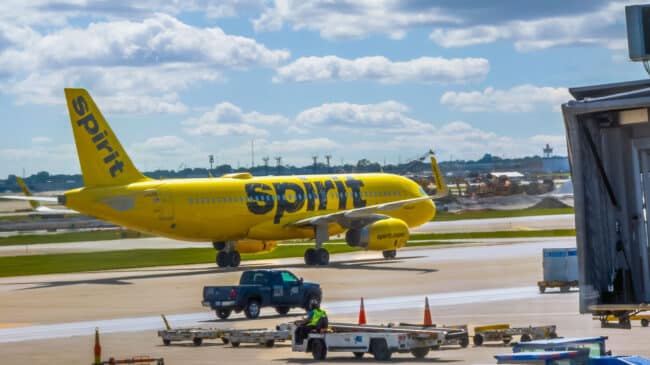

- Farewell to Spirit Airlines
- New group for remote/digital towers
- Progress on air travel/space launch conflict
- Isaacman revamps NASA’s lunar program
- Understanding air traffic controller hiring and training
- Greens propose cattle-car air travel
- News Notes
- Quotable Quotes
My only trip on Spirit Airlines took place about 15 years ago, when I needed to get from Fort Lauderdale to Atlantic City to attend a Federal Aviation Administration (FAA) conference. The only convenient choice was via Spirit. I was not fully prepared for the crowding and limited legroom, and I vowed, “never again.” But I admired what Spirit was doing: offering rock-bottom fares for people who could likely not afford American, Delta, or United. I’m sad to see it go, but bailing it out would have been wrong.
Economist Joseph Schumpeter introduced the concept of “creative destruction” in his 1942 classic, Capitalism, Socialism, and Democracy. He meant that one of the virtues of a market economy is that seriously-flawed businesses don’t survive, and that’s a very good thing. It’s one of the reasons the U.S. economy is far more productive than the economies of Europe.
Spirit died because its management was not as good as that of competitors Allegiant, Frontier, Sun Country, Avelo, Breeze, and others. One possible rescuer was JetBlue, but the Biden administration stopped that merger as anti-competitive. Its largest airport was Fort Lauderdale (FLL), and since I live near there, I followed Spirit’s activities more closely than I would have if it had been based elsewhere. I viewed Spirit’s recent opening of a grandiose headquarters complex near FLL as a symptom of bad management.
The U.S. airline sector dodged a bullet during Spirit’s last days, when the airline desperately sought a $500 million federal loan. When it started to look as if the Trump administration might do that, a feeding frenzy began. A recently created Association of Value Airlines (Allegiant, Avelo, Frontier, Spirit, and Sun Country) also sought a $2.5 billion federal handout.
Fortunately, none of those handouts took place, and with Spirit gone, the other “value airlines” will quickly fill the void left behind. Aviation Daily’s Karen Walker, on May 5, wrote that the two airlines most likely to benefit from Spirit’s demise are Frontier and JetBlue, based on their route structure. She noted that two days after Spirit’s last flight, the stocks of those two carriers “saw upticks in the 3%-6% range.”
Once again, America’s more productive market delivered a sensible outcome. No handouts or loans to losers, and competitors ready and eager to take up the slack.
New Stakeholder Group Aims to Advance U.S. Remote/Digital Towers
By Marc Scribner
Readers of this newsletter are familiar with the glacial pace of remote/digital air traffic control tower deployment in the United States. Despite proposing the technology more than two decades ago, the Federal Aviation Administration (FAA) has been unable to certify any remote/digital towers. Meanwhile, in the last decade, these technologies have become increasingly mainstream around the world. The Digital Tower Technology Coalition, a new aviation stakeholder group, aims to address the FAA bottlenecks to technology approval and deployment.
According to an April 22 press release announcing its formation, the Digital Tower Technology Coalition (DTTC) will support the deployment of remote/digital tower technology in the United States through a partnership among “U.S. airports, regional partners, air traffic controllers, original equipment manufacturers, and federal partners.” Rinaldi Consultants, the firm founded by former National Air Traffic Controllers Association President Paul Rinaldi, is coordinating the coalition. The Digital Tower Technology Coalition has also joined the Modern Skies Coalition, the umbrella group of aviation stakeholders pushing for broader modernization of the U.S. air traffic control system.
The DTTC is focused on the implementation of Section 621 of the 2024 FAA Reauthorization Act, which ordered the FAA to create a dedicated remote tower deployment program and publish system design and operational approval milestones. The coalition lists six main goals it hopes to accomplish:
- Digital tower system design and approval that complies with the congressional mandate;
- Evaluation of multi-airport management from a single remote tower center;
- Expedited deployment through faster system design approval and commissioning processes;
- Advanced air mobility (AAM) integration to support new aircraft entrants;
- Regulatory improvements that provide stakeholders meaningful opportunities for engagement with FAA; and
- Enhanced visual detection tools, including surface surveillance technology.
Reason Foundation helped draft Section 621 with congressional staff and had hoped it would instill more urgency at the FAA around remote/digital towers. Unfortunately, the FAA’s implementation of this directive has been disappointing to date.
A Reason Foundation report published last year on remote/digital tower deployment highlighted that the FAA failed to submit a comprehensive development and deployment plan on time, chose not to implement system design approval evaluation other than at the FAA’s Atlantic City Tech Center, and issued an abrupt update to technical requirements that delayed the lone project undergoing system design approval by at least four months. Testing of that system, developed by RTX and Frequentis, with piloted aircraft at Atlantic City International Airport, was completed by the end of 2025, but approval has yet to be granted.
In contrast to the FAA’s sluggish pace on remote/digital tower deployment, remote/digital towers are being implemented around the world. This began more than a decade ago when Sweden commissioned the first remote tower in 2015. As of May 2025, 30 remote towers were in operation globally with dozens more under development. Of those, 25 are managed by remote tower centers designed to manage multiple airports simultaneously. The improved situational awareness offered by remote/digital tower technology, coupled with the facility consolidation it enables, can improve safety while realizing substantial cost savings.
Importantly, it is no longer just affluent northern European countries deploying this technology. Romania commissioned its first remote tower and remote tower center in 2023, and the government of Thailand is in the process of deploying remote/digital towers at airports across the country. The Dutch Caribbean island of Curaçao held a groundbreaking ceremony in 2025 for its remote tower center that will manage traffic at Curaçao’s airport as well as the airport on the island of Bonaire, located approximately 50 miles away. The global market for remote/digital tower technology has been forecasted to grow more than sixfold over the next decade.
Increasing advocacy coordination and raising public awareness will likely be critical to delivering on the promise of remote/digital towers in the United States. This makes the launch of the Digital Tower Technology Coalition a very welcome development. Aviation industry stakeholders, such as Airlines for America, have become increasingly interested in the near-term deployment of remote/digital towers. FAA Administrator Bryan Bedford has publicly acknowledged the benefits of remote/digital tower technology. Congress has also increased pressure on the FAA to act more rapidly. With sustained effort and a bit of luck, the FAA might be pushed in the right direction.
Progress on Space Launches and Air Travel
Since 2023, total launches from the launch pads in Florida’s Brevard County (Cape Canaveral area) have increased from about 75 in 2023 to a record 109 in 2025, and an expected 2026 total that will be even higher. During launch windows, the FAA closes large blocks of airspace in defined “airspace hazard zones.” The projected increase in launches will require a number of changes to reduce the impact on air travel.
The last time I wrote about this, in the Nov. 2024 issue of this newsletter, I recommended that space missions should pay for their use of airspace for launches and returns. Hence, I was pleased to read last month that the FAA would soon start charging fees for commercial launches and re-entries. Politico reported (April 22) that the fees would be levied either on payload weight or a maximum amount, whichever is less.
When I read Sandy Murdock’s detailed explanation, “Space Launches and Air Space Intersect—What’s UP?” I came away better-informed but also dissatisfied. The FAA is planning to shrink the large blocks of airspace and the duration of closures. It is developing Dynamic Launch Hazard Areas (DLHAs). aiming to cut closure time in half and reduce the current large size of airspace closures. It is also working to expand the Space Data Integrator (at the FAA’s Command Center) by feeding it real-time telemetry so that closures can be terminated as quickly as possible. The FAA is also working to transition to “risk-based hazard modeling” using real-time data on debris dispersion and using “just-in-time” airspace management rather than long-duration blocks.
This is significant progress, but the part I’m least impressed with is the new launch fees. The rate charged appears to be a token amount, unrelated to the kinds of costs that are involved in the changes discussed above. Just as runway charges are (or should be) a significant funding source for airport infrastructure, space launch fees should likewise provide meaningful (rather than token) funding for the infrastructure needed for current and future launch and re-entry operations. Today’s token fees are a long way from that concept.
Isaacman Revamps Artemis Moon Program
I cheered when entrepreneur/astronaut Jared Isaacman agreed to serve as NASA administrator. Last month, he lived up to my expectations by making some important changes in the ongoing Artemis program focused on the Moon. As Irene Klotz detailed in Aviation Week, he has canceled the nearly useless Gateway space station in lunar orbit, aims to retire the old-technology/non-reusable SLS (aka Senate Launch System) as soon as politically possible, and plans to take full advantage of the growing capacity of the commercial space industry. Instead of a lunar base in orbit around the Moon (why?), the plan now focuses on a permanent base on the Moon itself.
Isaacman has scrapped plans for a larger SLS upper stage and the required multi-billion-dollar launch tower it would have required, to focus on making the remaining (congressionally mandated) SLS launches as identical as possible. And SLS will be over and done with after Artemis V, scheduled for 2029. Commercial space will provide a much larger share of launches, lunar landings, and development of the lunar base.
Next year, NASA plans on-orbit testing of the Blue Origin and SpaceX Human Landing Systems. The Artemis III mission now calls for astronauts from an SLS/Orion vehicle to rendezvous with one or both of the HLS vehicles in Earth orbit. Doing this in Earth orbit avoids the need to use the SLS Interim Cryogenic Propulsion Stage (ICPS), which would have been needed to propel Orion to a lunar orbit. That ICPS can now be saved for Artemis IV, as pointed out by Eric Berger in Ars Technica. And instead of sending an Orion to the Moon, future astronauts could make that journey on either the Blue Origin or SpaceX Human Landing System.
Actual lunar landings with astronauts will comprise Artemis IV and V in 2028. Klotz points out that the revamped program will build on NASA’s Commercial Lunar Payload Services (CLPS) and Blue Origin and SpaceX HLS.
Looking further ahead, Isaacman aims to contract with two launch providers to send crews to the Moon every six months, to what will be a Moon base built in three phases over the next 10 years. The estimated launches involved in this project will total 24 in 2026-28, up to 27 in 2029-32, and up to 29 in 2033-36. (Most of those launches will be cargo-only.)
This is a far more ambitious lunar program than previous NASA plans envisioned. Thus far, Isaacman has not asked for any large increases in NASA’s budget. This is due to both deleting costly but non-essential programs (e.g., Gateway) and relying more heavily on commercial launch providers.
Understanding Air Traffic Controller Hiring and Training
Here is a typical headline about the shortage of U.S. air traffic controllers: “FAA Proposes to Hire 2,300 Air Traffic Controllers in Budget Request.” That’s incorrect. Except in rare cases (such as the FAA hiring a military controller), what the FAA hires are would-be air traffic controllers. Sometimes even aviation journalists get this wrong. The lead article in Aviation Daily’s April 22, 2026, issue said, “The project has also aimed to address the national shortage of controllers, hiring nearly 2,400 since March 2025 when the campaign was launched.”
There are many steps between hiring a candidate and that person eventually being able to handle air traffic in an FAA facility (Tower, TRACON, or Center). It’s important to understand this process and its results because Congress and the FAA focus public attention on the starting number, when the end number is all that actually counts. Occasionally, one hears suggestions that in order to reach the number of certified controllers the FAA needs, the hurdles in the process should, in some manner, be eased to enable more applicants to actually make it to the end goal. That is the wrong direction for reforms.
To get the most value from the selection and training process, one of the best cost savings would be to increase the stringency of the first several steps in the process above. That would weed out those more likely to fail later. Weeding them out sooner would reduce the overall cost of hiring and training. This policy change would enable the FAA’s budget for hiring and training to generate more bang for the buck.
Several years ago, the National Academies carried out a research project on “The Air Traffic Controller Workforce Imperative.” Slide 29 of a PowerPoint summary is a graphic on “Controller Recruitment.” Of the total set of would-be controllers recruited:
- 10.1% did not meet system qualifications;
- 23.6% did not meet HR qualifications;
- 25.8% opted not to take the ATSA (qualifications exam);
- 21.3% scored below “Well Qualified” on ATSA;
- 6.7% did not proceed after receiving offer letter;
- 1.1% did not pass medical or other removal points;
- 4.5% failed or withdrew from Academy training; and
- 6.7% graduated from the Academy.
So when you read that the FAA has ‘hired’ 3,400 controllers, the yield after the above hurdles would be 228. Yet there is one additional hurdle. Those 228 get assigned to a tower, TRACON, or Center where they receive on-the-job training for several years. The same slide deck from which the above data were retrieved reported that in FY 2019, only 61% of trainees became certified professional controllers (CPC). Hence, out of the 228, we could expect only 139 to get to CPC. That’s pretty depressing, but that’s the reality.
In a commentary in the New York Times (Sept. 29, 2025), Binyamin Appelbaum provided some additional insights into the problem. (“Why Is Your Flight Always Delayed? Blame Government Shutdowns”) He notes that during government shutdowns, the FAA Academy in Oklahoma City is typically shut down. He also notes that a recent Transportation Research Board study found that between 2013 and 2023, the FAA hired so few controller trainees that it ended up with one-third fewer controllers than it estimated it would need. After citing some air traffic control near-misses, he noted that, “One possible corrective is to remove the government from its role. Other nations, including Australia, Canada, and Germany, have created stand-alone corporations, funded by industry [ATC fees] to operate their ATC systems.”
It’s a good point, and in nearly all of the 94 self-funded air traffic control corporations, only four are in some sense “private.” Nearly all are government-owned corporations that are not part of the national government’s budget—and hence are immune to government shutdowns.
Environmental Groups Propose Cattle-Car Airline Policy
Aviation Week (March 9-22, 2026) reported that European environmental groups such as The Shift Project and Aero Decarbo are urging governments to reduce the amount of air travel in order to reduce greenhouse gas emissions. “Now is the time for curbing traffic,” they argue. Other proposals include the termination of frequent-flyer programs, regulating airline advertising, and imposing CO2 taxes on airlines and passengers. Another organization, Nature’s Portfolio, calls for requiring airlines to switch to all-economy passenger loads.
Fortunately for the future of airlines and air travel, these ideas are being discussed only in Europe. There are no such discussions in North America, the Middle East, Latin America, or Asia, where air travel is growing faster than in Europe or the United States. Since CO2 is a worldwide phenomenon, curbing air travel only in Europe (where air travel is not growing much) will have little global impact.
Fortunately, the ongoing replacement of older airliners with new ones will lead to reductions in aviation’s carbon footprint. A paper published Jan. 7 in Nature Communications Earth & Environment, while recommending some of the above anti-air-travel policies, also pointed out how the ongoing replacement of aging fuel-hog airliners with newer aircraft will lead to continual reductions in aviation’s carbon footprint. For example, replacing most current airliners with the Boeing 787-9 for long-haul travel and the Airbus A321neo for shorter trips would lead to fuel savings of 25-28%. Increasing average load factors to 95% would reduce emissions by16%.
But the urge to regulate continues. Last year, several governments formed the Premium Flyers Solidarity Coalition to lobby for taxing premium flights. Except for France and Spain, the member governments are small (Barbados, Djibouti, Kenya). The International Air Transportation Association (IATA) commented that “Increased taxation on air travel threatens connectivity, distorts competition, and ultimately undermines social and economic development in the regions most reliant on aviation as a lifeline,” (emphasis added).
Fast-growing India and the Middle East are not about to reduce or give up air travel, in response to European hand-wringing about aviation’s carbon footprint. This anti-air travel concern seems to be a European obsession that may end up reducing air travel there but probably nowhere else.
Follow-Up on ADS-B/In for Small Aircraft
Newsletter reader Matt Thurber followed up on last month’s News Note about the Sentry Mini ADS-B/In receiver. He listed additional costs for a tablet computer to display traffic, electronic flight bag app to display traffic on the tablet, mounting equipment for the tablet computer, tablet case for mount to attach to, and purchase and installation of FAA-approved USB charging port. Total, including the Mini, is $1,802 plus the ongoing app fee of $100 to $300/year.
Washington Post Calls for Major FAA Reform
In a May 19 editorial that I could have written, the Washington Post calls for ending the FAA’s dual role as both aviation safety regulator and air traffic control system operator. “The proper role for the FAA in air traffic control should be setting safety standards and ensuring they are upheld. The provision of services should be spun off into a separate organization that only does air traffic control. It would be freed from the constraints of the federal budget and procurement rules to improve according to the best practices of business, not the demands of politicians.”
Major Modernization of Washington Dulles Airport Proposed
The January issue of this newsletter included an article on responses to an RFI from Transportation Secretary Sean Duffy for ideas on rethinking Dulles Airport (IAD). In response, noted public-private partnership (P3) developers such as Macquarie and Ferrovial released imaginative proposals for turning IAD into a world-class airport. And on May 11, Airport Architecture published an article about the airport authority’s not-yet-released $22 billion plan to transform the airport. Since the Metropolitan Washington Airports Authority does not have that kind of money, this would appear to set the stage for a very large-scale long-term airport P3, such as those proposed back in January.
House Passes ALERT Act Instead of ROTOR Act
By a vote of 396 to 10, the House passed HR 7613, a counterpart to the Senate’s unanimous vote for the ROTOR Act, which includes ADS-B/In for all aircraft equipped with ADS-B equipment; ALERT omitted that. In response, the Regional Airline Association (RAA) proposed that the compromise bill might allow ADS-B/In to be accessible via cockpit crew use of tablets and other electronic flight bag systems rather than built-in cockpit displays, which would be a costly addition for small-aircraft cockpits. A House/Senate conference committee has not yet come up with a compromise.
Port Authority Will Install Transponders in Airfield Vehicles
In the aftermath of the tragic airliner/fire truck collision at LaGuardia (LGA) in March, the Port Authority of New York & New Jersey has made a long-overdue decision to add transponders to all its airport ground vehicles. That way, their locations will show up in real time on ASDE-X, the collision-avoidance system that failed to detect the airport fire/rescue truck that collided with an airliner. I was surprised that the FAA hadn’t already made this a mandatory safety measure for airports with ASDE-X systems. But on May 13, the FAA announced that it will provide transponders for 1,900 airport vehicles at 44 airports that have ASDE-X or similar systems.
Retrofits Under Way on Boeing 757s and 767s
Aviation Daily reported (April 28) that ACSS and two other companies are teaming up to provide ADS-B/In retrofit packages for 757 and 767 airliners. The upgrade will combine ACSS’s ADS-B/In unit with Innovative Aerosystems’ flat-panel displays. For aircraft without displays, the system will be offered as a unit, including an Acron Aviation TCAS 3000 collision avoidance system. ADS-B/In with cockpit display of information provides information on nearby air traffic without relying on air traffic controllers.
Toronto Airport CEO Opposes Airport Privatization
With airport privatization again on the government’s agenda in Canada, Toronto Airports Authority CEO Deborah Flint expressed opposition to “privatization,” perhaps not understanding that what is being proposed is not a sale (loss of control by the public agency) but a long-term P3 lease (shared governance between owner and investor). Whoever in the Canadian government is discussing airport privatization should make this point clear.
Iridium Acquires Aireon
Satellite operator Iridium has signed a contract to acquire the 61% of space-based ADS-B provider Aireon, which it did not already own, per the Wall Street Journal. Iridium was the start-up investor in Aireon, which uses Iridium satellites to provide global ADS-B services to aircraft operators and air navigation service providers worldwide. Iridium shares have more than doubled over the last six months, WSJ reported.
JFK Terminal 8 Has Grand Opening
The Port Authority of New York and New Jersey last month celebrated the grand re-opening of Terminal 8 at JFK. Among those responsible for the revamp and upgrade are ASUR Airports, Phoenix Infrastructure Group, MERA USA, and American Airlines. Terminal 8 is the first of a number of terminal modernizations at JFK under the Port Authority’s $19 billion modernization of the airport.
Italy’s Catania Airport to Offer Shares
Infralogic reported (May 6) that Italy’s fifth-largest airport, Catania Fontanarossa, began its privatization process on May 4th. Several international airport groups are expected to be interested in bidding for the on-offer 51 to 66% of the airport’s shares, currently 100% owned by the local government airport company Societa Aeroporto Catania (SAC). The Infralogic reporters speculated that among those interested in bidding may well include Italy’s F2i, infrastructure fund Mundys, Corporacion America’s Toscana Aeroporti, and Venice Airport operator SAV. They also mentioned as possible bidders the Spanish airport company Aena and the French company Vinci Airports.
FAA Released First Phase of Modernized NOTAM System
On April 18, the FAA released the first version of its revamped Notice to Airmen (NOTAM) system for airspace users. The project’s goal is to replace the outmoded and poorly organized system for alerting pilots to such news as GPS outages, taxiway closures, out-of-service navigation aids, and temporary flight restrictions. The initial release used an upgraded delivery system, but the format and content of the NOTAMs was unchanged. The plan is that a new vendor-provided NOTAM Management Service (NMS) will revamp the presentation of information to pilots to make it easier to find information relevant to the route they plan to fly. This is still very much a work in progress.
NASA Looking Beyond Costly Space Launch System (SLS)
Aviation Week (May 4-17, 2026) reports that NASA and various contractors are revising the architecture for the Artemis program. Planned changes include revisions to the Orion crew module and the European Service Module. “Also included is a broader mission capability set and compatibility with additional launch vehicles beyond the current Space Launch System (SLS) rocket.”
Korean Company Makes a Second Try in Ecuador
Korea Airports Corporation has resumed discussions with Ecuadorian officials about engaging in a “strategic partnership” with Eloy Alfaro de Manta International Airport in the Pacific Manabi Province. The proposed P3 would be a 30-year concession. Eva Llorens reported in Infralogic (May 8th) that this is a second try for the Korean company, which is discussing the potential concession with Transportation Minister Dario Herrera.
Would Trump’s Arch Interfere with Reagan National Flight Paths?
The FAA has been asked by the Interior Department to evaluate the potential risks or impacts of the arch on flight paths to and from Reagan National Airport (DCA). At a planned height of 250 feet, it may conflict with north arrival flight paths or north departure flight paths, both of which involve low-altitude airspace close to and northwest of DCA. CNN noted in its article that the FAA “declined to give a timeline for its review of the arch.”
French ANSP Expects Full Free Route Airspace by 2028
Aviation Week reported that DSNA, the French air navigation service provider (ANSP), is planning to offer free route airspace at or above 19,500 ft. across the entire country by 2028. Under free route airspace, flight crews can choose their preferred routes. DSNA in March deployed the above FL 305, enabling high- altitude flights to operate this way when overflying France. At this altitude and above, France is part of the multi-country FABEC airspace block, encompassing 772,000 square miles. Free route airspace is a prerequisite for planned trajectory-based operations.
U.K. Working on Jam-Proof GPS Alternative
Last month, the U.K. Ministry of Defense awarded a contract to a team led by QinetiQ to develop a jam-proof alternative to GPS. As reported on April 27 by the Resilient Navigation and Timing Foundation, the system will be based on eLoran, which uses an entirely different spectrum from GPS and is not jammed by any of the systems that can jam GPS or related space-based systems.
“It took the FAA nine years and six months from contract award to achieve operational status at 15 sites with electronic flight strips. Why did it take this long, when at the beginning of this program, commercial off-the-shelf (COTS) systems were available from several vendors? First, it was the FAA that never saw a COTS product that is good enough for it. Second, the program was complicated by combining traffic management functionality into the TFDM [Terminal Flight Data Management] requirements, creating a very complex program. These requirements are not in TFDM Build 1. Just as an aside, Nav Canada achieved modernized air traffic control towers with electronic flight progress strips at all its 42 tower sites in 2009.
—John Kefaliotis, email to Robert Poole, Feb. 21, 2026
“RAND Corporation’s Adam Urwick and Jessie Osborne fret in a recent commentary on space developments, that ‘The pursuit of profit [on the Moon] raises paramount scientific and environmental concerns. Astronomers caution that large-scale mining activities could upset ongoing research and preservation of the lunar environment. . . .’ But Earth’s moon is a dead place where nobody currently does anything. There is nothing to disrupt, let alone an environment to worry about, unless you want to elevate the occasional boot print or tire tracks in lunar dust to the status of a problem.”
—J.D. Tuccille, “In Space, Regulators Seek to Boldly Go Where No Bureaucrat Has Gone Before,” The Rattler/Reason.com, March 13, 2026