-

Transportation and climate change: Public transit
This report focuses primarily on operating energy intensiveness and transportation energy impacts as affected by public transportation’s influence on land use.
-

Interstates first: Why the transition to road user charges should begin with limited access highways
To begin the transition from gas taxes to per-mile charging, the U.S. needs a plan to address drivers' privacy, double taxation concerns, and the cost of collection.
-

Transportation and climate change: Travel trends and GHG emissions
As the single largest domestic GHG emissions-producing sector, transportation is inevitably a focus of climate change mitigation initiatives.
-
-

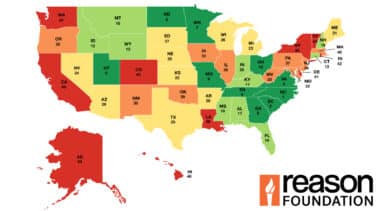
28th Annual Highway Report: Executive summary of findings and state rankings
The Annual Highway Report examines every state's road pavement and bridge conditions, traffic fatalities, congestion delays, spending per mile, administrative costs, and more.
-
Addressing the transit productivity crisis
Public transit ridership is unlikely to recover to pre-pandemic levels within the next decade.
-
Psychedelic treatment for neurodegenerative disorders
Recent research suggests that psychedelics, such as psilocybin and LSD, show strong potential as effective treatments for neurodegenerative disorders.
-
Debt trends for state and local governments 2020-2022
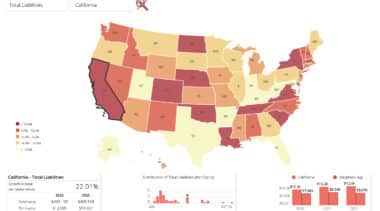
This tool provides debt and spending insights for the 100 largest municipalities, counties and school districts in America and all 50 states for fiscal years 2020, 2021 and 2022.
-
City debt: New York has more than four times the liabilities of Chicago, Los Angeles, Houston and other cities
New York City, the District of Columbia, Chicago, Atlanta, Yonkers and Austin have the most per capita liabilities.
-
County debt: Los Angeles, Miami-Dade and Cook counties among worst in nation
Los Angeles County had $54 billion in liabilities at the end of 2022. Miami-Dade County had $29 billion in total liabilities.
-
State debt: California, Illinois, New York, New Jersey and Texas each have over $200 billion in total liabilities
On a per capita basis, Connecticut's $27,031 total liabilities per capita are worst in the nation, followed by New Jersey.
-
Public schools without boundaries 2024: Ranking every state’s open enrollment laws
Study finds Arizona, Idaho, Oklahoma, Utah, and West Virginia have the best public school transfer and open enrollment laws.
-
Best practices in optional defined contribution plans for public workers
Governments expanding their retirement options can offer better benefits to employees and slow the growing costs caused by unfunded public pension liabilities.
-
Vision Zero and Complete Streets: Do they make roads safer?
In the wake of rising traffic fatalities, municipalities have been looking for a comprehensive solution to reduce or eliminate traffic fatalities.
-
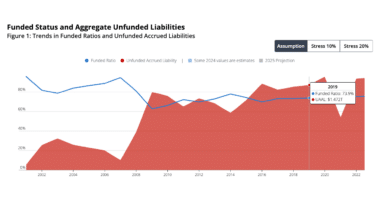
Annual pension solvency and performance report
At the end of the 2023 fiscal year, the nation's public pension systems had $1.59 trillion in total unfunded liabilities.
-
Working paper: Best practices in optional defined contribution plans
With the proliferation of unfunded pension liabilities among U.S. governments, optional defined contribution plans can serve as valuable risk mitigation solutions.
-
The case for Connecticut’s fiscal guardrails
The “fiscal guardrails” have saved Connecticut more than $170 million and could save $7 billion over the next 25 years.
-
A framework for federal and state hemp-derived cannabinoid regulation
The growing popularity of hemp-derived products has stimulated significant legislative attention in recent years, with over 90 regulatory proposals introduced in state legislatures in 2024 alone.