



New York's Rankings in the
29th Annual Highway Report
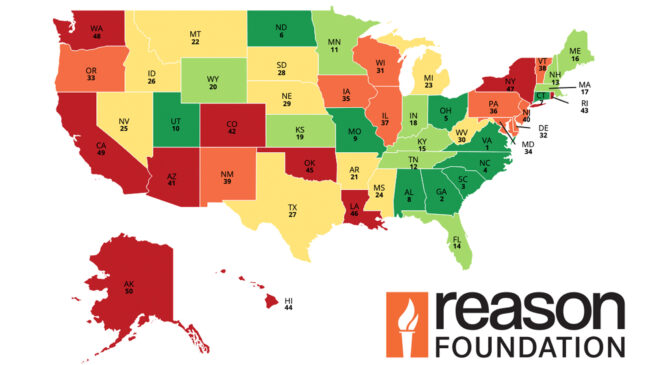
New York’s highway system ranks 47th in the nation in overall cost-effectiveness and condition.
According to the Annual Highway Report by Reason Foundation, this is a two-spot decline from last year’s ranking of 45th.
In safety and condition categories, New York’s highways rank 37th in Rural Interstate Pavement Condition, 47th in Urban Interstate Pavement Condition, 28th in Rural Arterial Pavement Condition, 47th in Urban Arterial Pavement Condition, 39th in Structurally Deficient Bridges, 12th in Rural Fatality Rate, and 17th in Urban Fatality Rate. New York ranks 48th out of the 50 states in traffic congestion, and its drivers spend about 62 hours a year stuck in traffic congestion.
In spending and cost-effectiveness, New York ranks 45th in Capital and Bridge Disbursements, which are the costs of building new roads and bridges and widening existing ones. New York ranks 46th in Maintenance Disbursements, such as the costs of repaving roads and filling in potholes. New York’s Administrative Disbursements, including office spending that does not make its way to roads, rank 43rd nationwide.
Compared to the previous report, the categories in which the state improved the most were Rural Interstate Pavement Condition (42nd to 37th) and Urban Fatality Rate (19th to 17th). New York worsened the most in Rural Fatality Rate (4th to 12th).
When compared to its neighboring states, New York’s overall highway performance is worse than Connecticut’s (7th), Massachusetts’ (17th), Pennsylvania’s (36th), Vermont’s (38th), and New Jersey’s (40th).
Comparing its overall performance to similarly populated states, New York ranks worse than Florida (14th) and Pennsylvania (36th). “In terms of improving in the road condition and performance categories, New York should focus on reducing Other Disbursements, improving its Urban Interstate and Arterial Pavement Conditions, and reducing its Urbanized Area Congestion,” said Baruch Feigenbaum, lead author of the 29th Annual Highway Report and senior managing director of transportation policy at Reason Foundation. “While the state performs relatively well in fatality rates, its poor pavement conditions and traffic congestion continue to undermine overall performance.”
Reason Foundation’s 29th Annual Highway Report evaluates the cost-effectiveness and performance of state-controlled highways across 13 categories, including pavement and bridge conditions, traffic fatalities, congestion, and spending. In the performance categories, a rank of 1 indicates the best outcome—for example, the lowest fatality rate or the best pavement quality—while a rank of 50 represents the worst outcomes. In the cost-effectiveness categories, a rank of 1 means the state spends the least, while a rank of 50 indicates the highest relative spending. The report’s data are primarily based on information each state submitted to the Federal Highway Administration for 2023, supplemented by deficient bridge data from Better Roads and Bridges and congestion data from INRIX. For full methodology and data sources, see the complete 29th Annual Highway Report.