Mariana Trujillo
Managing Director, Government Finance, Reason Foundation
Mariana Trujillo is managing director of government finance at Reason Foundation.
She holds a B.A. in economics from George Mason University. Before joining Reason Foundation, she interned at JP Morgan, The Mercatus Center, and The Cato Institute.
Trujillo’s research focuses on the fiscal health of federal, state, and local governments, particularly the impact of pension liabilities on fiscal condition and the effect of retirement benefits on public-employee recruitment and retention. Her work has appeared in outlets such as Reason magazine, the San Diego Tribune, Hartford Courant, Los Angeles Daily News, CQ Researcher, and more. She has also testified on these issues before the Oklahoma House of Representatives and the Connecticut General Assembly.
-

The public pension plans with the most debt, best and worst investment return rates
The Maryland and Massachusetts teachers' retirement plans saw the largest growth in debt, the Fire Fighters' Relief and Retirement Fund of Austin posted the worst returns and the Miami General Employees and Sanitation Employees Plan had the highest return rate.
-
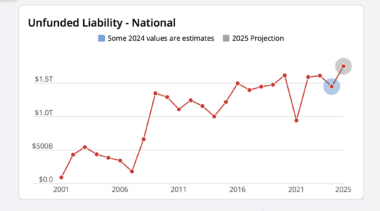
Report: State and local pension plans have $1.48 trillion in debt
State pension systems have $1.29 trillion in unfunded liabilities, and local governments have $187 billion.
-
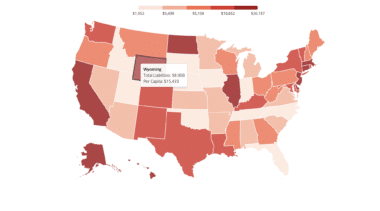
Report ranks every state’s debt, from California’s $497 billion to South Dakota’s $2 billion
Study finds state governments have a total of $2.7 trillion in debt, with 26 states exceeding $20 billion in debt each and 10 states over $70 billion.
-
Report: State and local governments have $6.1 trillion in debt
State and local debt is over $100 billion in 16 states and exceeds $50 billion in 27 states. California’s state and local governments have over $1 trillion in debt.
-
Best practices to prevent misuse of opioid settlement funds
States should adopt clear guidelines to ensure settlement funds support evidence-based treatment and recovery.
-
Over 99% of public pensions failed to meet their assumed rate of investment returns
And 86% of public pension plans still have assumed rates of return that are higher than their 23-year average.
-
Undoing public pension reforms would cost California taxpayers
Legislative proposals would reintroduce long-term fiscal risks and obligations to taxpayers and future generations.
-
Debtor Nation 2025
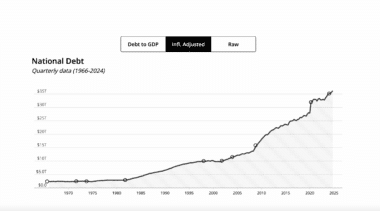
At $36 trillion, the United States' debt-to-GDP ratio now exceeds 120%, surpassing the peak reached after World War II.
-
Public employees are not underpaid
When adjusted for work hours, benefits, and aptitude, there is no meaningful compensation gap between equivalent public and private-sector employees.
-
With additional plans reporting, total unfunded public pension liabilities in the U.S. grow to $1.61 trillion
Information added to the Annual Pension Solvency and Performance Report finds the median funded ratio across public pension plans decreased marginally to 75.8%.
-
San Diego doesn’t have to accept spiraling public pension costs
By creating a new pension tier that shares pension risks with employees, San Diego can prevent escalating liabilities and ensure a more balanced distribution of costs.
-
How Brazil’s X ban signals growing control over online free speech
Brazil should be viewed as a cautionary tale for the United States regarding the consequences of unchecked discretionary power over digital speech.
-
Connecticut bill would redirect $1 billion away from debt reduction
Governor’s Bill No. 1246 proposes changes that would weaken a key component of the structural fiscal safeguards that have served Connecticut so well.
-
The U.S. national debt could end low interest rates
The projected surge in treasury bill issuances to finance fiscal deficits may hinder the Federal Reserve’s ability to lower interest rates.
-
Alaska is retaining public workers better than most states
Alaska's public sector turnover rates are significantly lower than both statewide and national private-sector averages and lower than most states offering defined benefit pensions.
-
As pension costs rise, San Diego must choose between raising taxes, cutting services, or more debt
Without reforming its pension system, San Diego will only get further trapped in this cycle of rising pension costs for taxpayers and challenging budget trade-offs.
-
CalPERS takes unnecessary risks that could cost taxpayers
The California Public Employees’ Retirement System has $180 billion in unfunded liabilities.
-
Public pension debt rankings for state and local governments
The median public pension system is equipped to finance 76% of its pension obligations.