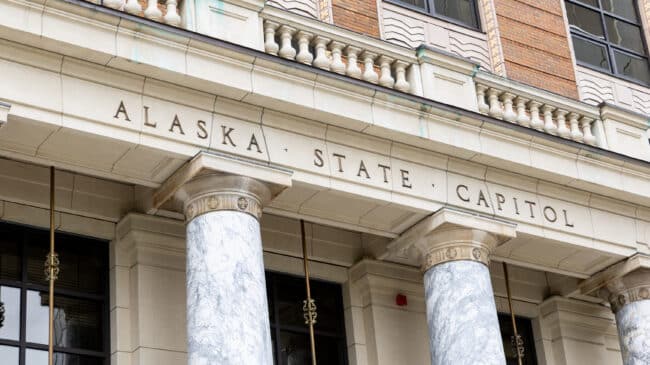

Last month, Alaska Gov. Mike Dunleavy vetoed House Bill 78 (HB 78), an attempt to reverse the state’s 2005 reform that made a defined contribution (DC) plan the retirement benefit for public workers. Though HB 78 was just the latest in a long line of efforts to undo Alaska’s DC policy, it was also the most robust version to reach the governor’s desk so far. Thanks, in part, to rigorous scrutiny from Reason Foundation and other fiscally-minded interest groups, the bill received more actuarial review than proposals in previous years, and evolved to include some risk-mitigating features that were not previously present. Still, Gov. Dunleavey recognized that HB 78 included major flaws that could have imposed hefty, unnecessary risks on the state’s future budgets.
Though HB 78 failed, political pressures are likely to keep lawmakers pursuing changes to the current DC structure put in place in 2005. Looking ahead, it is important to understand what happened in Alaska over the last few years, why lawmakers are considering an about-face on their DC approach, and what the state’s path forward should look like.
Latest pension proposal falls short
Ever since Alaska’s landmark 2005 reform that enrolled all newly hired teachers and public-sector employees in a state-sponsored DC plan—a move spurred by the growing costs of the state’s pensions—there have been ongoing efforts to restore traditional DB pensions for government workers. The latest of these proposals, HB 78, was the first to pass both chambers of the legislature but was stymied in May by the governor’s veto.
The bill’s sponsors named growing concerns with recruiting and retaining public workers as the reason for the proposal—concerns that were called into question by an analysis conducted by the Reason Foundation.
In his statement on the veto, Dunleavy expressed concerns about the added costs of bringing back public pensions in the state. Legislative actuaries projected that the bill would have added $89 million to annual costs in the short term, but it could have had a much larger impact on future budgets in the long term. Reason Foundation modeling found that the change could have increased total costs to Alaska’s state and local governments by more than $7 billion over the next 30 years.
Evolution of pension proposals in Alaska
HB 78 was the product of several years of evolution on the idea of reintroducing pensions in Alaska. While the proposal would still have been a significant rollback of the 2005 DC reform, this iteration featured numerous improvements over previous bills from the last several years.
Other legislative proposals seeking to reintroduce DB pensions (see, for example, House Bill 55 and House Bill 220 of 2021) would have completely closed the state’s DC plans and moved all new and existing employees back into the legacy pension plans, which are still only 71% funded and $7.4 billion short on assets to pay for benefits promised over 20 years ago. Previous efforts also received little actuarial evaluation, rendering legislators largely unaware of the potential costs of the proposed rollback.
By contrast, HB 78 received a higher level of actuarial scrutiny, with cost/risk analyses from fiscal consultants Gallagher (contracted by Alaska’s Division of Retirement and Benefits) and Cheiron (requested by the bill’s sponsor, Representative Chuck Kopp).
Responding to years of advocacy from Reason Foundation and other interest groups, the sponsors of HB 78 added several cost-sharing and risk-management mechanisms that would partially place any future unexpected costs on the shoulders of employees and retirees. The bill was also later amended to keep the existing DC plan open as an option for new and existing public workers.
Seeing that the latest effort to restore pensions gained sufficient support to pass through Alaska’s legislature, there are likely to be more proposals to address the perceived needs of the state’s public employees. Lawmakers should consider a few alternative approaches and improvements in future efforts.
Improving DC benefits for teachers, police, and firefighters
Before taking on any proposals to fundamentally change the core retirement plan of public workers, lawmakers should prioritize improvements to the current DC offerings, which could address some of the perceived needs of public workers without undermining previous reform objectives.
Alaska’s government workers do not participate in Social Security, but police, firefighters, and many civilian public workers have access to a supplementary DC plan called the Alaska Supplemental Benefits System Annuity Plan (SBS-AP). This plan harnesses market returns on personal savings and doesn’t force today’s workers to fund today’s retirees, making it a superior benefit to Social Security.
Teachers, however, do not have access to this benefit. A separate legislative proposal this session, Senate Bill 55, would have enrolled Alaska’s teachers in the SBS-AP benefit, but, with most of the focus on HB 78, this legislation did not receive enough attention to pass. Analysis by the Reason Foundation found that this proposal would have added an estimated $55,280 in annual benefits for a retired teacher.
Alaska lawmakers could also reevaluate and potentially increase the DC contributions for police and firefighters. Public safety employees generally retire earlier, which is why industry standards call for a higher total contribution rate for police and fire employees, set at a minimum of 30% when they are not participating in Social Security. Given that public safety workers in Alaska get a combined (employee and employer) contribution of 25.26%, policymakers would be well advised to consider adjusting the DC contribution rates for police and firefighters.
Addressing the lack of a Social Security replacement for teachers and the below-standard contributions for the state’s police and firefighters would demand significant additional commitments from the state budget, but it would address calls to improve the retirement benefits of public workers without undoing two decades of progress in distancing the state from unpredictable pension costs.
Many legacy pension risks remain today
Alaska stopped granting pension benefits to new hires beginning in 2006, but the legacy pensions remain underfunded and continue to saddle the state with significant interest costs on that debt. Annual actuarial reports show that, despite increased funding to the plans, contributions have not been sufficient to cover unexpected costs, the bulk of which stemmed from investment results below the plans’ assumptions and the prudent reduction of these assumptions over time. While the latest effort to reestablish pensions in the state included important cost and risk-sharing mechanisms, it would still have relied on the pensions’ current 7.25% assumed investment return.
Alaska has followed national trends in lowering its assumed rate from 8% to 7.25% over the last decade, but it still remains well above the national average of 6.9%. If these pensions were to lower their investment return assumption again—a move that is likely necessary and very probable—a reestablished pension benefit would instantly generate more unplanned unfunded liabilities.
Any future proposals to restore pension benefits to Alaska’s public employees should include policies to guard the state from this real risk. Lawmakers can do this by requiring liabilities to be discounted at lower levels. The lower the state sets these assumptions, the more likely it is to achieve desired outcomes and the less likely it is to experience the unexpected costs that have dragged down funding for legacy pensions.
A retroactive switch back to pensions carries massive risks
Another major problem lawmakers need to consider in future discussions is the unprecedented risk posed by retroactively granting pension benefits, as HB 78 would have done. Transferring DC balances to a DB pension fund as if they had been there all along (effectively adding 20 years of legally guaranteed pension liabilities overnight) creates a situation in which any downturn in stock market performance or a lowering of investment return assumptions would create significant unfunded liabilities in the system after just one bad year of results.
Any future iterations of these past proposals need to address these risks. They could be addressed by transferring DC funds to DB benefits at lower discount rates or by granting pension benefits only from the inception of the new tier, not retroactively as if members had been in a pension for 20 years.
While the latest effort to restore public pensions in Alaska fell short, discussions and future reform efforts for the state’s retirement plans are likely to continue. The evolution of pension proposals—the inclusion of cost-sharing, the retention of the DC plan as a choice, and the addition of actuarial scrutiny—reflects promising developments in a process that in recent years lacked analytic rigor.
Still, major risks remain, which policymakers should continue to weigh. Lawmakers today need to understand and appreciate the original intent of the 2005 reform: to eventually eliminate all of the state’s pension debt and free future budgets from the risk of unexpected costs. Alaska is still far from achieving that aim, but they need to stay the course. In the meantime, several improvements to the existing DC plans could be evaluated and pursued.