

In This Issue:
Articles, Research & Spotlights
- Webinar: Public Pensions Are Investing in Crypto
- Effort to Bring Back Pensions Fails in Alaska
- Policy Brief: How Governments Can Maximize Lifetime Income for Public Employees
- Women in Government Could Use More Flexible Retirement Options
News in Brief
Quotable Quotes
Data Highlight
Reason Foundation in the News
Contact the Pension Reform Help Desk
Articles, Research & Spotlights
Webinar: Crypto and Public Pensions–Risks, Rewards, and Fiduciary Duties
As digital assets like Bitcoin and Ethereum gain mainstream financial traction, public pension systems must determine if and how to include them in their portfolios. Join us for a live discussion with North Carolina State Treasurer Brad Briner, Todd D. Kanaster of S&P Global, Reason Foundation’s Mariana Trujillo, and moderated by Reason’s Leonard Gilroy. The panelists will discuss evaluating cryptocurrency investments and risks, strategies for managing risk and volatility for workers, retirees and taxpayers, and best practices for providing public transparency into any crypto investments.
Date, Time and Registration
Tuesday, June 23, 2026, at 2:00 pm Eastern Time / 11:00 am Pacific Time
Register to watch and attend via Zoom here. The panelists will take questions from attendees. Can’t join us live? Register, and we’ll send you the video recording.
Risk Concerns Sink Legislation to Reopen Alaska’s Public Pensions
Last month, Alaska Gov. Mike Dunleavy vetoed the most significant legislative attempt to date to roll back the state’s 2005 defined contribution (DC) retirement reform. While the bill underwent unprecedented actuarial scrutiny—bolstered by analyses from Reason Foundation and other fiscal watchdogs—it ultimately failed to overcome its fundamental flaws, and Gov. Dunleavy concluded that it still posed an unacceptable threat to Alaska’s long-term fiscal stability. With the expectation that lawmakers will continue to pursue the reintroduction of public pensions in Alaska, Reason Foundation identifies policy ideas that could alleviate some of the concerns that scuttled this latest effort, including avoiding granting retroactive benefits, adopting safer assumptions, and providing an adequate Social Security replacement program for teachers.
Evaluation of Lifetime Income Products for Public Sector DC Plans
As defined contribution (DC) plans become a primary source of retirement income for public employees, policymakers should focus on modernizing these benefits by improving lifetime income options that protect against longevity and investment risks. While individual annuities are available, correctly structured in-house options offer public workers a far more cost-efficient and functional path to security. Reason Foundation’s latest issue brief by Rod Crane and Richard Hiller explores the current landscape of lifetime income features, highlights the policy advantages of their inclusion, and provides plan sponsors with a best-practices framework for evaluating and selecting the right annuity options for their participants.
How Public Pension Systems Are Failing Women, Especially Mothers
A recent op-ed in Governing by Reason Foundation’s Mariana Trujillo highlights a growing challenge in retirement security: how traditional public pension systems, designed to reward long, uninterrupted careers, are failing modern female employees. Because these pension plans often rely on long vesting periods and heavily “back-loaded” benefits, where most wealth is earned at the very end of a 30-year career, they disproportionately penalize women, who are more likely to take career breaks for caregiving or to change jobs. Trujillo asserts that these rigid structures, originally built for a male-dominated workforce, must be modernized into more portable and flexible models to ensure that women in public service aren’t left behind in their retirement years.
News in Brief
Pennsylvania Counties Report on Pension Health
Pennsylvania’s auditor general has released audit reports on 28 county-run pension plans that provide benefits to police, firefighters, and non-uniformed municipal employees. While these plans are managed and funded by local governments, the state provides annual financial aid, giving nearly $442 million to 1,482 municipalities and departments in 2025. This reporting provides transparency on the allocation of these state funds (collected through a statewide tax on fire and casualty insurance) and reinforces good pension policy and funding among local governments. Access the full collection of reports here.
Quotable Pension Quotes
“Pension obligations extend for decades, and the full cost of this bill may not be apparent until years after its enactment. If the Legislature intends to increase the State’s long-term spending obligations, it must also be prepared to support the long-term revenue needed to pay for them.”
––Alaska Gov. Mike Dunleavy’s statement on his veto for HB 78, May 18, 2026
“The pieces of the [Illinois] proposal are constructive for the state’s credit, insofar as they continue the forward momentum on addressing liabilities … But in terms of materially changing the needle? The annual funding shortfall between the statutory contributions and the actuarial recommendations is about $5 billion in the most recent year, so there’s a pretty big gap there.”
––Scott Nees, director and lead analyst at S&P Global Ratings, quoted in “Pritzker secures passage of parts of Illinois pension proposal” on a buyout program and redirection of surplus income tax into the pensions in The Bond Buyer, June 12, 2026
“Enhancing Tier 6 benefits was unnecessary and unwise…It will require local governments and school districts to either siphon money from programs or increase taxes.”
––Andrew Rein, president of the Citizens Budget Commission, quoted on “New York Teachers Win Lower Retirement Age as Lawmakers Pass Pension Reforms,” in Education Week, May 27, 2026
Data Highlight
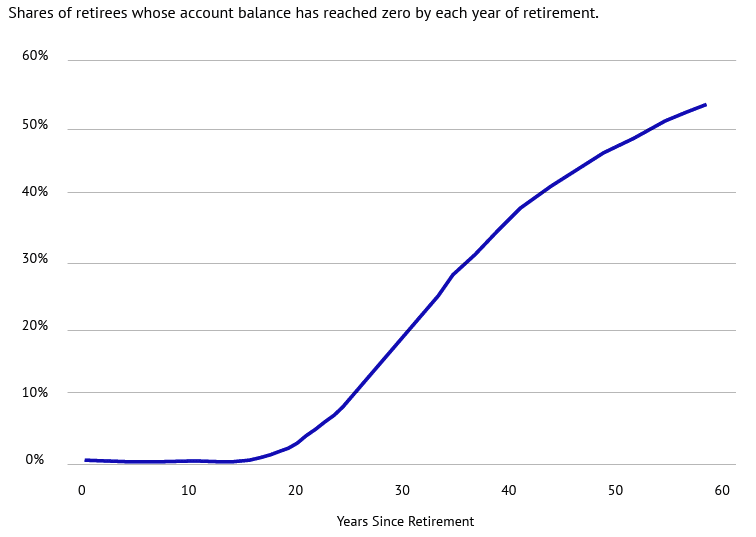
As noted above, Reason Foundation’s latest policy brief examines and seeks to address the risks that an individual participating in a defined contribution (DC) plan could face. One of the major risks is that a retiree may deplete their retirement savings and outlive their benefits. The brief’s analysis estimates that around 20% of retirees could exhaust their savings after 30 years of retirement, but guaranteed lifetime income—usually purchased through an annuity—can eliminate this risk and provide a more efficient and secure DC benefit. See the full brief here.
Cumulative Probability of DC Balance Depletion
Reason Foundation in the News
Reason Foundation’s Annual Pension Solvency and Performance Report was cited in “Working overtime to rip off taxpayers,” by The Washington Post editorial board, in an opinion piece in Pensions & Investments, “If you can’t measure it, you can’t manage it—the quiet crisis of institutional investment underperformance,” and Real Clear Markets in “California municipal bonds: Are the risks fully priced?”
“Specifically, Mr. Mamdani plans to restructure the city’s pension payment structure to stretch out the ramp over the next five years. This saves money for the city in the short term but likely adds billions of dollars in higher liabilities down the road, according to the Reason Foundation.”
—Reason Foundation’s Mariana Trujillo’s analysis was cited in, “Capitalism Delivers for Zohran Mamdani,” in The Wall Street Journal, May 27, 2026.