
A version of the following public comment was submitted to the members of the Texas House Committee on Transportation on August 17, 2026.
Texas has more than 9,000 public highway-rail at-grade crossings, where roads and railroad tracks intersect at the same level. Many are located on roads outside the state highway system, including roads under city and county jurisdiction. Grade-separation projects, such as railroad bridges and underpasses, can cost tens of millions of dollars. Before Senate Bill 1555, Texas did not have a dedicated state grant program specifically for these off-system projects.
What Senate Bill 1555 does
Senate Bill 1555 added Transportation Code §471.010, directing the Texas Department of Transportation (TxDOT) to award road grants for rail grade separations on off-system public roads and for grade-separated pedestrian crossings. The Texas Transportation Commission must approve each grant; at least 10% of total project cost must come from a non-state source; State Highway Fund money cannot be used; and TxDOT must manage contracting and construction supervision.
By separating trains from vehicles and pedestrians, these projects can reduce crashes, blocked-crossing delays, emergency-response delays, roadway congestion, and freight congestion. The non-state match requirement also aligns with Transportation Code §201.703, which prohibits state money from being used exclusively for an off-system transportation project.
Implementation and first-round awards
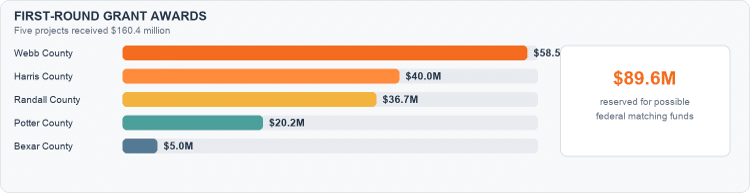
TxDOT met the implementation deadline. Rules in 43 TAC §§7.120–7.134 became effective October 15, 2025. They created a statewide competition, limited awards to self-contained projects, defined eligible costs, and required staff evaluation before Commission approval. House Bill 500 supplied $250 million in general revenue for the 2026–27 biennium. In February 2026, the Commission awarded $160.4 million to five projects costing about $385.7 million and reserved $89.6 million to seek federal matches. The selected projects are in the Amarillo, Houston, Laredo, and San Antonio districts and include state, local, railroad, and other funding.
S.B. 1555 has served its immediate purpose by establishing the grant program and moving the first projects toward construction, but it is too early to determine whether it has achieved its longer-term safety, congestion, and economic development goals. None of the five funded projects has been completed, and the projects remain in various stages of development before construction and completion.
Practical improvements for Texas
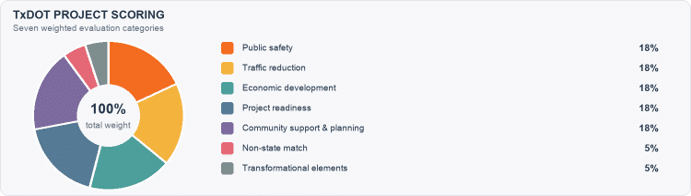
Because project outcomes cannot yet be measured, the program can instead be evaluated based on how projects are selected and managed. TxDOT’s scoring system already considers safety, traffic reduction, economic development, project readiness, and local support. However, community support and planning receive the same 18% weight as public safety and traffic reduction, while cost-effectiveness is not a separate scoring category. The program could also benefit from clearer performance reporting and additional safeguards as projects move from selection to construction.
- Add cost-effectiveness and publish project scores. TxDOT should add a simple benefit-cost measure comparing project costs with expected safety and delay benefits and publish project-level scores.
- Expand the annual Commission report. In addition to nominations and selections, TxDOT should report project costs, schedules, crossings eliminated, and, after completion, changes in crashes and delays.
- Add interim project milestones. In addition to the existing one- and three-year deadlines, TxDOT should establish checkpoints for design, right-of-way, railroad agreements, and major cost changes.
- Reassess projects before increasing state funding. If project costs rise substantially after selection, TxDOT should confirm that the expected safety and congestion benefits still justify the investment before committing additional state funds.
Texas should continue S.B. 1555 while using the first round of projects to determine whether the program delivers measurable safety and mobility benefits at a reasonable cost.