


In This Issue:
Articles, Research & Spotlights
- Reason Foundation Ranks Status of State Pensions
- Crucial Pension Reforms Under Fire in California
- Oklahoma Bill Would Improve the DC Plan for Public Workers
- Washington Lawmakers Raid Police Pension for Political Pet Projects
- Alabama’s Pensions Suffer from Unrealistic Assumptions
News in Brief
Quotable Quotes on Pension Reform
Data Highlight
Reason Foundation in the News
Contact the Pension Reform Help Desk
Articles, Research & Spotlights
How State Public Pension Systems Rank on Key Health Metrics
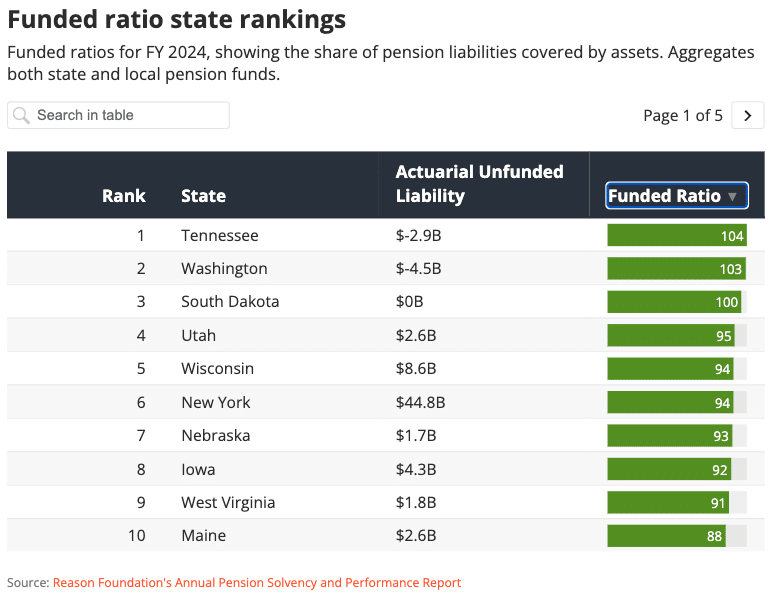
Reason Foundation’s Pension Solvency and Performance Report compiles crucial pension measurements by state to rank their overall health in funding, contribution adequacy, investment performance, and investment risk. The funding ranking, the most commonly used measurement for pensions, indicates that Tennessee, Washington, and South Dakota are the only states with fully funded public pension systems. Illinois, Kentucky, and New Jersey are the states with the poorest pension funding, all having saved up only about half of the assets needed to pay for promised benefits. Reason Foundation’s calculation of long-term investment results shows that only four states (Kansas, Michigan, Washington, and South Dakota) achieved investment returns above their plans’ assumptions in the most recent year.
Reason’s State Pension System Ranking Analysis
Reason Foundation’s Pension Solvency and Performance Report
California Lawmakers Prepare to Stick Taxpayers with More Pension Costs and Debt
California’s total public pension debt has surpassed $200 billion, leaving taxpayers to shoulder the burden of rising retirement costs. Despite an extra $7 billion in payments toward this debt since 2020, a massive funding gap remains for the benefits promised to public employees like teachers and first responders. In a new op-ed, Reason Foundation’s Zachary Christensen warns that lawmakers in the Golden State are now moving to weaken taxpayer protections that would pave the way to increase benefits for police and firefighters. Reason Foundation modeling estimates this move could add $14 billion to the state’s already growing pension costs. Another op-ed by Reason Foundation’s Mariana Trujillo notes that California’s public pensions are increasingly relying on Bitcoin and crypto investments. Taxpayers and public workers need more transparency from policymakers to prevent pension systems from overextending into high-risk investments.
Oklahoma Bill Advances Retirement Goals of Government Employees
Oklahoma House Bill 3313 updates the state’s “Pathfinder” defined contribution (DC) plan to meet industry standards, ensuring public employees can build a more secure retirement. Since its inception, Pathfinder has served as the primary retirement vehicle for members of the Oklahoma Public Employees Retirement System (OPERS). The bill would update contributions and remove onerous vesting requirements, thereby improving the DC benefit for employees and protecting the state’s retirement system from the mounting pension debts seen in other systems. By strengthening this plan now, lawmakers can ensure that Oklahoma’s retirement benefits remain sustainable and effective for the next generation of public workers.
Washington Bill Redirects Pension Funds for Non-Pension Spending
Washington House Bill 2034, which has now passed in the legislature and awaits the governor’s signature, would take $569 million from the police pension to spend on climate programs and billions more to cover the state’s growing budget deficit. These funds were originally set aside strictly for retirement benefits, yet lawmakers are now looking to use them for unrelated political projects. This redirection of assets ignores the intent of the workers and employers who contributed them, creating a concerning legal and moral precedent for how the state handles pension debt and surpluses.
Alabama’s Unrealistic Pension Assumptions Are Putting the State in Debt
More than a decade ago, Alabama passed sweeping reforms to tackle its public pension debt by raising retirement ages, reducing benefits for new hires, and increasing employee contributions. However, these changes only slowed the bleeding. Analysis by Reason Foundation’s Brayden Myers identifies overly optimistic investment assumptions as the primary reason for the state’s pension shortfall, which now exceeds $20 billion. Fourteen years later, it is clear that those initial reforms were not enough, and a new round of action is required to secure the state’s financial future.
News in Brief
Public pension investment trends in private markets
The new “Public Pension Private Markets Report” from Dakota finds that public pension systems continued committing substantial capital to private markets in 2025. Tracking more than 1,800 commitments across 185 plans, the report identifies roughly $192.7 billion in total allocations, with the majority directed to three core asset classes: private equity ($68.3B; 35%), real assets ($56.7B; 29%), and private credit ($47.4B; 25%), followed by smaller allocations to venture capital ($11.2B; 6%) and hedge funds or liquid alternatives ($9.2B; 5%).
Activity was highly concentrated. The 10 largest pension systems accounted for roughly 48% of total capital deployed, and commitments frequently took the form of repeat investments with existing managers.
Looking ahead, the report expects continued strong activity in private markets through 2026, as rising plan assets may require larger nominal commitment budgets simply to maintain target allocations. Read the full report here.
Quotable Pension Quotes
“There are no easy answers here; there’s no way to make the pension debt magically go away.”
––Robert Martwick, Illinois state senator (D-Chicago), quoted in “A new bill would force Chicago Public Schools to pay into municipal retirement fund,” Chalkbeat, Feb. 24, 2026.
“People want to retire sooner and pay less toward their retirement. Either of those things can happen only if you shift enormous costs to taxpayers.”
––Ken Girardin, Manhattan Institute fellow, quoted in “Big unions want to sweeten pensions. Albany is rallying with them,” Gothamist, March 10, 2026.
Data Highlight
The Reason Foundation’s 2025 Pension Solvency and Performance Report ranks every state’s public pension system across five metrics, including funding levels, investment performance, and contribution discipline. The results reveal wide variation in fiscal health across states. Only three states have enough assets set aside to fully cover promised pension benefits. Visit the rankings here.
Reason Foundation in the News
Reason Foundation Senior Fellow Rod Crane joined the Broadcast Retirement Network program to discuss his research on how pension debt is not scrutinized to the same extent as other types of government debt. The full interview is available here.
“In December, the Reason Foundation noted that ‘California’s state and local governments have the most public pension debt in the country, with total unfunded pension liabilities of more than $265 billion,’ amounting to more than ‘$6,000 in pension debt for every state resident.’ The report reminded us that taxpayers ultimately are responsible for any shortfalls. The likely results are higher taxes and service cutbacks.”
—Reason Foundation’s analysis, cited in “Maybe the Pension Mess Can Go on Forever,” The American Spectator, March 11, 2026.
“According to research by the Reason Foundation, a national libertarian think-tank, re-instituting DB plans could easily add $7 billion in additional costs to future [Alaska] state budgets.”
—Reason Foundation’s modeling analysis on Alaska HB 78, cited in “Opinion: There Are Always Bad Choices, But Why Repeat Them?,” Juneau Empire, Feb. 22, 2026.