

Illinois is facing a severe and ongoing housing shortage. Current estimates suggest the state is short 142,000 housing units, with all 26 Illinois metro areas seeing a drop in inventory since 2019, the highest being Bloomington at 75%. As of February 2026, the average Illinois home value is over $285,000, up nearly 5% from just a year ago, and over 46% since January 2020. As of 2024, nearly one in three Illinois households is cost-burdened, meaning they spend more than 30% of their income on housing. In response to this mounting price pressure, Governor J.B. Pritzker proposed the Building Up Illinois Developments (BUILD) plan that is currently making its way through the state legislature.
This plan includes unnecessary spending in a state already strained by excessive government expenditure. However, the proposed deregulatory reforms have the potential to transform Illinois’ housing landscape and create a more resilient housing market for both current and future residents. The Illinois Municipal League is opposing these efforts for fear of overriding local authority and is proposing its own alternative housing plan.
Given the severity of Illinois’ housing challenges and the dangers of continuing to prevent housing market adjustment, the governor’s housing package will help a great deal, and the concessions recommended by the Municipal League will make it less effective. While the spending is unnecessary and harmful to the state budget, deregulatory reforms are necessary to ease housing pressure for residents.
The housing package
Illinois’s BUILD package includes multiple positive deregulatory measures that will make it easier to build housing. The full package is currently moving through the Illinois House in House Bill 5626, while each individual provision is moving separately in the Senate. Below are the Senate bills and their potential impact:
Senate Bill 4060: Missing middle housing
SB 4060 simultaneously addresses minimum lot size regulations and allows increased density across residential areas. In addition to not allowing a minimum lot size greater than 2,500 square feet for a single-family home, SB 4060 further allows the density increases described in Table 1 statewide.
Table 1: Density requirements imposed by SB 4060
| Lot size | Dwelling units allowed by right |
| 2,500 – 5,000 sq ft. | 4 |
| 5,000 – 7,500 sq ft. | 6 |
| >7,500 sq ft. | 8 |
Further, this law provides a framework for converting single-family homes to “middle-housing” types and ensures that the review process for these units is no stricter than it would be for single-family detached homes. Enacting SB 4060 at the state level would make substantial progress toward standardization and predictability in the law and pave the way for starter homes.
In 2025, the median age of a first-time homebuyer in the United States reached an all-time high of 40 years old. The lack of smaller housing options has greatly contributed to this delay in life milestones, and exclusionary zoning codes are the driver of this gap. Data on the average size of new single-family homes reveal that they have been shrinking since 2015, suggesting consumers are willing to make the tradeoff in size to have a shot at homeownership. Allowing markets to respond to signals of housing demand is key to a healthy, balanced housing market. Enacting SB 4060 does not mean every new development will be at maximum density, but this law allows communities that desire these units to more easily align lot sizes with residents’ needs.
Senate Bill 4061: Single-stair reform
Building codes for multifamily housing in the United States are based on the International Building Code, and typically require multiple stairways for residential buildings taller than three stories. Although this provision is typically justified on fire safety grounds, evidence from countries that permit buildings with only one stairway shows no worse fire safety outcomes than those in the United States.
Maintaining this standard adds substantially to the cost of multifamily residential development. Buildings with four to six stories and one stairway can cost 6% to 13% less than a similar two-staircase building. By reducing the cost of taking on these projects, removing dual-stairway requirements can encourage multifamily development.
If enacted, SB 4061 would allow buildings up to six stories to have only one staircase, provided they have smoke detectors, sprinklers, and no more than four units per floor with an emergency exit for each unit. This reform would open the door for more efficient multifamily development in Illinois.
Senate Bill 4062: Impact fee standardization
Impact fees are one-time fees charged to new developments for the additional strain they place on public services, including fire, police, and roads. These fees are necessary to ensure that new development pays for itself, but can raise concerns regarding proportionality and regressivity. Impact fees are passed on to homebuyers, with evidence indicating they raise the cost of new housing dollar for dollar. Ensuring these fees are not overly burdensome, especially for smaller homes, can encourage new housing development.
SB 4062 would establish a standard, transparent statewide formula for calculating impact fees charged to new development, reducing the ambiguity and variability typically associated with these fees. Municipalities can charge less if they deem the formula’s results too burdensome for new development. Like the other bills in this package, SB 4062 advances a predictable and fair regulatory landscape and streamlines the process of building a new home.
Senate Bill 4063: Simplifying plan review and inspections
This law would require municipalities in Illinois to complete building permit reviews within set deadlines: 15 business days for single-family homes and duplexes, and 30 business days for multifamily, mixed-use, and commercial projects. If these deadlines are not met, developers could hire qualified third-party reviewers or inspectors, and municipalities would have to accept their findings if they show compliance with local building codes. The bill is intended to reduce permitting delays and create more predictable approval timelines statewide while still maintaining safety standards.
States like Arizona that have passed permitting reform similar to SB 4063 have seen their timelines speed up, and this is promising for Illinois. The state has significant permitting delays and variable approval timelines, making it difficult to plan projects. Standardizing this process is a straightforward way to increase predictability and spur housing development in Illinois.
Senate Bill 4064: Parking reform
Illinois’ SB 4064 would reduce and standardize parking requirements for residential development in the state. Under this law, no more than 0.5 parking spots could be required per unit in a multifamily development, and no more than one parking spot could be required per single-family home. For units smaller than 1,500 square feet, assisted living facilities, or affordable housing developments, municipalities would not be able to institute any parking minimum.
Excessive parking requirements drastically increase the cost of development, which is especially burdensome to low-income residents. For these households, requiring one parking spot per apartment accounts for 6% of the annual budget.
Enacting this law would not mean that parking disappears. SB 4064 would simply give developers greater flexibility to build housing that reflects the needs of residents, rather than adhering to a one-size-fits-all mandate. Expanding opportunities for more affordable housing options, including developments with fewer costly amenities like parking, is essential to creating choices for lower-income residents.
Senate Bill 4071: Accessory dwelling units
Accessory dwelling units (ADUs) are created on the same lot as a larger primary residence. They may be detached, such as backyard cottages, or attached, including units created within the main home, like basement apartments, or converted from existing spaces such as garages. ADUs are particularly attractive for adding new housing stock because they serve as infill, incrementally increasing density without an additional strain on local infrastructure. They can serve as student housing, affordable housing, and an opportunity for elderly relatives to age in place while maintaining their independence.
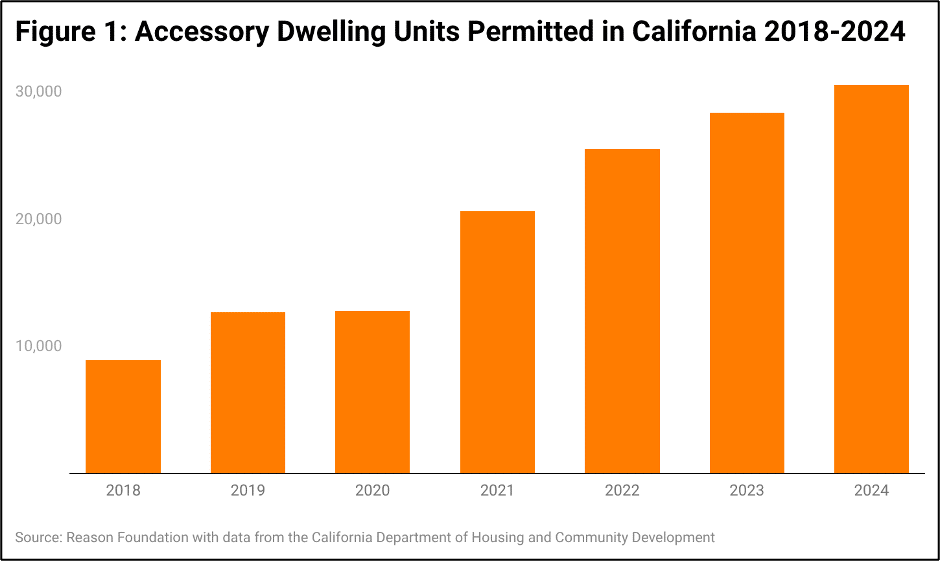
Where they have been allowed statewide, ADUs are widely utilized. California, for example, passed a series of laws that make it easier to build ADUs. Since 2018, when these reforms started, California has seen a massive increase in ADU permitting, indicating that residents are interested when the regulatory burden is not prohibitive (see Figure 1). Currently, Illinois has no statewide law allowing ADUs, so legality is determined on the municipal level. SB 4071 would allow ADUs on all single-family parcels and prohibit any additional regulations or parking requirements beyond those applicable to the primary structure, ensuring localities do not circumvent statewide rules.
Challenges by the Municipal League
The Illinois Municipal League (IML) has protested these regulatory changes since their initial proposal because they preempt local decisions on housing. In response, the IML proposed its own alternative, the Reducing Expenses and Advancing Local (REAL) housing package.
This package includes several notable requests. The first is the establishment of both a “Middle Housing Incentive Fund” and a grant program for comprehensive planning and zoning assistance, encouraging municipalities to increase their density allowances through financial incentives. The REAL housing package would further incentivize, but not mandate, the creation of by-right overlay districts where middle-density housing may be allowed by right. There is also a suggestion to create a blight-clearance grant program. The IML is effectively arguing that, rather than preempting exclusionary zoning practices outright, the state should subsidize municipalities to pursue weaker reforms on a slower timeline, with no guarantee of change.
Further provisions include setting a maximum commission on real estate transactions, exempting building materials from certain state taxes, limiting the use of artificial intelligence in housing, and price-controlling rent-related expenses, among others.
There is little evidence or economic suggestion that these kinds of regulatory interventions, particularly price controls and transaction limits, will meaningfully increase housing supply. Local governments have neither prevented nor resolved Illinois’ current housing affordability crisis. Indeed, while preempting local authority is a last resort, decades of local housing policy decisions to restrict housing supply are the cause of the current crisis. If municipalities refuse to liberalize their land-use codes and allow more housing development, state preemption becomes necessary. Every community in Illinois is indeed very different, but the most granular decision-making level is not the municipality, but the individual parcel. Land-use decisions should be driven voluntarily by community members, developers, and markets, not by restrictive regulation. Illinois’ housing policy should prioritize property rights and allow housing supply to adjust to demand. Evidence from across the country suggests that reforms like the BUILD Act, which liberalize land-use regulations, are an effective way to increase housing supply.
To establish a baseline, evidence from Florida shows that areas with more restrictive land use laws for residential development, including larger minimum lot sizes, more density restrictions, and more complicated approval processes, are associated with higher home prices. In contrast, Houston, Texas, while not without land-use regulation, has avoided traditional zoning and allowed greater housing flexibility than many peer cities. As a result, Houston has maintained strong permitting levels and experienced lower home price appreciation than similarly fast-growing cities.
Recent reforms in California, as previously discussed, enabled a boom in ADU development. In Florida, the Live Local Act, a slightly different program using state preemption to allow dense development, has seen over 62,000 units permitted under its provisions since it passed in 2023. If Illinois embraces deregulatory measures, it could see similar results.
Takeaways
The BUILD Act is far from perfect, most notably because of the $250 million in funding for housing programs, down payment assistance, and infrastructure grants. Including this funding undermines both the goal of impact-fee standardization, which would ensure new growth pays for itself, and the low-cost appeal that makes land-use liberalization an attractive policy proposal. However, the other deregulatory measures are essential for building a more resilient and adaptable housing market in Illinois.
While these laws may not pass this legislative session, their introduction marks a promising step forward for housing policy in the state. Adjusting Illinois’ housing market is not a matter of minor tweaks and optional financial incentives. Creating a resilient housing market capable of overcoming current price pressures and future challenges requires a fundamental restructuring of land-use laws to establish a baseline of freedom and property rights enforcement to which all residents are entitled.
A previous version of this story misstated the amount of spending under the Build ACT, which has been corrected to $250 million.