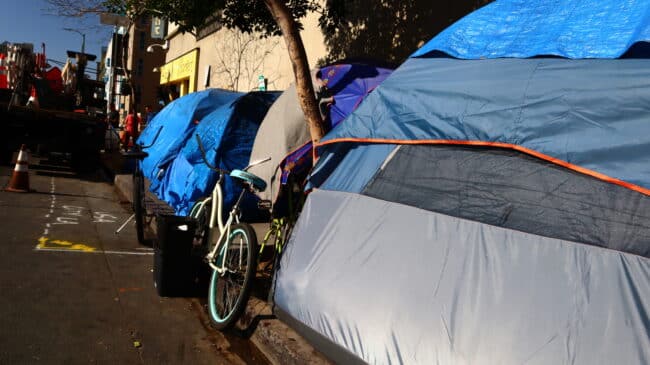

Louisiana House Bill 211 recently passed the state Senate after clearing the state House by a vote of 70 to 28. The bill creates a new criminal offense for unauthorized camping on public property, establishes a Homelessness Court program, and limits when political subdivisions may allow camping on public property. Its stated goals are to reduce homelessness, address substance use and mental health issues, and improve public safety.
Those are the right goals. The approach is likely to make them harder to achieve. To understand why, it helps to understand who is experiencing homelessness in Louisiana and why.
The state has a severe shortage of affordable housing. Only 43 rental homes are affordable and available for every 100 extremely low-income households, and Louisiana needs approximately 104,000 more affordable homes to meet current demand. Most extremely low-income renters in Louisiana are seniors, people with disabilities, or people already in the labor force. Vacancies exist in Louisiana’s housing market, but they are concentrated at price points that the lowest-income households cannot access. Even assistance programs struggle to function effectively in markets where the supply of lower-cost housing is already severely constrained. New market-rate supply does filter down over time, gradually reducing costs across the market, but that process unfolds over years or decades and offers, in the near term, little practical relief for households at the very bottom.
The shortage at the lower end exists because zoning restrictions, permitting barriers, and regulatory costs have made it too costly to build there. The shortage does not explain every case of homelessness, particularly among individuals struggling with severe mental illness or addiction, but it does shape how many people fall into housing instability and how difficult it becomes to recover from it. HB 211 does not address those underlying conditions. States across the country have passed meaningful housing supply reforms in recent years, from streamlining permitting to reducing parking mandates and expanding by-right development. Louisiana has not been among them. Rather than addressing the regulatory conditions that constrain supply, the legislature is moving in the opposite direction, adding a new layer of criminal justice involvement for people caught in a gap the market has not been allowed to close.
The housing shortage does not explain every case of homelessness. The highly visible street homelessness that often drives public frustration and legislation like HB 211 disproportionately involves individuals struggling with severe mental illness, addiction, or repeated behavioral crises. Those challenges are real, and communities are not wrong to demand responses to the public safety concerns tied to them. But repeated involvement with the criminal justice system is unlikely to stabilize individuals whose behavior is rooted in untreated illness or severe addiction.
HB 211 responds to those challenges primarily through enforcement, even though homelessness is tied to broader housing and public health conditions. When someone is living outside, the first question the bill asks is whether they have violated the law. The answer, under HB 211, will increasingly be yes.
A first conviction for unauthorized camping carries a fine of up to $500 and up to six months in jail. A second conviction carries a minimum of one year and up to two years of imprisonment with hard labor. For someone already navigating housing instability in a state where only 43 affordable units exist for every 100 households that need them, a criminal conviction can become a long-term barrier to stability.
Criminal records make it harder to pass background checks, secure employment, qualify for housing, and rebuild financially long after a sentence ends. Without addressing the underlying shortage, the bill risks creating a cycle of repeat arrests that effectively turns jail cells into expensive temporary shelters, shifting costs to taxpayers without producing any lasting reduction in homelessness. In practice, the bill risks making homelessness and unemployment more difficult to escape for the very people it claims to help.
The Homelessness Court program included in HB 211 is presented as a more humane alternative, and diversion programs can serve a useful function in some contexts. But this one has a structural problem: access to services requires entering the criminal justice system first. Participants must plead guilty to be eligible. They are then placed on supervised probation for a minimum of twelve months, subject to court-imposed conditions that can be difficult to sustain for individuals managing untreated mental illness, substance use disorders, or the daily instability of having no stable place to live. Failure to comply with those conditions can result in revocation of probation and incarceration.
For individuals who fall into homelessness due to economic hardship or temporary crisis, research on repeated criminal justice system involvement consistently finds that it worsens outcomes by increasing stress and disengagement from services. For individuals experiencing severe mental illness or chronic addiction who are already disconnected from care, criminal prosecution is not the most effective intervention. Co-responder models that pair law enforcement with behavioral health professionals can achieve the same goal of removing individuals from public spaces and connecting them to services, without adding a criminal record that creates long-term barriers to stable housing and employment. Criminalizing behavior does not treat illness, and it does not produce the stable outcomes that communities, taxpayers, or individuals need.
HB 211 also shifts responsibility in ways that do not match the scale of the problem. A bill that criminalizes one of the most visible consequences of a 104,000-unit housing shortage, without meaningfully addressing the shortage itself, is likely to move people around rather than move them forward. It may reduce visible encampments in some areas while increasing cycling through courts, jails, and emergency systems, placing added strain on both individuals and public systems that are already operating under significant pressure.
Louisiana’s housing shortage is structural, and the response to it should be too. The more productive question is not how to manage the visibility of homelessness but how to reduce the conditions that produce it. That starts with supply, with regulatory reform that makes it possible to build housing at price points the market has not been permitted to reach.
There is a more effective path, and the evidence for it is well established. Better outcomes in homelessness response come from aligning public safety, public health, and housing systems in ways that do not require criminal charges as the point of entry. Diversion pathways that connect individuals to housing and treatment before charges are filed address the underlying instability rather than layering legal consequences on top of it. Managed outdoor spaces with basic services, where jurisdictions designate areas with sanitation and behavioral health access while working toward permanent housing placements, have proven more effective and less costly than enforcement-driven clearings.
None of this requires abandoning accountability or ignoring the legitimate concerns of communities dealing with public safety challenges. The more reliable path to both public safety and individual stability run through housing and services, not through the criminal justice system. For people navigating homelessness in a state with a documented shortage of affordable housing, a criminal record is an obstacle, not a solution.
The evidence points clearly toward what works. HB 211 ignores it.