

Accessory dwelling units (ADUs) have become a central focus in contemporary housing policy debates, not just for their practical value but for what they reveal about how housing systems operate under pressure. The increasing prevalence of ADUs highlights the intersecting influences of land, regulation, and system design in determining housing outcomes.
ADUs take multiple forms across housing markets. Detached backyard cottages, garage conversions, basement apartments, and internal suites all fall under the ADU umbrella. The unifying feature is adaptability, with independent living spaces on the same lot as a primary residence, able to flex to different needs and contexts. This flexibility allows ADUs to adapt to the constraints shaping different housing markets.
Over the past decade, state and local governments have increasingly turned to ADUs to expand housing supply within existing neighborhoods without requiring large-scale redevelopment or new infrastructure. By 2025, at least 18 states had passed reforms enabling ADUs. California’s trajectory is especially instructive. After multiple regulatory changes, permits rose from fewer than 1,300 in 2016 to nearly 25,000 in 2022.
California’s trajectory reflects a broader national trend in which streamlined, by-right frameworks have begun to support incremental housing supply. As shown in the figure below, total permit activity across leading jurisdictions since 2018 reflects this shift. California’s share, which accounts for nearly one-third of ADU permits nationwide, highlights how regulatory reform shapes whether these units move from policy into actual production.
Figure 1
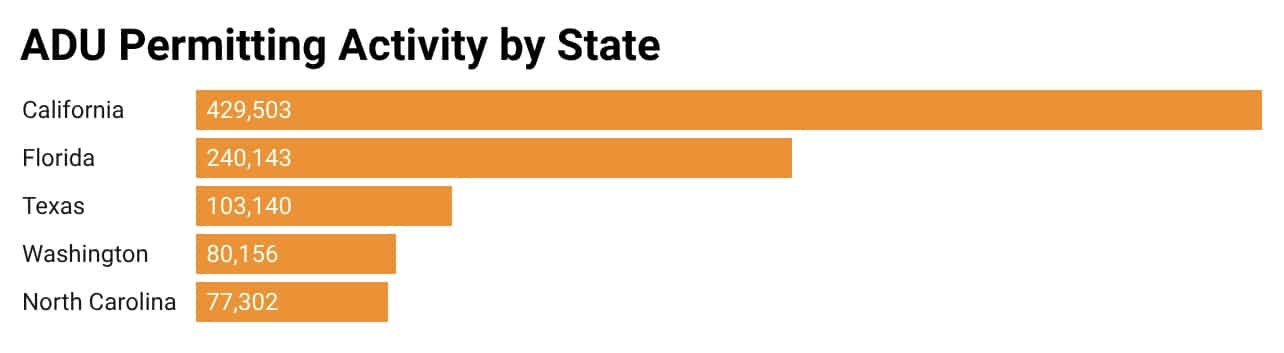
Some states, such as California and Oregon, have treated ADUs as a routine form of housing by establishing clearer rules and limiting discretionary barriers. In these places, ADUs are simply another way to add homes in established neighborhoods, and the policy conversation is largely about practical details. Elsewhere, the process for building ADUs remains tangled in discretionary approvals, restrictions on unit types, or persistent local hurdles. Legalization is only the first step. The specifics like permits, fees, required reviews, and the predictability of the process are what determine whether ADUs become a practical option or remain an abstract gesture toward reform.
Land constraints and aging in place
In Hawai’i, multigenerational living is both a cultural tradition and a practical necessity. For many families, ADUs offer a viable solution by creating private, self-contained spaces that enable older adults to remain close to family while maintaining independence. Renting ADUs can supplement retirement income, and single-level units often better accommodate evolving mobility needs than existing homes do. These are not fringe solutions. They are essential tools for facilitating aging in place and supporting family networks in markets where alternatives are often out of reach.
ADUs provide a way to support older adults within existing households and neighborhoods, particularly in high-cost, land-constrained markets. In Honolulu, these conditions are especially pronounced. More than 19% of residents are 65 or older, and that share is projected to approach one in four residents in the coming decades. Hawai‘i also has one of the nation’s highest life expectancies. Housing costs continue to rise relative to fixed incomes, narrowing the range of affordable options. Seniors, typically relying on fixed incomes that lag behind rising rents, are especially exposed to price pressures.
Yet even with cultural support and clear need, ADU delivery in Honolulu has historically been slow. Since 2015, fewer than 1,400 ADUs have been approved, well below what demand would suggest. This low production reflects the complexity of a system in which homeowners must navigate sign-offs across multiple agencies, meet infrastructure requirements, absorb high upfront costs, and navigate fragmented approval processes.
In 2024, Hawaii passed Act 39, requiring counties to allow at least two ADUs on residentially zoned land and eliminating owner-occupancy requirements. This is a meaningful shift in state policy in a context where land is limited and expanding housing outward is not feasible. However, Act 39 leaves the bulk of development standards to counties. Parking requirements, setbacks, size limits, and building standards remain under local control, which means counties can still establish rules that make construction costly or difficult in a market where space is already constrained. Honolulu followed with Ordinance 25-2 in January 2025, expanding eligibility and simplifying certain local standards. But the core barriers remain: local governments retain the authority to set requirements that discourage construction, agencies must still coordinate across multiple reviews, and upfront costs remain an obstacle for homeowners. State-level legalization is not the same as removing the conditions that make building feasible.
ADUs play a critical role in markets like Hawai‘i, where limited land and aging demographics make small-scale, flexible housing especially valuable. They allow older adults to remain close to family while maintaining independence, but their impact remains constrained by the regulatory and approval systems that shape whether these units can be built at all. This reflects a broader pattern: even where need is clear, regulatory and approval structures determine whether these units can be delivered at scale.
Concentrated demand: student housing markets
Similar pressures appear in other settings, though they are not driven by land scarcity. In college towns, the constraint is concentrated demand rather than limited space. Although overall enrollment trends vary across institutions, demand remains persistent in many markets, particularly around large public universities and high-demand campuses. Enrollment often outpaces new housing, and limited on-campus options push students into an already constrained rental market. Vacancy rates can fall below 2%, leaving almost no slack in the system.
This pressure exemplifies a broader pattern of demand that extends beyond any single campus or year. Student housing shortages are often described as local issues, but persistent underlying drivers continue to generate demand over time.
Table 1
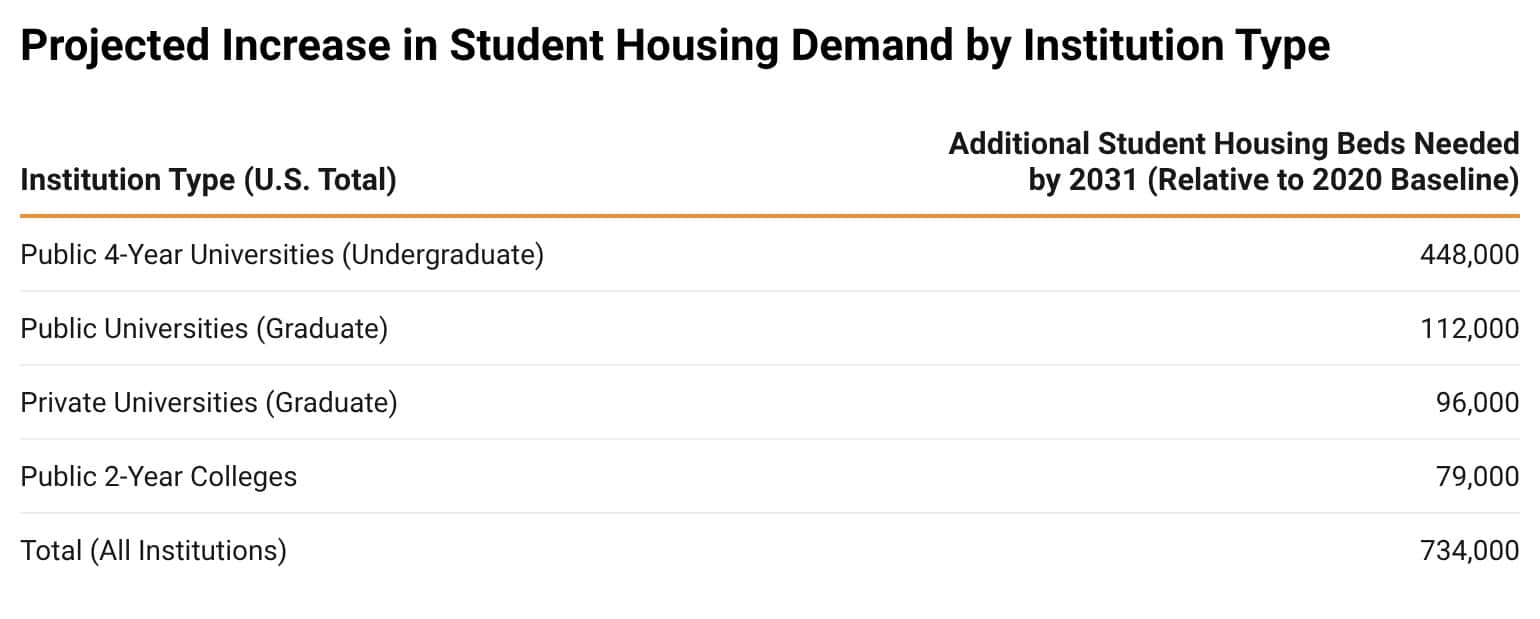
The estimates above reflect projected growth across the U.S. higher education system, though demand is not evenly distributed across institutions. Even where overall enrollment growth is uneven, these projections highlight how demand remains concentrated in certain regions and institutions. Public four-year institutions account for the largest share of additional demand, placing pressure on surrounding housing markets where most students live. Even though the projections are national, the effects are local and tend to show up most clearly in areas where supply is already constrained.
As demand intensifies, it spills into surrounding neighborhoods, affecting rental prices and availability for other residents. In that sense, student housing shortages mirror broader supply constraints in a more concentrated form, where demand is localized and difficult to absorb through traditional development alone.
In practice, this demand is often met through small-scale, incremental housing rather than large developments, particularly in markets where supply is already constrained. ADUs are one way to meet this housing demand while integrating with surrounding communities. In college towns, ADUs are often created by converting garages, basements, and backyard additions, expanding the supply within existing neighborhoods.
Where policy supports these developments, the impact is more visible. Cities like Austin and Seattle have adopted zoning changes and incentives that make ADU construction easier, increasing units near universities. While these changes do not eliminate demand pressure, they allow it to be absorbed gradually through small-scale additions. Most projects are single units built by individual homeowners, showing that ADUs are an incremental response to concentrated demand.
This pattern underscores the broader point that demand alone does not translate into supply. The ability of ADUs to absorb that demand depends on whether policy allows small-scale housing to be built predictably within existing neighborhoods.
System constraints: homelessness response
Addressing homelessness presents different challenges, with the primary constraint centered on how housing and services are structured and delivered. This dynamic is unfolding within a system under growing strain. Table 2 below shows how family homelessness has shifted since 2020 — declining briefly before surging to its highest recorded level in 2024.
Table 2

On a single night in 2024, more than 770,000 people were experiencing homelessness in the United States, an 18% increase from the previous year and the largest recorded rise since national tracking began. Roughly one-third of those individuals were unsheltered, living in places not meant for habitation. Over the course of the year, homelessness response systems served more than 1.1 million people, reflecting both the scale of need and the limits of existing capacity.
Cities such as Seattle, Portland, Los Angeles, and Denver are integrating ADUs into homelessness response strategies. Programs such as Seattle’s BLOCK Project, Multnomah County’s “A Place for You,” and Los Angeles County’s Second Dwelling Unit Pilot Program place ADUs on private lots and pair housing with support services and coordinated tenancy arrangements. A Place for You, which has since concluded, demonstrated how ADUs can be used to house families transitioning out of homelessness within existing neighborhoods. These models expand housing capacity within existing neighborhoods by coordinating among homeowners, nonprofit organizations, and public agencies.
Research adds important context to these efforts. A University of California, Los Angeles, Lewis Center evaluation finds that ADU-based programs face challenges related to cost-effectiveness, permitting, financing, and tenant selection. Many programs include affordability commitments that last only 3 to 10 years, after which units often return to market use, limiting their long-term impact. In tight housing markets, voucher payments often fall below local rents, reducing homeowner participation once program requirements expire.
Even with these constraints, ADUs continue to play a role within homelessness response systems. They support rapid rehousing, transitional housing, and community-based models that emphasize stability, privacy, and neighborhood integration. Their ability to add units within existing communities makes them a practical option in systems where expanding supply is otherwise difficult.
The broader takeaway is the role of system design. Programs that connect ADUs to services, oversight, and funding structures are better positioned to support long-term housing stability. The capacity to deliver housing, services, and stability together shapes outcomes more than the number of units alone. ADUs expand options within that system, but their scale and impact remain tied to how those systems function in practice. These outcomes highlight how ADUs function differently depending on system design, reinforcing that delivery structures, not just unit availability, determine their impact.
Regulatory barriers: The New York and San Diego contrast
New York City throws both the promise and the limits of ADUs into focus. The city’s housing crunch is severe. One analysis from 2024 by the Regional Plan Association estimated a shortage of roughly 540,000 units across the New York City metropolitan region. Space is scarce, land is tapped out, and large-scale construction is difficult. At the same time, basements, attics, and backyard structures contain significantly underutilized space. This tension has brought ADUs back into the policy conversation.
The scale of this embedded housing is substantial. New York already has thousands of basement apartments in use, but most remain illegal due to outdated regulations. A key barrier is a 1929 tenement law that prevents many of these units from being legalized, regardless of demand. The result is a mismatch. Housing exists and is being used, but cannot be formally recognized, upgraded, or protected. This leaves tenants in informal arrangements without basic safeguards and limits the city’s ability to expand its housing supply through relatively straightforward means.
Policy efforts are beginning to respond to that gap. New York City has recently reinvigorated its ADU strategy by launching a dedicated “ADU for You” platform, reopening its Plus One ADU program, and offering up to $395,000 in financial assistance for qualifying homeowners. The city has also introduced pre-approved designs and cost estimation tools, alongside a 2024 policy change that allows ADUs in one- and two-family homes, including basements, attics, and backyard structures.
The demand behind these changes is already visible. Informal units exist across the city, homeowners are seeking ways to generate income or house family members, and renters are already occupying these spaces. ADU reform in this context brings an existing housing type into the formal system, where the main constraint is whether it can be recognized and used.
In places where regulatory barriers have been reduced, similar dynamics lead to different outcomes. San Diego County provides a clear example. Following state reforms that streamlined approvals, ADU production increased rapidly. Between 2020 and 2024, permits more than tripled, and completions rose by 247%. Much of this growth has come from small-scale additions such as backyard units and garage conversions that build on existing residential lots.
Most ADU projects remain incremental. They are typically single units, even where multiple units are allowed, and they continue to function as a distributed form of housing supply. At the same time, they are not always used in ways that policy assumes. The majority are proposed as rentals, but available data does not confirm whether they ultimately enter the rental market or remain owner-occupied. Pricing patterns show that most ADUs fall within moderate-income ranges, though they are not always affordable.
Across these cases, housing challenges reflect different constraints that shape how housing can be delivered. In New York, ADUs make use of space within an already built environment. In San Diego, they expand outward through small-scale additions made possible by regulatory changes. Their role becomes clearer when those constraints are considered together, showing how policy determines whether ADUs remain latent capacity or translate into actual housing supply.
Conditions for delivering ADUs at scale
Across all these examples, a consistent theme emerges. ADUs function in two ways: as a source of incremental housing supply and as a tool embedded within systems that coordinate housing, services, and oversight. In some cases, they expand the overall housing supply. In others, they are integrated into programs that serve specific populations, including older adults and individuals experiencing homelessness. In both contexts, their effectiveness depends on how they are delivered, not simply whether they are allowed.
Fees, utility connections, and permitting costs are often structured in ways that do not reflect the scale or impact of ADUs. These requirements serve important functions, but their cumulative effect can make small projects financially unworkable. Adjusting cost structures to better match small-scale development can expand participation and increase supply. Fragmented approval processes, unpredictable fees, and the lack of by-right development keep most homeowners from participating, even where laws nominally allow ADUs.
The experience with ADUs demonstrates a central point: the primary constraint is not the legality of a housing form, but whether it can be delivered at scale, with predictability, and at reasonable cost and risk. Fragmented approval processes and unpredictable fees continue to deter most homeowners from participating, even after legalization.
Policy must go beyond legalization and address the conditions that determine whether small-scale housing can be delivered in practice. This requires a more consistent approach to how ADUs are regulated, financed, and integrated into the broader housing system:
- Establish by-right approval with clear, standardized processes: Where ADUs remain subject to discretionary review or fragmented approvals, development becomes uncertain and difficult for individual homeowners to navigate. Establishing by-right frameworks with defined timelines and consistent standards reduces that uncertainty and allows small-scale housing to emerge more directly.
- Align cost structures with the scale of ADUs: Impact fees, utility connections, and permitting costs are often structured in ways that do not reflect the size or impact of ADUs. Because ADUs are typically built as infill within existing neighborhoods, they rely on existing infrastructure rather than requiring entirely new systems or service extensions. These requirements serve important functions, but their cumulative effect can make projects financially unworkable. Adjusting cost structures to better match small-scale development can expand participation.
- Reduce fragmentation across approval systems: Multiple agency sign-offs for infrastructure, safety, and zoning can introduce delays and unpredictability, even where ADUs are technically allowed. Coordinating these processes or providing clearer sequencing and timelines can make development more feasible without removing necessary safeguards.
- Integrate ADUs into existing housing strategies: ADUs can complement broader housing efforts when connected to existing systems, including housing vouchers, aging-in-place initiatives, and local programs. This approach expands housing options without relying exclusively on large-scale development or new construction pipelines.
- Support incremental housing as part of the supply ecosystem: ADUs function as small-scale, distributed additions to the housing stock rather than replacements for larger development. Recognizing their role as incremental supply can help align policy expectations with how these units are actually produced and used across different markets.
- Prioritize predictability to enable broader participation: Consistent and transparent rules allow not only homeowners, but also builders, lenders, and nonprofit organizations to engage more actively in ADU development. Where policies are unclear or vary significantly, this broader ecosystem remains underdeveloped, limiting the potential for these units to scale.
ADUs show how much housing can be unlocked when constraints are reduced, and how little progress is possible when those constraints remain. The challenge is to move past pilot programs and patchwork reforms and create systems where small units can have a lasting impact. The future of incremental housing will depend on the extent to which these conditions are addressed in practice, making it possible for small-scale development to be feasible, predictable, and widely accessible.