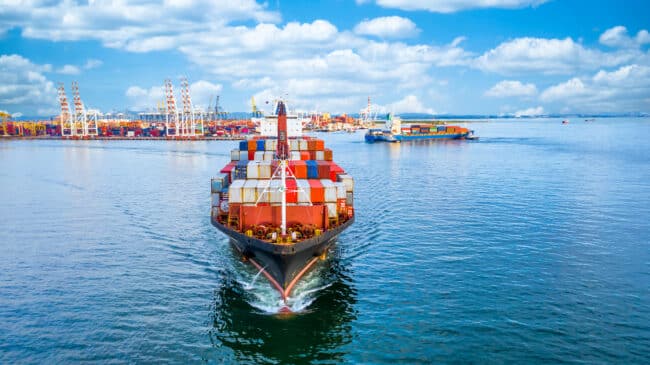

A new proposal from the Trump administration would impose a universal fee on foreign-built vessels entering US ports, adding another layer of cost to international trade at a time when the supply chain is already fragile.
Yet the United States already imposes the Harbor Maintenance Tax (HMT) on incoming vessels, regardless of where they are built. This double taxation would harm already-strained relations with our trading partners by raising the cost of doing business in the country. Everyday Americans would ultimately bear these additional costs in the form of higher-priced goods.
This idea is a perversion of a tonnage fee, initially proposed by the Clinton administration in 1999 as a remedy for longstanding problems with the HMT. But the Trump administration proposal does not aim to fix the problems with the HMT. Rather, the problems with the proposed universal fee on foreign vessels mirror those associated with the HMT.
The HMT, when first implemented, was an ad valorem tax levied on all vessels, regardless of whether they were importing or exporting goods into the United States. However, the US Constitution flatly states that exports cannot be taxed in Article I, Section 9, Clause 5. As such, the Supreme Court ruled that the HMT could not be applied to exports. This shifted the financial burden for America’s port and navigability projects squarely onto importers’ shoulders.
However, the Supreme Court did not rule out the implementation of a user fee, which is distinct from a tax. The test of a user fee was outlined in another Supreme Court case, Evansville Airport v. Delta Airlines. For a levied fee to be considered a user fee rather than a tax, it must pass what is now called the Evansville Test: it must not discriminate against interstate commerce, must be based on a fair approximation of use and must not be excessive.
Congress never passed legislation to convert the harbor maintenance tax into a user fee, so the HMT remains an ad valorem tax that cannot be levied on exporters, giving exporters cheaper access to US port infrastructure compared with importers.
The Trump administration says of its proposed universal tax: “As foreign-built vessels benefit from US market access, this policy ensures that they contribute to the long-term revitalization of America’s maritime capabilities.”
This isn’t wrong in principle. Those who benefit from infrastructure ought to contribute to its maintenance. But those foreign vessels targeted by the administration’s fee already help fund maritime infrastructure through their HMT payments.
Instead of this double taxation, the Trump administration should reform the HMT, which could be changed to a harbor maintenance fee. The new fee should be based on tonnage, not on whether the freight is on- or off-loaded, and be applied to the net or gross tonnage of the vessel, depending on the type of vessel. The weight of the cargo being moved on and off a ship has no bearing on the maintenance needs of the harbor itself, but the tonnage and capacity of the ship do.
Net and gross tonnage serve as better proxies for the actual costs of services rendered during a port call and account for the vessel’s draft and the dredging depth required. These changes alone would allow a proposed harbor maintenance fee to pass the Evansville Test and satisfy the legal requirements for a fee. If enacted, exporters would once again pay to support the infrastructure they use, regardless of the vessel’s country of origin.
The upcoming biennial Water Resources Development Act offers Congress an opportunity to reform the existing HMT into a proper user fee levied on both exports and imports. The best step to improve American maritime infrastructure is to modernize and reform the existing HMT, not to layer more poorly targeted taxes on top of it.
Congress and the Trump administration should pursue solutions that expand maritime capacity without raising the cost of moving goods through American ports.
A version of this column first appeared in the Journal of Commerce.