
- Private-sector adding space-launch capacity
- Who is Peraton and what are they doing?
- Update on United’s D.C. fortress hub
- TSA airport security modernization unravels
- Another $10 billion to “finish the job”?
- The Miami cargo aircraft crash
- News Notes
- Quotable Quotes
Not Enough Space Launch Capacity? The Private Sector Responds
On Sept. 8, Breaking Defense published an article that highlighted the White House’s “lofty space launch ambitions,” but raised doubts about the limited amount of space-launch infrastructure, especially for the military. But a lot of other media in this time frame pointed to expanding launch capacity. Prior to that, the Federal Aviation Administration (FAA) put out a query asking for input on spaceport and launch corridors on Aug. 28. From what I see, the private space industry is moving forward on launch infrastructure.
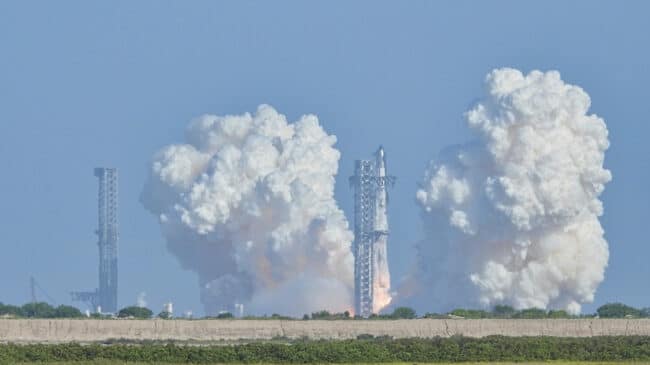
First, in the near term, SpaceX is on track to use less launch capacity on Florida’s Space Coast. That’s because, as its huge Starship becomes fully operational, it plans to phase out its Falcon 9 as far less cost-effective than Starship. On Aug. 4, SpaceX CEO Elon Musk announced its plan to increase Starship launches to daily by sometime in 2027.
While that would be impossible for the existing launch facilities in Florida, on Aug. 25 SpaceX announced plans for a 10-pad spaceport in Louisiana for Starship launches and recoveries. The Economist reported that SpaceX had purchased 124,000 acres in southern Louisiana. It plans to spend up to $100 billion for a Starship launch complex on Pecan Island, about 230 kilometers west of New Orleans. Construction is planned to begin next year, with the first launches planned for 2029.
The new site is also close, via barge transport, to the Starship rocket factory SpaceX is building at its current launch site on the Texas coast and close to Louisiana’s pipelines for natural gas (methane), which Starships use for fuel.
Aerospace Daily (part of the Aviation Week Intelligence Network) reported that SpaceX’s final Falcon 9 launch from Florida will take place in the near future, putting Starlink satellites into orbit. That task will soon be the responsibility of the growing fleet of Starships.
Who is Peraton and What Are They Doing at FAA?
It must have seemed like a good idea last year: Hire a technology-friendly outside contractor to review the FAA’s ongoing efforts at modernizing the air traffic control (ATC) system. But after eight months since they were hired, there is growing skepticism within the FAA and among air traffic control subject matter experts that Peraton is providing useful information for the $1.5 billion it’s costing FAA. Though Peraton has little aviation or FAA experience, its mission is to lead coordination on the agency’s air traffic control modernization efforts.
I hear from FAA and ex-FAA people who are very skeptical that Peraton either knows enough or can learn enough to be worth the $1.5 billion that FAA is paying it. Concerns about value for money extend beyond current and former FAA engineers and managers. The discontent reached Politico last month, which reported:
“Federal Aviation Administration officials are raising concerns about the performance of a contractor overseeing the Trump administration’s overhaul of the nation’s air traffic control system—unhappiness that could result in scaling back the company’s role, three people familiar with the situation told Politico. The big issues here are threefold, said the person familiar with discussions, adding that ‘Peraton has basically not done any work since they got in.’ The person said the agency was partially at fault, too, saying the agency has stonewalled Peraton’s efforts to work seamlessly with FAA counterparts.”
FAA’s Hannah Walden told Politico that “FAA has not penalized Peraton for underperformance or issued a ‘cure letter’,” but that does not say very much. One of the newsletter’s insider informants said “It’s what they’re not doing—they are not managing the project—and that’s the problem.”
A former FAA systems engineer whom I’ve known for many years told me this week that Peraton has received a “cure notice” for performance that is not satisfactory. I think the real problem with an external review of the FAA’s management of the ATC system is that hardly anyone who has not worked at FAA for many years or taken part as a technology provider knows enough to do a serious analysis of ongoing problems.
One precedent for such an approach is the 2023 FAA Safety Review Team (see my article on this in the Dec. 2023 issue). Its members included a former FAA administrator, a former Air Traffic Organization chief executive, a former National Transportation Safety Board chairman, a former NASA administrator, and former senior officials of both the Air Line Pilots Association and the National Air Traffic Controllers Association. These people all had detailed subject matter knowledge and expertise of the kind no outside non-aviation entity could possibly possess.
For these reasons, I doubt that Peraton will be able to produce anything worth the $1.5 billion that the FAA has agreed to pay them. The best thing the FAA could do at this juncture is to terminate the contract, paying only for whatever work has been done to date.
Update on United’s D.C. Fortress Hub
Just as Delta Air Lines dominates Atlanta’s Hartsfield Airport as a fortress hub (with 75% of all passengers), so United enjoys its own fortress hub at Dulles International Airport (IAD). Its market share is 68.5% of passengers, with the next-largest presence being Delta at a miniscule 3.5%. As I noted in last month’s article on Dulles, it has enough land (20.3 square miles) as this country’s third largest airport to serve a much larger number of passengers and airlines. But since it is dominated by United’s fortress hub, it is not taking advantage of its huge area.
United has every intention of preserving its fortress hub. Being the very dominant airline there, it can charge higher prices than if it had significant competition. Average fares out of Dulles are in the $475-532 range, much higher than the national average for trips of comparable length. It’s the lack of meaningful airline competition that keeps air fares so high—and United values its near-monopoly position.
Instead of enabling or encouraging United to play a leading role in Dulles modernization (which will build a better fortress), U.S. aviation policy should focus on expanding competition. An article in Politico on July 31 noted that bonds for the $20 billion expansion could be issued by United or by the Metropolitan Washington Airports Authority (MWAA). If United issues the bonds, we can be sure it will reap nearly all the benefits.
What northern Virginia needs is not a fortress hub but a major airport served by competing airlines. Robust competition from a larger array of airlines would result in lower fares and more destination choices (e.g., domestic and foreign airports not served by United). Upsetting the Dulles status quo would likely require a change in board members of the MWAA, whom I’m sure United loves. Were that to eventually happen, what would be a path to a much better IAD served by competing airlines?
The most effective way for MWAA to accomplish this transition would be to change the management structure. It would invite proposals from global airport groups and infrastructure investment funds for a long-term public-private partnership lease. Based on a landmark policy paper from the National Bureau of Economic Research (NBER #30544) the key to higher-preforming airports world wide is to have the airport managed by a team that includes a global infrastructure fund. As I’ve reported previously in this newsletter, airports whose governance includes such a fund have higher productivity, larger growth in passengers, more airlines and destinations, and a larger amount of service from low-cost carriers. High-productivity airports such as those studied in the NBER report are the antithesis of a fortress hub like the current IAD.
Helping United build a bigger fortress hub is precisely what should not be done.
TSA’s Airport Security Screening Modernization Unravels
By Marc Scribner
Last month, this newsletter highlighted the promise of the new Transportation Security Administration (TSA) Gold+ program in improving airport security screening. Unfortunately, just days later on Aug. 24, TSA announced it was canceling the Gold+ program in favor of an “evolved Screening Partnership Program.” Perhaps not coincidentally, Tampa International Airport, one of the three enrolled airports in TSA Gold+, revealed it was withdrawing on the same day and opting to maintain conventional TSA screening.
It remains unclear what exactly caused these policy reversals, but this turn of events suggests the post-9/11 statutory framework may need updating before airport security screening can be modernized in the United States.
Readers will recall that following the Sept. 11 terrorist attacks, Congress quickly nationalized airport security screening that had previously been provided by private companies paid by airlines under FAA oversight. TSA was created and tasked with both regulating and providing security screening. That law also created a pilot program to test an alternative model whereby airports could opt for private screening companies contracted by TSA in lieu of TSA-provided screening. This evolved into the Screening Partnership Program (SPP).
The SPP currently has 20 airports enrolled and growth has stalled. Many, including we at Reason Foundation, attribute airports’ lack of interest in the SPP to the poor design of the program. Under the SPP, airports have little say in how screening will be conducted, with TSA rigidly dictating terms from above.
TSA Gold+ was designed to reinvigorate the “partnership” promise of SPP. Back in July 2025, TSA posted a request for information on how to build on the legacy SPP to “creat[e] the TSA checkpoint of the future” by implementing “innovative technology, modern operational models, and process design” to improve the provision of airport security.
Interest in alternatives to conventional TSA screening had been growing in late 2025 and early 2026 as prolonged partial federal government shutdowns halted payroll. This led to TSA screeners calling in sick or quitting, leading to understaffed checkpoints and hours-long passenger queues.
In April, the TSA’s budget justification accompanying the White House Fiscal Year 2027 Budget Request proposed to expand the SPP to all category III and IV airports—those with the smallest passenger volumes that face the lowest security threats. The agency estimated that mandating SPP screening at small airports would reduce the TSA’s workforce by 4,500 employees and save $52 million per year.
This was followed by a May 2026 pre-solicitation notice that debuted TSA Gold+ as the new and improved SPP. As I noted in the May 2026 issue of this newsletter, “A key innovation is TSA’s encouragement that contractors ‘propose innovative and modern technology solutions and process improvements.’ Contractors could bring their own technology to bear, subject to TSA approval. Under the status quo, contractors are provided with TSA-owned equipment and must follow strict TSA-dictated processes.”
But, I warned, while “TSA Gold+ may make the SPP more attractive to airport applicants, and agency leadership deserves credit for this initiative, these improvements could be undone by a future administration.” Ultimately, TSA Gold+ was undone by the same administration that proposed it, which now suggests it will “evolve” the SPP “to better harness the role of the private sector in delivering a safer, more secure, and more efficient aviation system” under a new initiative it is calling the Horizon 25 Strategy.
The withdrawal of Tampa International from TSA Gold+ and sudden demise of the program was cheered by the American Federation of Government Employees (AFGE), which represents 47,000 TSA-employed screeners and had filed a Freedom of Information Act lawsuit against TSA seeking records related to Gold+. In early August, Tampa Congresswoman Kathy Castor sent a letter to the Tampa International CEO and the chair of the Hillsborough County Aviation Authority, which owns the airport, urging them to reject TSA Gold+. In September, AFGE hosted a rally in support of Rep. Castor’s reelection campaign, praising her opposition to TSA Gold+.
The two other airports that had enrolled in Gold+, Charleston International and Des Moines International, remained in the program until it was cancelled. The New York Times reports that Charleston International officials would need to more closely examine the Horizon 25 Strategy before recommitting to SPP screening.
The triumph of government employee unions in Florida, a conservative right-to-work state, suggests that expanding the SPP model will be challenging. This is especially true given the well-known design flaws of the SPP. Instead, Congress should consider a fundamental refresh of its airport security screening law. As I argued in a Wall Street Journal op-ed in April, there are three components to aligning U.S. airport security screening with global best practices.
First, the regulation and provision of airport security screening should be separated. TSA would remain as a stand-alone regulator, but screening services would be provided at arm’s-length by non-federal providers. This would eliminate the fundamental conflict of interest inherent in the current TSA self-regulation model.
Second, airports should be allowed to contract directly with screening companies or self-provide screening. A fundamental flaw of the SPP is that private screening companies are contracted with the TSA. Airports can apply to the SPP, but TSA assigns and manages private screening companies. If problems with the screening company arise, an airport cannot terminate that contract for cause and select a competitor—or provide security itself. TSA holds all the cards.
Finally, the existing 9/11 Security Fee assessed on airline passenger tickets should be converted into a local airport user fee with revenue remitted directly to the airport. This would be similar to the Passenger Facility Charge that supports eligible airport improvements. The TSA would regulate the use of security fee revenue, much like the FAA does for Passenger Facility Charge revenue, but the funds could be used by airports to pay for eligible security personnel, facilities, and equipment.
To encourage more substantive discussions on Capitol Hill, Reason Foundation has developed draft legislation we call the TSA Reform Act that would implement these reforms.
Another $10 Billion from Congress to “Finish the Job”?
I don’t know about you, but with the annual federal budget deficits running at an unprecedented 6% of Gross Domestic Product and the national debt at an unprecedented $40 trillion, the idea of the aviation community asking Congress for a “second $10 billion” for air traffic control modernization is bizarre. Ever since Congress created the Airport & Airways Trust Fund, fed by aviation user taxes, the job of Congress has been to allocate those set-aside user-tax proceeds for airport and airspace modernization.
This is an especially bizarre time for the aviation community to ask Congress for another $10 billion to finish the job. Instead of adding further to the unprecedented national debt, the responsible thing for the aviation community to do is to ask Congress for a robust increase in aviation user taxes to pay for needed improvements to the air traffic system.
Our peer nations nearly all pay for air traffic control and airport improvement based on dedicated aviation user fees. In most of the nearly 100 countries with user-funded ATC systems, the user fees are paid directly to the air navigation service provider (ANSP), rather than to the government. This dedicated user fee concept was blessed by ICAO shortly after World War II and is used by nearly all developed countries. An added benefit of this approach is that it would be immune from federal government shutdowns.
This is not a call for air traffic control “privatization,” which only a handful of governments have done. But nearly all our peer countries pay for their ANSP’s services via aviation user fees, generally paid directly to the ANSP itself. Doing that here would de-politicize ATC funding while also protecting it from government shutdowns.
Reflections on the Miami Cargo Aircraft Crash
On Sept. 6, an Amazon Prime 767 air freighter overran the end a Miami International Airport (MIA) runway, colliding with several small motor vehicles and killing five people. While we do not yet have a detailed report from the National Transportation Safety Board (NTSB), this is an “accident” that should not have happened.
We already know a lot about what happened. The crash was caused by incompetent flying, as the eventual NTSB report will make clear. The plane touched down too far down the runway, with only the right main wheels on the ground initially. Shortly thereafter, the brakes were released and the throttles increased in an apparent effort to do a go-around, but that action was quickly terminated and the brakes were re-applied (though there was no indication of thrust reversers being used). When the plane reached the end of the runway (at 75 miles per hour), it smashed into several vehicles, killing five people.
This is a horrible example of incompetent flying. As a detailed article in the Wall Street Journal pointed out, cockpit discipline apparently broke down. “Over the next few seconds, the crew vacillated between slowing the aircraft or speeding it up to re-do the landing,” per NTSB’s initial report. Whatever happened to “pilot in command”? That wise principle is intended to prevent arguing over what to do in emergency situations.
The cargo airline that owned the crashed the 767 is 21 Air, which the WSJ article reported as operating “about 17 aircraft, eight of which fly for Amazon.” The article also reported that the first safety chief hired by the current owner quit after three months “and wrote that the company was ignoring its own safety program.” He said that “everywhere I looked there are issues. In my opinion, what they wished me to do is say nothing, but that is not how safety is supposed to operate.”
Karl Seuring, the former president of 21 Air’s pilots’ union, told the WSJ reporters that, “21 Air’s training for redoing landings was good, but management pressure, procedural shortcuts, and discouraging open discussions about risks were ingredients for a poor safety culture.”
Former 21 Air chief pilot Bruce Joseph testified in a legal case that he brought safety concerns to 21 Air’s safety director on numerous occasions but was told not to file them.
The Miami airport’s runway ends all have 1,000-foot Runway Safety Areas required by FAA regulations, but the 21 Air overrun (with five fatalities) shows that this was not enough to prevent five people being killed when a large aircraft barrels through the runway safety area. This leads me to suggest that Miami-Dade officials might consider adding EMAS on its runway ends. This acronym means Engineered Materials Arresting Systems. They use crushable concrete to stop aircraft that have overrun the runway end. It’s not as if EMAS is unknown to Miami officials. Both Fort Lauderdale and Palm Beach airports use them.
The Miami Herald reported that Miami-Dade officials are looking into EMAS, which if implemented would make Miami the first U.S. airport to have both full Runway Safety Areas and EMAS.
Canada Plans P3 Leases of Largest Airports
In a speech at the Canada Investment Summit on Sept. 16, Prime Minister Mark Carney announced that the government plans long-term public-private partnership leases (concessions) for its four largest airports: Toronto Pearson, Montreal-Trudeau, Calgary International, and Vancouver International. Canadian pension funds and infrastructure investment funds are expected to be interested.
JSX Evaluating Electra EL9 for Untapped Markets
Aviation Week reported that public charter operator JSX has been evaluating Electra’s ultra-STOL EL9 (which can take off and land in 150 ft.) for potential feeder service from smaller markets than would be economical for JSX itself. Electra has a backlog of 2,200 letters of intent from 63 regional aircraft operators.
Airlines Versus ICE at Airports
The Wall Street Journal reported that airlines are pushing back against Immigration and Customs Enforcement (ICE) officers seeking to arrest people in the portions of airport terminals past TSA checkpoints. The article cites examples at several airports of ICE agents attempting to make arrests in aircraft boarding areas. In one case, an ICE agent wanted to board a Southwest aircraft using an administrative warrant. In that case, the gate agent declined the request due to the lack of a judicial warrant. The WSJ reported, “The shift in tactics comes as ICE leaders face growing pressure from the White House to increase the number of daily arrests they perform, to meet a quota of about 2,000 a day.”
Controllers Went Home Early Before LaGuardia Crash
Both Reuters and The Wall Street Journal reported that two LaGuardia Tower controllers went home before their shift was over the night of the deadly Air Canada/fire truck collision. Both articles reported that the FAA is taking steps to fire them. The WSJ article reported that the FAA investigated that practice at Reagn International and found that it was “widespread.”
Electra.aero Forms Regional Aviation Team
Startup electric aircraft developer Electra.aero has formed a regional aviation team with fixed-base operator Signature Aviation and vertiport developer UrbanV to build the foundation for point-to-point regional aviation, reported Aviation Daily. Graham Warwick reported that the rationale for the memorandum of understanding is to advance Electra’s concept of “direct aviation,” meaning point-to-point service bypassing hub airports. The team will begin with a system based on Electra’s EL9 that can take off and land within 150 feet.
Ecuador’s Largest Airport Gets Upgraded Credit Rating
S&P Global Ratings upped the rating on Corporation Quiport (the country’s main airport) from B to B+. Corporation Quiport operates and manages the airport under a concession agreement that runs from 2006 to 2041. The airport’s owner, the municipality of Quito, receives 11% of the airport’s regulated revenue, reports Infralogic (Aug. 20).
Amazon Plans Major Expansion of Drone Delivery
The Wall Street Journal reported that Amazon.com plans to roll out drone delivery to nearly 500 cities by the end of this year. Named Prime Air, the service will offer delivery in as little as 30 minutes for items meeting its weight limit. Product categories include electronics, groceries, household products, and medications. Initial markets will include Atlanta, Boise, Chicago, Cleveland, and Syracuse. Amazon told reporter Gareth Vipers that by the end of 2026 they plan to reach customers in “nearly 500 cities and towns.”
FAA Grants Permission for Heart X-1 Test Flights
Heart Aerospace’s all-electric X-1 demonstrator aircraft has received an experimental certificate from FAA. Aviation Daily (July 21) reports that Heart Aerospace will be able to carry out ground and flight testing of its X-1 prototype aircraft, to pave the way for its planned 30-seat hybrid-electric regional airliner, the ES-30.
Blue Origin Will Provide Mars Telecommunications Network
A NASA news release informs us that the agency has selected Blue Origin to design and develop the agency’s planned Mars Telecommunications Network. It will lead to the development and launch of a Mars-orbit Mars telecommunications hub. Under the $700 million contract, Blue Origin will design, build, launch, and operate the telecom network.
White House Calls for Integrating Space and Air Traffic
Last month the White House released a space transportation policy document, which aims to have the capability for more than 1,000 launches and re-entries by 2030. It calls for NASA and the Pentagon to work together. It also calls for air traffic control improvements in parts of the country with significant space launch and recovery activities.
Will Manassas Attract Commercial Air Service?
Scott Sowers reported for Bond Buyer that “investors see more competition in D.C. airspace.” This is due to commercial services having been approved for Manassas Airport, a regional airport 40 miles west of Washington, DC. The airport is managed by Avports, and that company plans to invest up to $125 million in airport improvements. This will include a new 32,000 sq.ft, passenger terminal and 2,000 parking spaces. How much and what kind of commercial service the airport will attract remains to be seen. Its new role will likely require airspace changes in the region.
Indian Government: Should Airport Operators Own Airlines?
The Ministry of Civil Aviation is considering changes in airport ownership rules that currently prevent Delhi and Mumbai Airports from owning more than a 10% stake in any airline. Aviation Pros reported that airport operators, including Adani Group and GMR Airports, may be interested in launching airlines of their own. IATA projects that India will add 425 million passengers by 2044, nearly tripling 2024 levels.
Near Misses at Sydney Airport and Controller Shortage
Reuters (Aug. 17) reported that “a series of near-collisions” near Sydney Airport is leading to questions about air safety and a shortage of air traffic controllers. The head of the controllers union told the Sydney Herald that there are not enough controllers for the region’s airspace, leading to controllers working overtime and some doing 10 shifts on and one day off. Rob Sharp, the CEO of Airservices Australia, acknowledges a controller shortage but says it has not affected safety.
FAA Mandate Leads to New Cockpit Voice Recorders
The new FAA rule requiring cockpit voice recorders (CVRs) to record for 25 hours is leading to a new generation of CVRs that do additional tasks. One such change being pursued by Honeywell is to stream the voice and data to a highly secure satellite network reported Business Aviation Insider in its July/August issue.
“The press is loaded with discussion of the two air traffic controllers who left their positions in LaGuardia Tower early on the night of March 22nd, the night that an Air Canada flight and a fire truck collided, resulting in two deaths and multiple injuries. It has been reported that the Local Control and Ground Control positions were combined during the period of this collision. Also in the press is discussion indicating that the practice of ‘early shoves’ may not have been uncommon, with justifying excuses about controllers’ stressful jobs, the early shove might have been in conjunction with a break, etc. All these comments aside, there can be no excuse for the behavior. Blame for these controllers’ actions belongs to FAA air traffic control management for failure to control the ATC workforce. Where does this come from? My experience, when I was with the FAA (and I have no reason to assume a change) is that a facility manager who does nothing is a hero as long as nothing bad happens. A facility manager who tries to manage the staff and generates union grievances will not survive long. This model does not support aviation safety. There have been two fatal collisions in 14 months, with the Washington National collision also involving combined [controller] positions. In this instance, four of the nine ATC specialists on duty that night were not in the tower cab, leaving the Local Control and Helicopter Control positions combined during a busy period. Coddling the ATC workforce is not producing good results.”
—John Kefaliotis, “There Can Be No Excuse,” LinkedIn, Sept. 1, 2026