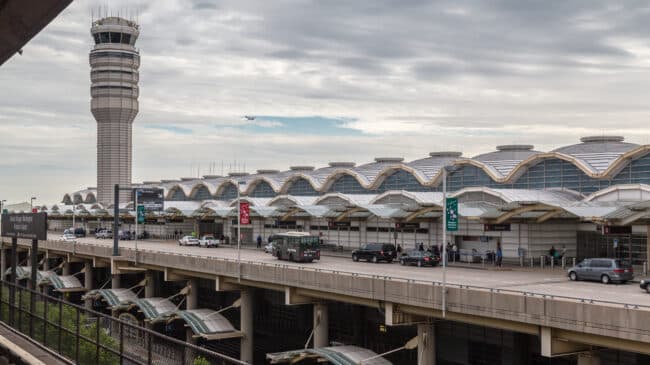

Washington Dulles International Airport, serving the nation’s capital and Northern Virginia, leaves much to be desired. The airport’s facilities are outdated, and it is close to being a fortress hub for United Airlines. Back in January, in response to a U.S. Department of Transportation Request for Information, two of more than 30 respondents proposed dramatic makeovers, from Ferrovial and Macquarie. Each proposed a long-term public-private partnership lease that would rebuild the terminals and open the airport to more airlines.
What a difference eight months make. After perusing various scale models from an array of companies, President Donald Trump announced his own $22 billion plan for the airport, beginning with a 32,000-space parking structure in front of the iconic terminal designed by architect Eero Saarinen. The parking structure, whose capacity is far larger than the airport estimates for 2045, would be about eight stories high (fully above ground), hiding the iconic terminal building.
A detailed CBS News article summarizing Trump’s new role as airport designer. At Trump’s request, several engineering companies brought detailed Dulles Airport scale models to and from the White House, to facilitate “his edits to plans for all aspects of Dulles International Airport (IAD).” But Trump also invited development and financial companies to submit proposals. At least one of them, BlackRock, proposed a long-term public-private partnership (P3) lease under which it would finance, design, rebuild, and operate the airport.
For the White House, another key source was United Airlines, which accounts for two-thirds of airline operations at Dulles, making the airport one of its fortress hubs. United CEO Scott Kirby met with Trump a number of times, CBS News reported. Needless to say, the operator of a fortress hub would not welcome anything that would open the airport to an influx of new airline service. Kirby proposed that United contract for the new construction and pay debt service on new bonds issued by Dulles. Anything to preserve its dominant position at the airport!
Since much of the current discussion about Dulles concerns parking, we should separate parking fact from fantasy. Trump’s eye-catching proposal is for a 32,000-space parking garage, conveniently located right in front of the main terminal. Dulles currently has 22,000 parking spaces, all in ground-level parking lots. In July 2025, the Metropolitan Washington Airports Authority (MWAA) projected that the current number of spaces should be adequate until at least 2045.
MWAA currently plans to build a three-story parking deck in front of the main terminal, between 2031 and 2034, to handle 6,400 cars. According to UCLA’s Institute of Transportation Studies, a 32,000-space parking deck would cost in the vicinity of $900 million, close to $1 billion. That would be sheer waste.
Moreover, if Trump’s 32,000-space structure were located right in front of the main terminal, its size would imply eight to 10 levels. That would surely block passengers’ view of the iconic Saarinen terminal building.
Setting aside President Trump’s builder fantasies, what is a wiser path forward for IAD?
A long-term P3 lease of the entire airport, as proposed in January by Ferrovial and Macquarie, would be a better option. Here are some of the benefits of that approach.
First, there would be no federal spending on the airport’s reconstruction.
Second, the project would be financed by equity as well as debt, a key distinction. A major study from the National Bureau of Economic Research (NBER 30544: “All Clear for Takeoff: Evidence from Airports on the Effects of Infrastructure Privatization”) found many large-scale benefits from long-term P3 leases. Drawing on a huge database of 2.444 airports in 217 countries, they found significant productivity gains in one subset of airports: those with majority ownership by an infrastructure investment fund.
Comparing airports with and without infrastructure fund part-ownership, among the benefits of infrastructure fund participation are:
- Significant passenger growth
- More passengers per flight (possibly via airlines shifting to larger aircraft)
- Deregulated airport pricing
- Increased terminal capacity
- More airlines serving the airport, including low-cost carriers.
One key point is that no airport under this kind of management is a “fortress hub” like Dulles is, with United’s dominant service.
Letting Trump play airport designer is a recipe for retaining the current United fortress hub and potentially wasting nearly a billion dollars on a totally unneeded parking facility.
If MWAA wants wise investment in Washington Dulles and better management, it should cease protecting United from serious competition. The best way to do this is to follow the long-term P3 lease model proposed in January by Ferrovial and Macquarie. Long-term P3 leases of large and medium airports are a global trend, which I have documented in a forthcoming Reason Foundation policy brief.
The only U.S. airport public-private partnership lease of any consequence is that of Puerto Rico’s San Juan airport. Its P3 lease has transformed that airport into a modern, passenger-friendly facility with increased airline competition. It has been a rousing success, pleasing airlines and air travelers alike. U.S. aviation law poses no barriers to any U.S. air-carrier airport wanting to do likewise.
A version of this column first appeared in Public Works Financing.