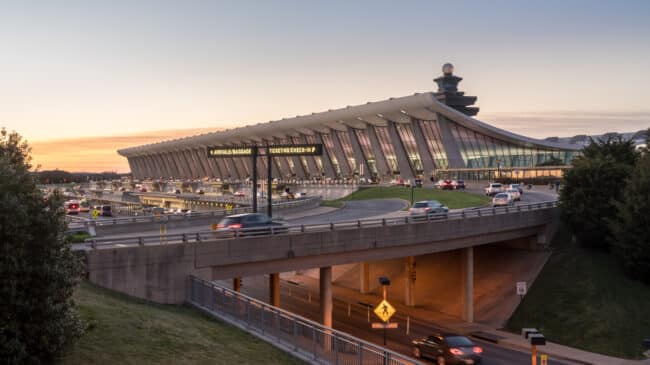

- The future of Washington Dulles Airport
- TSA Gold+ airport security breakthrough
- Does SpaceX Crew Dragon have a future?
- French air traffic controllers debacle
- Air traffic controller or trainee?
- Where to relocate FAA’s DC staff
- Will LAX people mover serve the Olympics?
- News Notes
- Quotable Quote
Washington Dulles Airport: Transformation or Business as Usual?
Last December, the U.S. Department of Transportation released a Request for Information about re-imagining Washington Dulles International Airport. It asked for design concepts, financing proposals, and potentially new terminals. Some 15 responses were submitted by companies and teams of companies. The two most ambitious proposals came from Ferrovial and Macquarie, each proposing large-scale modernization under a long-term public-private partnership (P3) lease.
Fast-forward to today and those ideas seem to have gotten lost. First, the Metropolitan Washington Airports Authority (MWAA) in May proposed a $22 billion makeover that would junk the hated “mobile lounges” but use conventional airport financing. In July, President Donald Trump unveiled his own plan, calling for a huge new parking structure and an expanded train system linking the terminals. The Washington Post reported that United Airlines “had agreed to help pay for” improvements to what amounts to its fortress hub.
These Dulles modernization proposals leave a lot to be desired. To begin with, government agencies have a pretty poor track record doing megaprojects on their own. A good overview of this problem is Bent Flyvbjerg’s 2003 book Megaprojects and Risk. Over the last several decades I have written many articles and policy studies explaining how long-term public-private partnerships can shift significant risk (e.g., of cost overruns and late completion) to investors, rather than taxpayers. In these projects, those risks are borne primarily by equity investors.
Another problem with attempting a $22 billion airport expansion of a fortress hub airport is that it would further lock into place the dominant airline (in this case United). Were Dulles to be dramatically expanded, it would likely attract more U.S. and international airlines, providing much-needed competition with United (as well as a more robust array of landing fee and terminal space rentals).
The long-term P3 ideas previewed in January by Ferrovial and Macquarie would be financed by a mix of debt (revenue bonds) and private equity. And, as I’ve written before in this newsletter, there is strong empirical evidence that airports managed under long-term P3 leases (and especially those financed via infrastructure investment funds) lead to increased airline competition, more destinations served, and somewhat lower air fares. The leading study on this is National Bureau of Economic Research Working Paper 30544, “All Clear for Takeoff: Evidence from Airports on the Effects of Infrastructure Privatization,” which found that airports managed under a long-term P3 lease that included an infrastructure investment fund have more airlines, lower average air fares, increased airport productivity, and greater passenger satisfaction.
By contrast, a conventional airport expansion would likely further entrench United’s fortress hub at Dulles, foregoing the benefits of increased competitive airline service. In a forthcoming Reason Foundation policy brief, I provide data showing that a growing majority of major airports worldwide are now managed under long-term P3 leases. The United States lags the rest of the world in using this superior model, with our only real example being San Juan, Puerto Rico’s Luis Munoz Marin Airport, which has been transformed through its long-term P3 lease.
The Trump administration and the Metropolitan Washington Airports Authority would be wise to take a much closer look at the NBER research findings and the growing global track record of long-term airport public-private partnership leases. This would be a far better way to expand and modernize the international airport serving America’s capital.
On Aug. 19, the MWAA board approved an additional $15.5 billion to replace the unpopular people movers with underground rail tunnels and add some terminal expansions. It did not include Trump’s proposal for a massive new parking deck costing nearly a billion dollars.
A Breakthrough in Airport Security Screening
In my June 2026 Reason Foundation policy brief, “Fixing TSA’s Conflict of Interest,” I criticized the Transportation Security Administration (TSA) for being both the airport security regulator and the provider of nearly all airport screening—a conflict between regulation and service delivery. I noted that the only exceptions were the 20 airports that had opted into TSA’s Screening Partnership Program (SPP). In those few cases, TSA serves primarily as the regulator, though it also selects the private contractor rather than allowing the airport to solicit bids from TSA-certified companies.
In 2026, however, TSA has begun to implement a significantly different model. Under its new TSA Gold+ program, TSA is actively seeking airports to “opt in to privatized security screening,” as Aviation Daily referred to it in a May article.
What is different about TSA Gold+ and why did the agency make this change?
At the Global Airport Development/Americas conference in Charleston, SC, on May 27, TSA Deputy Administrator Adam Stahl noted, “We have 20 airports in the [SPP] program, and it’s been stagnant for the past 15 years or so.” He envisions Gold+ as a way to rethink airport checkpoints. Gold+ is intended to be a “public-private partnership” in which the private partner is expected to propose improvements to make the process more passenger-friendly.
If Stahl and TSA are serious, they should remember a cost comparison carried out for the House Transportation & Infrastructure Committee in 2011. Committee staff did a detailed comparison of TSA screening costs at Los Angeles International Airport (LAX) and San Francisco International Airport (SFO). LAX uses TSA screening, while SFO uses a TSA-approved private contractor. The report found that screening quality was about the same at both airports, but the screening contractor at SFO processed 65% more passengers per screener than those at LAX. If the TSA screeners at LAX performed as efficiently as the contract screeners at SFO, the LAX screener workforce would be 867 persons smaller, saving an estimated $33 million per year. The study also found that annual screener turnover at LAX was 13.8% versus 8.7% at SFO. The report estimated that if LAX applied the private SFO model, its annual cost to taxpayers would drop from $90.6 million to $52 million.
In the traditional TSA Screening Partnership Program, the airport had to apply to TSA, which conducts some kind of specialized review, after which TSA assigns a private screening company to that airport. For almost any airport service other than screening, the airport defines what it is seeking (consistent with any FAA or TSA requirements) and issues a request for proposals (RFP) to qualified providers. The airport then works with the winning bidder to design the program.
TSA is promising that under Gold+, things will be a lot more like this. Instead of going through TSA’s arduous application process for SPP, the agency and incoming TSA Administrator David Cummins plan to “aggressively promote” airports to sign up for TSA Gold+. One of the greatest benefits of the public-private partnerships under Gold+ will be no interruptions in airport screening during inevitable federal government shutdowns. That’s because funding for Gold+ (like SPP) has already been paid in advance to cover payroll and other expenses, so that funding is not at risk during a federal shutdown. (This explains why passenger screening at SFO was unaffected by recent federal shutdowns.)
TSA unions are upset about Gold+, claiming that using private screeners poses a public safety threat. They have no evidence for that claim. There have been no such problems at the 20 airports that have been in the SPP for decades.
The American Federation of Government Employees (AFGE), which represents TSA screeners, alleges that private screening companies would pay screeners less than TSA does. Last month, Politico reported that Sen. Andy Kim (D-NJ) asserted that “private contractors answer to the bottom line, incentivizing them to cut labor costs. The TSA’s privatization push is built on offloading its highest-expenditure, personnel compensation and benefits.”
There is no evidence that would support such a claim. Incoming TSA Administrator David Cummins noted that on his recent visit to Kansas City International Airport (a long-time SPP airport), the entry-level SPP screeners there are paid more than entry-level TSA screeners and get comparable benefits. Under federal law (49 U.S.C. § 44920(c)), SPP screeners must receive wages and benefits “that are not less than the level of compensation” paid to TSA screeners.
In late July, TSA announced that three significant airports will be the first to offer TSA Gold+: Charleston (SC), Des Moines (IA), and Tampa (FL). Because of the separate funding source for SPP and Gold+, airports that take part will be assured of uninterrupted screening the next time the federal government has a funding shutdown. That’s a plus for airports, travelers, and checkpoint and baggage screeners.
While TSA Gold+ does not eliminate TSA’s built-in conflict of being both the aviation security regulator and the large-majority provider of airport screening, Gold+ is a significant move in that direction. If Gold+ airport screening is shown to be equal to or better than traditional TSA screening, Gold+ could become the primary model for airport screening. That would be a significant step toward TSA becoming mostly focused on regulation rather than service provision.
Potential Customers Worry About Crew Dragon’s Future
Ars Technica Senior Space Editor Eric Berger reported that space industry officials are concerned about the future of SpaceX Crew Dragon vehicles. NASA intended to have two companies providing crew transportation to and from the International Space Station (ISS). But Boeing still hasn’t been able to perfect its troubled Starliner vehicle. SpaceX does not see a long-term future for its Crew Dragon, which is launched by its Falcon 9 rocket. SpaceX plans to phase out Falcon 9 after its Starship system becomes fully operational. As Berger points out, it would be difficult to dock the huge Starship to the ISS.
What alternatives might there be?
Berger suggests a possible niche for Blue Origin, but this appears to be only speculation at this point, especially after the explosion earlier this year that destroyed the company’s launch facility at Cape Canaveral. He also notes that a European firm, The Exploration Company, has opened a U.S. office near the Johnson Space Center in Texas and is developing a cargo vehicle to supply the ISS. Its CEO has expressed interest in also developing a crew vehicle.
In Space News, Jeff Foust followed up, noting that SpaceX says there is a “significant” amount of life left in its Crew Dragon fleet, it “has hedged” on how long they will continue using it as Starship becomes operational. Next month’s planned Crew Dragon trip to ISS will be the 13th such mission, using its new “Grace” Crew Dragon for the second time. That will be SpaceX’s 18th human spaceflight mission. SpaceX has produced five Crew Dragons and has no more planned. They were originally certified for five missions each, but SpaceX is working with NASA to expand this to 15 missions each. The space agency has filed plans for six additional Crew Dragon missions after the final (Crew-14) mission in its current contract.
While SpaceX has no plans to attempt servicing the ISS from its huge Starship, the ISS itself has only a limited number of years before it is dismantled and de-orbited. In its coming role in the Artemis lunar landing missions, Starship will be a key player.
French Air Traffic Controllers Out of Control?
A July 9 article by Charles Bremmer in The Times of London was headlined, “High Life of France’s Air Traffic Controllers Under Attack Again.” The article’s opening sentence is, “The ‘signalmen of the sky’ have caused widespread disruption through repeated strikes and a poor work ethic, the Senate and the Court of Auditors find.” I’ve heard allegations along these lines for years, but it appears that the authorities are getting serious.
Among the auditors’ findings in Bremmer’s article are the following:
- Would-be controllers receive a five-year training program and earn full pay the whole time.
- They are France’s highest-paid civil servants, at an average of €110,000 per year for 22 hours a week in front of their screens.
- They take “unofficial time off” during quiet periods, and 20% fail to use their biometric clocking-on badges.
- The regional control center at Aix-Marseille was responsible for 16% of all airline delays in Europe last year.
- The agency failed to recruit new controllers during and after the pandemic, and now faces 30% tof staff taking full retirement before 2030.
The inquiry also stated that controllers were refusing to use the new electronic flight strips, sticking with paper strips.
After all this dismal news, the good news is that the Court of Auditors suggested stripping air navigation from the transport ministry’s Civil Aviation Directorate (DGAC) to a new semi-private entity of the kind operated by NATS in Britain and most other European states. In response, the unions “have threatened industrial action,” Bremmer reported.
European airlines should pick up on this recommendation and start a serious effort to corporatize the French air traffic control system. The status quo is both dangerous and a barrier to on-time flights.
Who Is and Is Not an Air Traffic Controller?
Earlier this month, Transportation Secretary Sean Duffy tweeted “we launched a NEW CAMPAIGN to recruit video gamers as air traffic controllers — and supercharged the entire hiring process” and “2,000+” candidates had been hired and were in the pipeline.
Duffy’s proclamation resulted in news headlines like, “Facing a decadeslong shortage, the FAA has now hired more than 2,000 air traffic controllers after its campaign recruiting Gen Z video gamers,” in Fortune and “FAA hires 2,000+ gamers to be air traffic controllers,” in The Hill.
Duffy should know there is a big difference between being hired with the aspiration of becoming an air traffic controller and actually making it through the process and working as one. Understanding the process is critical to accurately representing air traffic control workforce challenges, so I will outline it again.
From a major study published by the National Academies of Science, Engineering, and Medicine (The Air Traffic Controller Workforce Imperative), I extracted the following chart showing the weeding-out process that starts with would-be air traffic controllers being hired. Here’s what will likely happen with the 2,000 video gamers Duffy is celebrating.
| Step in the process | Percent | Number Remaining |
| Did not meet system qualifications | 10.1% | 1798 |
| Did not meet HR qualifications | 23.6% | 1374 |
| Did not take ATSA exam | 25.8% | 1020 |
| Scored below “well-qualified ” | 21.3% | 803 |
| Did not proceed after offer letter | 6.7% | 749 |
| Did not pass medical, etc. | 1.1% | 681 |
| Failed or withdrew from Academy | 4.5% | 652 |
| Graduated from Academy | 6.7% | 607 |
| Became certified controllers | 61.0% | 370 |
As these numbers show, of the 2,000 video gamers Duffy says were hired, only about 30% will likely make it through the process to be assigned to an air traffic control facility to begin on-the-job training, from which another fraction will wash out. If another 39% wash out of on-the-job training, only about 370 would actually become certified air traffic controllers.
Secretary Duffy and everyone involved in the aviation industry should avoid equating hiring 2,000 trainees with increasing the air traffic controller workforce by 2,000 when the end result is fewer than 400 of those people actually going on to work as controllers.
Where to Relocate FAA’s D.C. Staff
The two Federal Aviation Administration buildings on the Mall in Washington, D.C.—the Orville and Wilbur Wright buildings—have housed the FAA’s D.C.-based staff for decades. Those buildings are now considered obsolete, and the Department of Transportation (DOT) had hoped to move all occupants to DOT’s headquarters complex in the Navy Yard part of D.C.
A July 16 report from the Government Accountability Office (GAO) compared the number of FAA staff in the two Wright buildings with the space available in the DOT’s Navy Yard facilities. Whoops! There is no room at Navy Yard for about 950 FAA workers. At least in the short term, GAO suggested that those 950 people must remain in one of the Wright buildings until a new home for them can be found. GAO apparently has not developed a viable plan for those 950 people, despite FAA’s target of emptying the Wright buildings by summer 2027.
To provide a more complete picture, it’s not just the 950 FAA staff who need to move into to-be-determined new locations. The FAA also needs, presumably in the same place, classified “secure space,” its Washington Operations Control room, and an airspace monitoring center. Oh, yes; also an estimated $91 million in relocation costs.
The need to relocate the FAA’s D.C.-area staff offers an opportunity to separate the FAA’s two very different roles. One role is to be the national aviation safety regulator. That role should be separate from operating the ATC system, which in most modern countries is at arm’s length from the safety regulation function. Many aviation safety experts (such as Clinton V. Oster and John S. Strong) have persuasively made the case for this separation (which has been done in about 100 other countries). The need to relocate the FAA’s D.C.-based staff could provide the opportunity to move FAA safety regulators to one facility and its air traffic organization (ATO) to a different location. One potential location for ATO staff would be adjacent to the ATO command center in Warrenton, VA. If there is not sufficient space in that facility, an expansion of that building would be appropriate.
This way, the need to relocate the FAA’s D.C.-area staff could facilitate the long-needed separation between aviation safety regulation and operating the air traffic control system.
Will LAX People Mover Be Ready for the 2028 Olympics?
A recent article by Colleen Shalby in the Los Angeles Times raises some questions about the troubled project at Los Angeles International Airport to move people between the terminals and the nearby rental car facility and remote parking lots. The route is a mere 2.25 miles of elevated trackage. Despite missing its original target date of being operational by 2023 (after starting construction in 2019), LAX officials had hoped that it would be operational before the 2026 World Cup, but that is now history, without an operational LAX people mover.
The $3.3 billion project has been plagued by contract disputes and litigation. Shalby cites negotiations over timeline, production, and compensation between Los Angeles World Airports (LAWA) and the LINXS consortium building the project. The hope today is that it will finally be operational in time for the 2028 Olympics.
While I’ve been following this project at a distance, Shalby’s article reports yet another problem: financing. She explained that Fitch Ratings recently moved the rating on its $1.2 billion senior bond to its negative watch list. It has been downgraded from BB+ to BB, “which highlights the project’s vulnerability to default risk…in its report, Fitch said further delay ‘leaves the project in a precarious position with a limited margin of safety before it could breach its lenders’ longstop of Oct. 8, 2026 and the project’s longstop date of Dec. 8, 2026.'”
She adds, “In that unlikely scenario, the project with LINXS could be terminated, and LAWA, which manages LAX, would have to find a new contractor, further delaying the train’s future.”
I think the odds of this people mover being operational for the 2028 Olympics are highly unlikely.
Boston Remote Terminal Deemed a Success
CBS News‘ Neal Riley reported that Massport’s Logan Airport remote terminal in Framingham is a success. Since it opened on June 1, it has served 10,000 passengers. Still a pilot project, it will be continued through at least next March. Massport will now consider additional locations for similar remote terminals at Logan Airport.
France Announces $9.7 Billion Modernization for Paris Airports
Aviation Daily reported that Group ADP and the French government have signed a 2027-34 Economic Regulation Agreement under which the three Paris airports will be modernized. Still needed (by Jan. 1) is agreement by the airlines serving these airports (CDG, ORY, and BVA).
SpaceX Starship 13’s Miracle Landing
Brian Wang noted (in Next Big Future, July 25) that the water landing of Starship 13 was so soft that there was no explosion. After retrieving the vehicle, SpaceX engineers will learn a lot by carefully examining the condition of its 18,000-tile heat shield. All previous water landings have ended with an explosion and sinking of the wreckage.
Nav Canada Reports Large Decrease in ATC Delays
Bill Carey reported in Aviation Daily that during the peak summer travel season, Nav Canada had a sharp decline in ANSP-related delays at major Canadian airports. During the nine-week period of World Cup events, delays decreased by 91% from the same period last year. Nav Canada attributed this performance to more controllers and an operational readiness plan for the summer months.
FAA Announces Changes for Cockpit Voice Recorders
On July 1, the FAA announced a new policy under which circuit breakers for cockpit voice recorders (CVRs) should be pulled following a “reportable incident.” If such action does not occur, during the next flight the data from the CVR would be recorded over the data from the flight just completed. This is a good idea, but it should have been a requirement rather than just a recommendation.
NTSB Investigating Near Miss at Reagan National
Once again, a passenger plane and a helicopter were in too-close proximity at Reagan National Airport, this time on August 4. The copter was Marine One carrying President Trump, and the airliner was from Envoy Air. Politico’s report said the NTSB will be looking into the loss of separation between the two aircraft. The article noted that controllers at DCA did not suspend other flights when Marine One began its departure, as per DCA’s standard practice.
Singapore Plans Major ATC Modernization
Chen Chuanren reported in Aviation Daily that the Civil Aviation Authority of Singapore (CAAS) plans to invest $3.1 billion to expand and modernize its ATC system. The plan includes a next-generation air traffic management system from Thales and an expansion of the Singapore Air Traffic Control Center, including the addition of 50 more controllers to the current staff of 100. Separately, CAAS will develop an Integrated Digital Tower System, which may replace conventional control towers in Singapore.
New Aviation Group Supports Wide Use of ADS-B Data
Last month I heard from Pete Coleton, CEO of Vector Airport Systems. He emailed to tell me about a new organization of airports, consultants, and other aviation stakeholders. AFSA (Alliance for Financially Sustainable Airports) was formed to bring a voice to the funding problems airports face. He noted that AFSA is especially active at the state level, where airports have little representation, and where aviation-naïve legislators can sometimes be persuaded to adopt anti-airport or anti-aviation policies, based on special pleading by interest groups. Go to www.SustainableAirports.org.
Nav Canada Under Way on Digital Control Towers
Canada’s first remote/digital control tower, in Kingston, Ontario has been completed, CBC reported on Aug. 10. And it will soon also be managing traffic at Hamilton, 300 km away. Nav Canada’s plans suggest that between 10 and 15 airports could have their tower functions managed at the new Kingston facility.
FAA Streamlines Rules for Commercial Space Companies
On July 28, the FAA announced a draft rule that would streamline commercial space licensing. The rule would allow waivers from 13 federal laws for commercial space activities, including NEPA, the Clean Water Act, Clean Air Act, and the Endangered Species Act. Public comments are accepted until August 28th.
Memphis Airport Renamed for Frederick Smith
Memphis International Airport has been renamed the Frederick W. Smith International Airport. Smith built FedEx’s primary hub at the airport, starting in April 1973 with 14 small aircraft. Memphis remains FedEx’s largest hub.
London Gatwick Second Runway Approved
Aviation Daily reported that because the Court of Appeal turned down an appeal by opponents, the taxiway parallel to its single runway can be converted to a parallel runway, nearly doubling Gatwick’s capacity to 80 million passengers per year.
Newark Airport Gets Surface Movement Radar
Senior DOT and FAA officials earlier this month took part in dedicating a new surface movement radar (SMR-4) that is expected to increase safety on the ground by keeping track of aircraft and ground vehicles. EWR is one of 44 airports scheduled to receive the SMR-4. So far, it is in use at five airports, including EWR.
Skyroot Aerospace Has First Private Launch in India
Indian private rocket company Skyroot Aerospace last month accomplished the first private orbital launch in India. It was also Skyroot’s first orbital launch attempt. It successfully launched several satellites, including its own Scope satellite.
Alligator Alcatraz Dismantled
Aviation Pros reported on July 28 that Miami-Dade County has resumed control of the rural airport site that housed immigration detainees. The temporary facilities have been removed, and it will resume operations as a training site for pilots, under control of the Miami-Dade Aviation Department.
Three-Way Partnership for eSTOL Aviation
Graham Warwick reported in Aviation Daily that Electra.aero has partnered with Signature Aviation and vertiport developer UrbanV to develop facilities for point-to-point regional air mobility. Electra is the developer of the EL9 that can land and take off in 150 feet.
Vantage Group to Manage Green Bay Airport
Infralogic reported (July 29) that Vantage Group has been selected to manage the Green Bay, Wisconsin Austin Straubel Airport. The contract term is five years.
“The House version of the legislation contains a provision not in the Senate version that airports are very concerned about. It’s Section 105 of the House bill, and it would preclude airports from their ability to use ADS-B for fee collection purposes. We think it’s an appropriate tool for airports to be able to use that for [landing] fee collection, so that we can make sure that we’ve got appropriate safety projects going on at airports. And we don’t think that turning off that technology, as some pilots have threatened to do . . . to avoid having to pay those small landing fees; we don’t think that’s good for safety.”
—Todd Hauptli, CEO, AAAE, in Matt Ryan, “Airports Object to ADS-B Landing Fee Limits in Safety Bill,” Avweb, June 23, 2026