
Introduction
Traffic congestion in major metropolitan areas limits economic activity, reduces safety, and robs commuters of personal time. Dynamic tolling, in which toll rates rise or fall based on traffic congestion, has been the most effective way to manage congestion. Since drivers may or may not want to pay tolls at all times, giving drivers a choice is important from a political and policy perspective.
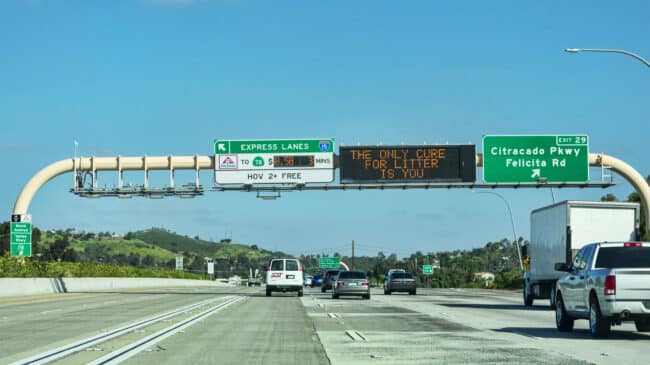
As a result, express toll lanes (ETLs) are expanding in multiple U.S. metro areas. These facilities are grade-separated, limited-access lanes, built alongside existing general-purpose (non-tolled) lanes. The express lanes are dynamically priced to manage demand. The dynamic tolls ensure that the lanes maximize vehicle throughput regardless of the traffic conditions. The toll prices for using these lanes rise based on congestion in the general-purpose lanes and in the managed lanes, ensuring that the express lanes provide consistent travel times. Transit vehicles (as well as carpools in some regions) can use these lanes free of charge, making service speedier and more reliable and increasing person throughput. On many highways, the tolls collected on express lanes can provide a significant portion of the funds needed to build and maintain them.
The first variably priced (based on time-of-day) express lanes were built on State Route 91 in Orange County, California, more than 30 years ago. Inspired by a paper written by Reason Foundation’s Robert Poole, the SR 91 lanes showed that express toll lanes were viable. During the past 20 years, multiple metro areas such as Atlanta, Denver, Los Angeles, Miami, Minneapolis, San Francisco, Seattle, and Washington, D.C., have added express toll lanes to at least one of their major existing freeways. But since variably priced express toll lanes were a new concept, many transportation agencies implemented them on only one or two highways in a region, typically on the freeway with the greatest congestion.
State departments of transportation (DOTs) and metropolitan planning organizations (MPOs) have worked to expand the number of express toll lanes in their regions, but several factors have slowed the expansion. Some transportation departments simply did not have the resources for the projects. In other instances, the projects were planned but not under construction due to delays such as those arising from the environmental review process.
Commuters often use multiple freeways on their journeys and do not receive the full benefit of express toll lanes if they have a reliable travel time on one highway but encounter stop-and-go travel on another. While some of the regions that pioneered express toll lanes have developed robust networks, no region in the country has added these lanes to all feasible highways where right-of-way and construction costs allow additional capacity.
This policy brief starts by providing an overview of the express toll lane concept, government support, and financing tools that help advance express toll lanes.
It details the advantages of express toll lanes over general-purpose and carpool lanes.
Finally, it examines major regions in the country with express toll lanes and details the managed lanes that are currently operated, under construction, and planned. It also recommends additional express toll lane projects where warranted.
It catalogs managed lanes activities in 15 U.S. regions. The regions are Atlanta, Charlotte, Dallas-Fort Worth, Denver, Houston, Los Angeles, Miami-Fort Lauderdale-West Palm Beach, Minneapolis-St. Paul, Nashville, Salt Lake City, San Diego, San Francisco, Seattle, Tampa-St. Petersburg, and Washington, D.C.
Each region is a separate subsection. In each subsection, this analysis does the following:
• Describes the managed lanes in operation;
• Details the managed lanes under construction;
• Explains what expansions are planned for the region; and
• Makes recommendations based on projected growth and economic plans on future expansions.
The report used the Census Bureau definition of combined metropolitan statistical areas (CMSAs) to define regions, since they are based on traffic patterns.
Full report: The value of managed lanes networks