


In This Issue:
Articles, Research & Spotlights
- Rules on How Public Pensions Should Invest in Crypto
- Alaska Could Take on Billions by Rolling Back Reforms
- Florida Lawmakers Should Avoid Adding Pension Costs
- Unfunded Public Pension Liabilities Are a Debt
News in Brief
Quotable Quotes on Pension Reform
Data Highlight
Reason Foundation in the News
Contact the Pension Reform Help Desk
Articles, Research & Spotlights
U.S. Public Pension and Trust Fund Investment in Digital Assets
Bitcoin and other digital assets are gaining prominence among institutional investors, prompting public pension systems to explore investing in these assets for diversification. While Bitcoin is compared to gold as an inflation-sensitive store of value, a new study from the Pension Integrity Project at Reason Foundation warns that most other alternative cryptocurrencies remain too risky for pension portfolios. Many public pension systems already hold over $1 billion in total exposure in crypto, often indirectly through public equities like Coinbase and MicroStrategy. The paper establishes a fiduciary framework that suggests limiting digital asset exposure to between 2% and 10% of total assets. This framework mandates enhanced due diligence, transparent public reporting, and rigorous stress testing to account for extreme market volatility. Ultimately, Reason Foundation’s guidelines aim to help pensions use digital assets as controlled inflation hedges while protecting beneficiaries from unreasonable risk.
Full Study: Pension and Trust Fund Investment in Digital Assets
Frequently Asked Questions About Public Pensions Investing in Bitcoin and Other Digital Assets
Alaska House Bill 78 Would Expose the State to Billions in Additional Costs
A piece of legislation currently under consideration in Alaska, House Bill 78, aims to reinstate defined benefit pensions for new public employees and allow current staff to convert their defined contribution retirement accounts into pension service credits. This would be a major rollback of the state’s previous pension reforms and would introduce significant actuarial risk. Analysis from Reason Foundation’s Pension Integrity Project finds that this proposal could burden the state with over $7 billion in additional costs. This bill also risks a return to the fiscal instability of 2005, when over $8 billion in public pension debt forced the state to close the original pension benefit to new hires.
$7 Billion in Projected Costs of Bringing Back Alaska Pensions
Alaska’s Defined Contribution Plan Is a Better Benefit than a Pension For Most Public Workers
Restoring the Florida Retirement System’s COLA Would Increase Pension Costs, Risk
Florida’s 2011 suspension of pension cost-of-living adjustments (COLAs) was a vital tool in managing skyrocketing costs and steering the state’s pension system toward solvency. Although the state is still working toward fully funding its pension promises, Senate Bill 7028 threatens this progress by reinstating the costly COLA. An actuarial analysis by the Pension Integrity Project estimates that this move could add $14 billion in costs over 30 years. Before moving forward, Florida officials must consider how this legislation might revive the same financial risks and unpredictable taxpayer burdens that the state has spent years trying to resolve.
Public Pension Debt Should Be Scrutinized Like Other Types of Government Debt
Pension obligations promised to public workers are unique in that they are legally backed by the government. Unfunded pension liabilities are fundamentally a form of debt, yet they are rarely treated with the same scrutiny as other government obligations. In a new commentary, Reason Foundation’s Rod Crane notes that public pension liabilities are not legally treated as general obligation-type debt and are not subject to the same safeguards. Given the ironclad legal backing of public pension liabilities, policymakers should consider strong oversight and limits similar to those of general obligations.
News in Brief
Funded Ratios Improve, But Are on Thin Ice
A new report from S&P Global Ratings, “Four U.S. Public Pension Points to Watch In 2026,” projects continued improvement in public pension funded ratios in fiscal year 2026, driven primarily by strong market returns. Average funded ratios have risen to just over 80% as of fiscal 2025, nearly a 10-percentage-point increase since fiscal year 2022. The funding improvement is driven by a recent run of unusually strong investment returns, not by meaningful structural changes.
At the same time, S&P highlights growing exposure to contribution volatility as plans continue to increase allocations to private equity and private debt. Private assets now account for nearly one-fifth of public pension portfolios, up from about 11% a decade ago.
The report also flags emerging cost pressures. Workforce disability rates have risen sharply since 2020, from roughly 3–3.5% of the labor force to about 5%. In addition, S&P warns that political pressure may build to scale back pension reforms as newer cohorts, who bear higher contributions and lower benefits, grow in number and gain governance influence.
S&P expects near-term funding improvements to continue but emphasizes that they rest heavily on favorable market conditions while longer-term fiscal risks, such as riskier asset mixes, demographic trends, and reform reversals, remain unresolved. Read the full report here.
Quotable Pension Quotes
“This is no way to run a government, or if you were running a business…You don’t do things this way. You set aside the money you need for your obligations, and then you determine what’s left over for discretionary spending. The city of Chicago is doing just the opposite. They’ve decided the programs they want to spend on, then they’re trying to figure out ‘how do we find enough money to pay our obligations.’”
–– Illinois State Rep. Dan Ugaste in “Chicago splits pension payments in hopes of improving cash flow,” The Center Square, Jan. 22, 2026.
“We’ve made virtually no progress for the amount of money being spent on that over the last decade.”
–– Alaska State Sen. Bert Stedman in “Alaska House leaders commit to passing pension reform amid concerns from Senate budgeters,” Anchorage Daily News, Feb. 9, 2026.
Data Highlight
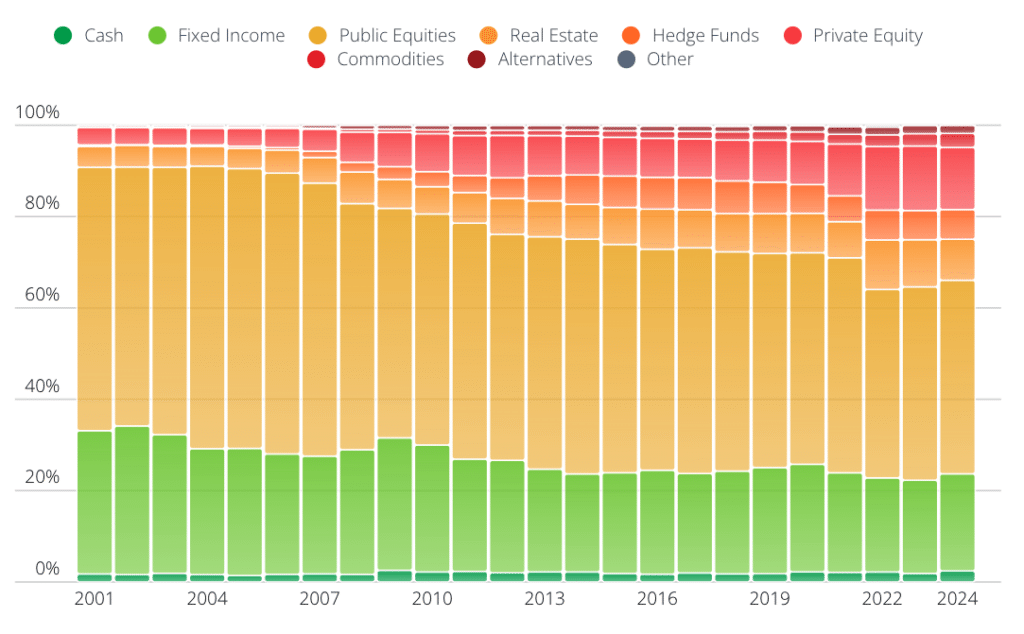
Reason Foundation’s Annual Pension Solvency and Performance Report illustrates changes to the asset allocation of public pension plans. In the early 2000s, public equities and fixed income made up roughly 85-90% of the typical pension portfolio. By 2024, traditional investments had shrunk to approximately 66% of assets. The difference went into alternatives like private equity, real estate, hedge funds, and private credit. Alternative investments used to represent 9% of public pension portfolios in 2001 but now make up 34% of total assets. Read the analysis here.
Reason Foundation in the News
“According to a report from the Reason Foundation, in 2023, Michigan public schools had an average long-term debt of more than $46,000 per student — greater than the national average of more than $26,000.”
—Reason Foundation’s data in “Hillsdale Public Schools Pension Debt Totals $18M,” The Collegian, Jan. 29, 2026.
“It illustrates how squishy all this is…It’s very easy to divest and to back it up with fiscal or fiduciary reasoning — and it’s easy not to as well.”
—Reason Foundation’s Zachary Christensen on political pressure put on pension funds in “NYC May Reinvest in Israel Bonds in Defiance of Mayor Mamdani’s Stance,” Financial Times, Jan. 17, 2026.
“The riskier the investments, the greater the volatility and the greater the downside risk is on the taxpayer,” Frost said.
—Ryan Frost on investment risk in “WA Treasurer Warns State to Pull Back on Private Equity Investments,” The Seattle Times, Jan. 29, 2026.