

I wanted to share Reason Foundation’s “Public Schools Without Boundaries: 2026” report, which is being published today and ranks and grades the open enrollment laws in every state.
These policies, which allow kids to attend the best public schools for them, have helped at least 1.8 million students attend traditional public schools other than their assigned one. Oklahoma, Arkansas, and Idaho have the strongest open enrollment laws, while North Carolina, Maryland, Maine, and Alaska have the worst.
Data show many students use open enrollment policies to escape bullying, enroll in college-level courses, shorten family commutes, or access smaller class sizes. In fact, four of the five studies on open enrollment’s effect on student achievement found statistically significant or null effects. This means that these policies make a real difference to kids in the classroom.
However, open enrollment policies are often only effective at maximizing students’ schooling options when they are well designed. Unfortunately, the Reason Foundation finds that 33 states get F grades for their open enrollment policies, and two more get D grades. As a result, the report finds 39.4 million students, or 80% of students enrolled in public schools, reside in states with weak or ineffective open enrollment laws.
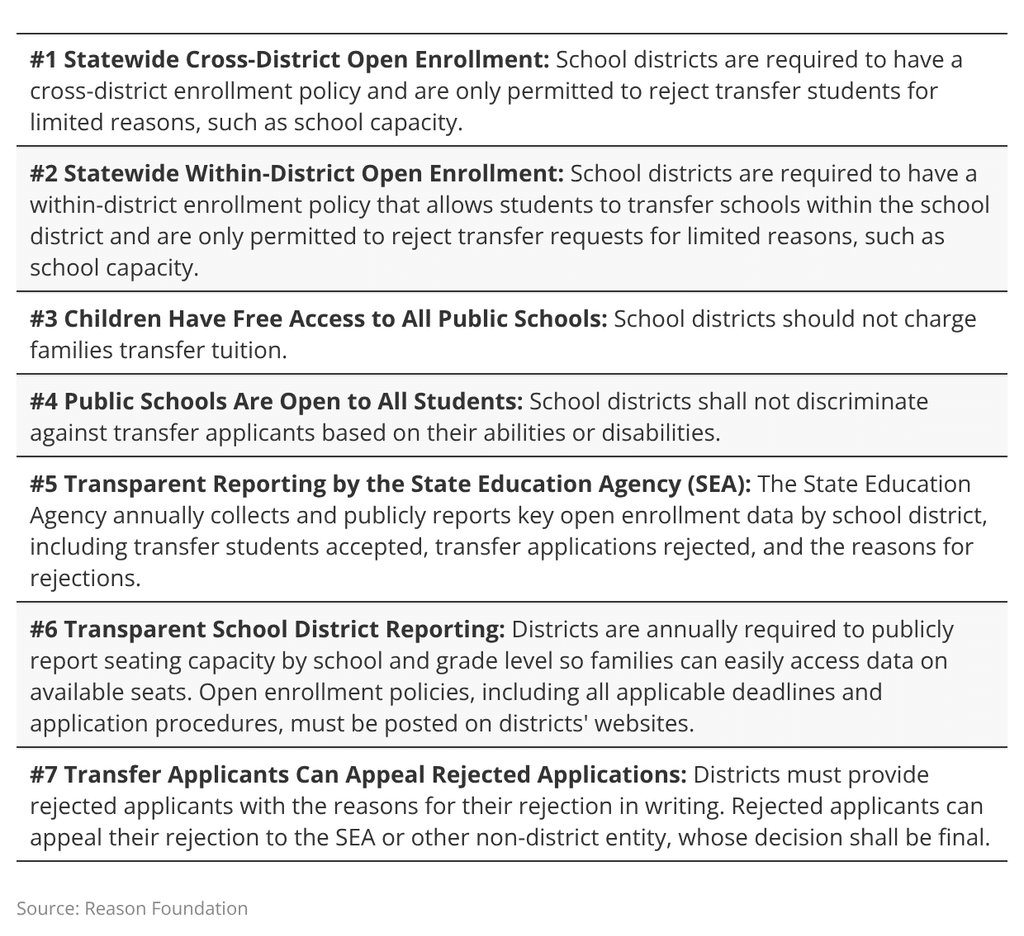
This fifth installment of Reason Foundation’s annual open enrollment study grades and ranks the open enrollment laws in the seven best practices outlined in Table 1. These best practices are essential to building a robust public education system that lets students identify and transfer to the public schools that are best for them.
Overall, my study finds 16 states have strong statewide cross-district open enrollment laws, 17 states have robust statewide within-district open enrollment laws, 28 states make public schools free to all students, 12 states make public schools open to all students, four states must publish transparent open enrollment reports annually, seven states require districts to be transparent about their open enrollment policies and openings, and five states have a robust appeals process for denied transfer applicants.
Disappointingly, no state fully meets all seven best practices. However, Oklahoma and Arkansas meet six out of seven. Idaho and Kansas fully meet five out of seven metrics. Arizona, Florida, Kansas, Nebraska, Utah, and West Virginia fully meet four out of seven metrics.
In the report’s letter grades, six states—Arkansas, Arizona, Idaho, Oklahoma, Utah, and West Virginia—get A grades.
The states receiving B grades are: Florida, Kansas, Colorado, Delaware, Nebraska, South Dakota, and Wisconsin.
Montana and North Dakota received C grades, while California and Iowa received D grades.
Georgia, Michigan, New York, North Carolina, Ohio, Pennsylvania, Texas, and Virginia are some of the states earning F grades.
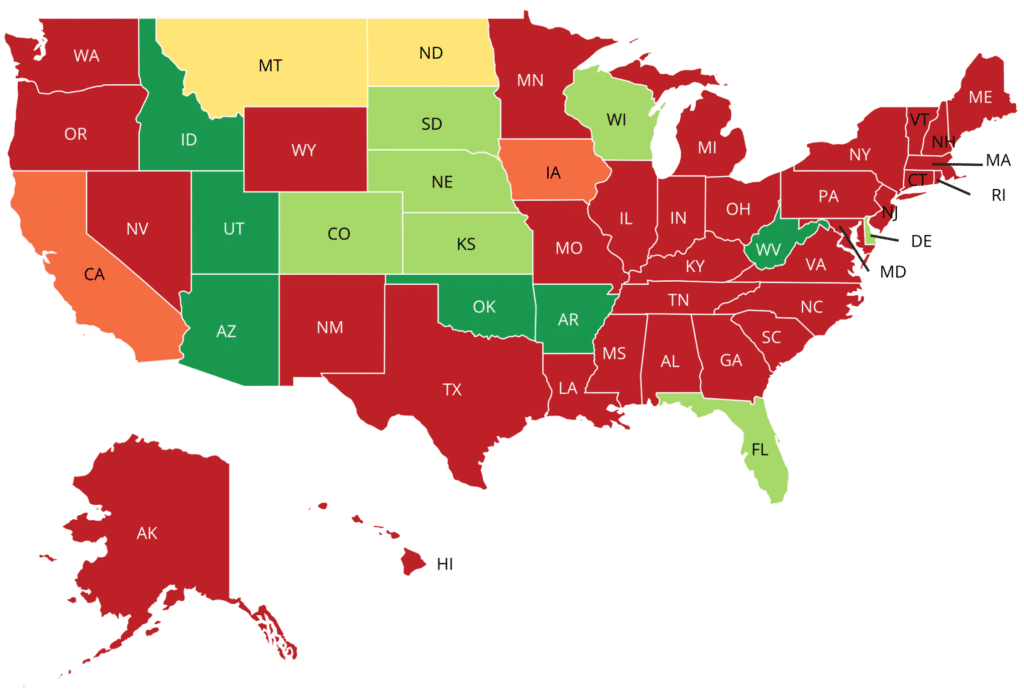
Table 1: Reason Foundation’s seven open enrollment best practices
Compared to previous years, states made modest improvements to their open enrollment laws during 2026. Iowa and Vermont improved their scores by one point, increasing their scores to 67/100 points and 49/100 points, respectively, by strengthening their state-level open enrollment reports.
Iowa, in particular, could easily improve its grade to a B by adopting Reason Foundation’s best practices on transparency and clarifying that districts cannot charge transfer students out-of-pocket tuition.
South Carolina got an F in this report but did improve its open enrollment policy in 2026. The state department of education adopted new regulations governing open enrollment, which reflect some of Reason’s open enrollment best practices, such as statewide open enrollment participation when space is available, ensuring that public schools are open to all students, robust transparency provisions at the state and local levels, and a transparent appeals process for rejected applicants. These regulations are commendable, but they lack the permanence of state law because future administrations can change them, and they fall short of best practices. If these policies were codified in state law, the Palmetto State would score 79/100 points, or a C+ grade, instead of its 37/100 points, an F grade.
At the bottom of the barrel, the open enrollment report finds four states, Alaska, Maine, Maryland, and North Carolina, are in last place, scoring 0/100 points.
Across the country, state lawmakers should strengthen open enrollment laws, especially to help the nearly 40 million students in public schools in states with subpar policies. The best way to do this is to codify statewide cross-district open enrollment policies that ensure all districts participate in open enrollment whenever extra seats are available.
In fact, in 17 states, significantly strengthening cross-district open enrollment policies would boost grades to a C or better.
Similarly, more states should ensure that students can transfer to any public school inside their district with open seats. Nationwide, 33 states don’t guarantee within-district transfer options to families districtwide who pay the same taxes as other residents regardless of their address.
As public schools grapple with declining enrollment and a more competitive education marketplace, they should increase flexibility within the public school system. Stronger open enrollment laws are a straightforward solution because they increase student agency in school selection while keeping students enrolled in public schools.
With nearly three in four parents supporting strong open enrollment laws, state policymakers should update their policies to reflect this demand and make it easier for students to attend schools that are the right fit.
A detailed summary of the study, including rankings and grades for every state and its methodology, is available here.
The full report, Public Schools Without Boundaries: 2026, is available here (PDF).
Previous editions of the study are here.