

The nation’s public schools increasingly recognize that they’ll be educating fewer students and must reform their funding systems and reduce costs in the years ahead.
Since 2020, public school enrollments nationwide have declined by 1.4 million students, according to the federal National Center for Education Statistics. Student counts are unlikely to reverse anytime soon. U.S. births have declined by 18% since 2007. And since the pandemic, many families have chosen homeschooling, charter and private schools over public schools. These trends are leaving many school buildings across the nation increasingly underutilized or vacant.
The latest data from nine of the nation’s 12 largest school districts show that nearly 938,000 seats sat empty during the 2025-26 school year. On average, these school districts only used about 71% of their available space.
The three largest school districts not examined are Clark County, Gwinnett County, and Fairfax County. Data on underused seats for those districts was not immediately available.
Figure 1 shows the number of empty seats and the rate at which the other nine largest districts’ facilities are used.
Figure 1: Empty seats in select large school districts
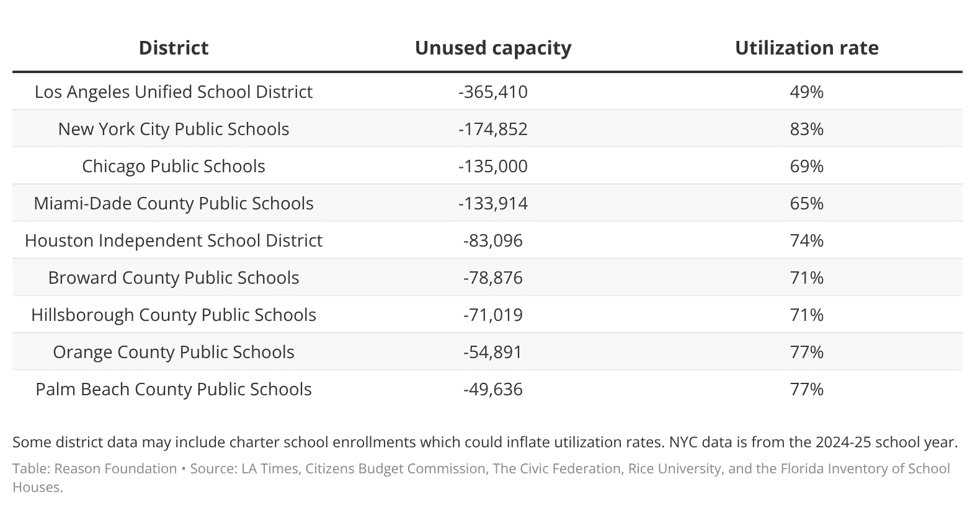
While capacity and utilization measures can vary across districts and states, Figure 1’s data gives a snapshot of how lower student counts are leaving many school facilities empty.
The Civic Federation’s 2025 report on building underutilization identified 50 schools in Chicago Public Schools (CPS), or 11% of the district, as severely underutilized, meaning 33% or less of the school was used. An extreme example of this is CPS’ Frederick Douglass Academy High School, which enrolled just 30 students this year, despite having the space to accommodate 900 students. In extreme cases like this, districts obviously must confront the need to close schools.
Underutilized buildings aren’t limited to Chicago. About 65% of Los Angeles Unified School District’s (LAUSD) 738 schools are enrolled at 60% or less of their available capacity.
Similarly, about one in four Houston Independent School District (HISD) schools use 50% or less of their space, according to Rice University’s Baker Institute for Public Policy.
This can become costly for districts. Half-empty buildings require the same maintenance and upkeep as fully utilized schools, regardless of usage, and districts may be contractually obligated to overstaff them. For instance, Civic Federation President Joe Ferguson said CPS’ contract with the local union requires it to staff Frederick Douglass Academy with 30 employees, creating a 1:1 staff-to-student ratio. Ferguson estimated that this costs CPS at least $94,000 per student, or five times what the district usually allocates per student.
Policies like this don’t best serve students and are untenable for school districts and taxpayers.
To balance their budgets in this new landscape, many districts will need to right-size, trimming payrolls and facilities. However, because layoffs and school closures are so painful, school district administrators often delay decisions as long as possible.
To safeguard taxpayer dollars, state policymakers should adopt policies that steward public funds and increase transparency. Most states aren’t transparent about how many school buildings are underused. States should publish data identifying unused, underutilized or vacant school buildings in every school district.
Moreover, states should eliminate declining enrollment provisions that base education funding on outdated student counts. These policies cost taxpayers more because they fund “ghost students” who have exited the public school system by graduating or enrolling in non-traditional public schools. Education funding should be based on current or prior-year enrollments, ensuring district budgets reflect actual student counts.
Additionally, policymakers can ensure that facilities slated for closure continue to benefit local student populations. Charter schools should be able to purchase, lease, or co-locate in underutilized district school buildings, as they do in Indiana and Florida. Those states offer strong models for maximizing publicly funded infrastructure in ways that benefit school children, regardless of where they go to school.
School closures are difficult for students and communities, but public school enrollment declines and districts’ financial situations are unlikely to improve, so these challenges must be addressed.
From the states
In West Virginia, the State Superintendent of Schools and School Finance Operations Officer shared draft legislation with lawmakers proposing changes to the state funding formula, mainly by adding funds to particular student weights, such as disability, low-income, and English language learners. If codified, the proposal would cost the state $410 million, with funding for students with disabilities accounting for 46%. The draft legislation retains much of the state’s current formula and would introduce a declining-enrollment provision that would cost the state more money.
What to watch
After the midterm elections, some states with private school choice programs could face greater scrutiny from skeptical lawmakers. In Arizona, New Hampshire and Wisconsin, new Democratic-controlled legislative trifectas appear poised to weaken or overhaul existing programs. In Texas, Gov.-elect Gina Hinojosa, once Austin Independent School District Board president, promised in her victory speech to “undo the damage of the Texas voucher scam.”
New Mexico became the latest to opt into the federal tax-credit scholarship program, while Virginia’s Gov. Abigail Spanberger opted out of the program, reversing her predecessor’s (former Gov. Glenn Youngkin) decision to participate.To date, four states have opted out; 31 states have opted in, and 15 states remain undecided. While Arizona is unofficially undecided, Gov. Katie Hobbs vetoed 2026 legislation that would have opted the state into the program.
The latest from Reason Foundation
–States and public school funding systems must adapt to declining student enrollment
–Public schools without boundaries 2026: Ranking every state’s open enrollment policies
–How states can slow the staffing surge and improve teachers’ salaries
–Eight ways to make meaningful K-12 school finance reforms
–Open enrollment laws can benefit students and districts
–How to improve public schools and give tens of millions of families school choice
–California’s public school transfer laws are failing kids, parents and schools
Recommended reading
Lessons from the First Great Enrollment Decline
Parker Baxton at Education Next
“Enrollment statistics, district budgets, and media stories from across the country make clear that 50 years after the first national decline, school districts today have fallen into the same patterns and are making the same mistakes as their predecessors. Having studied the first decline and identified the stages through which any district passes as it struggles with the consequences of fewer students, I have concluded it is not too late for district leaders to learn from those past challenges and adapt to the present reality.”
Empty Desks: Schools and Staffing after the Pandemic
Thomas S. Dee and Jaymes Pyne at Annenberg Exchange
“We find that, in the post-pandemic period when public-school enrollment fell by over 1 million students, the number of operating schools is effectively unchanged while the number of teachers increased. This combination implies average enrollment per school and pupil-teacher ratios declined. One in four public schools currently has enrollment at least 15 percent below its pre-pandemic baseline. Over the same period, pupil-teacher ratios fell by 4 percent. Where closures did occur, they were more common among schools in lower-income neighborhoods, those serving higher concentrations of Black students, and charter schools.”
To Build the Education Systems of the Future, Look to Indianapolis
Brandon Brown at The74
“Here’s the lesson for other cities: Policymakers should pair school-level autonomy with system-level accountability and shared infrastructure. This enables the conditions that make charter schools successful to be replicated across more schools, while ensuring the system writ large becomes sustainable for generations to come. As the country grapples with declining enrollment and increasing school options, will education decisions be driven by a desire to protect the status quo, or will leaders take bold action to create a sustainable system of high-quality public schools? That’s the question education leaders and policymakers in other geographies should be asking themselves.”