
Since 2019, public school enrollments have dropped by 2.8%, or 1.4 million students as of 2024, according to National Center for Education Statistics (NCES) data. Several factors have driven the decline in public school students, including fewer births, shifting migration trends, and a more competitive education marketplace. The latest NCES forecasts project public schools losing an additional 1.3 million students by 2031.
The enrollment trend and forecast are grim news for school districts. Enrollments dropped in all but 10 states from 2019 to 2024. Going forward, school districts in every state will likely have to cut costs, and many will need to close schools to reduce budget deficits related to reduced enrollment and the need to right-size.
Some school districts haven’t considered school closures even when facing significant fiscal strains. For example, Chicago Public Schools (CPS) has lost about 39,000 students since 2019, an 11% drop and faces a projected $732 million budget shortfall in 2027.
Despite these problems, CPS imposed a moratorium on school closures from 2024 until the 2027-28 school year. Moreover, CPS scrapped plans to cut 1,000 positions, banking on increased state funding to balance its budget. This uncertainty led CPS Superintendent Macquline King to announce that CPS’ 2026-27 school year may not start on time later this month.
“As it stands right now, though, we do not know if we will be able to secure the short-term financing needed to pay our employees in September, which would effectively shut down the district just as staff and students are set to return,” King wrote in an email to families.
Similarly, the Los Angeles Unified School District (LAUSD), whose fall 2024 enrollment dropped by almost 71,000 students, or 16% compared to fall 2019, hasn’t closed any schools since the enrollment losses started. Even though LAUSD faces a projected $1.5 billion budget deficit in fiscal year 2027, it continues to hire more staff to support an ever-shrinking K-12 population.
However, some districts are finally facing the inevitable, albeit reluctantly. For instance, Houston Independent School District, which was taken over by the state in 2023, has closed 12 schools, a 4.4% reduction, this year. The closures are estimated to save $14 million to $20 million. If the district hadn’t closed these facilities, they could have also cost it $400 million in needed upgrades and renovations.
At least 14 school districts, including Houston, across eight states have announced school closures this year, according to K12 Dive. Figure 1 summarizes these school closures, their potential savings, and the school districts’ declining enrollments since 2019, according to K12 Dive.
Figure 1: The impact of 2026 school closures
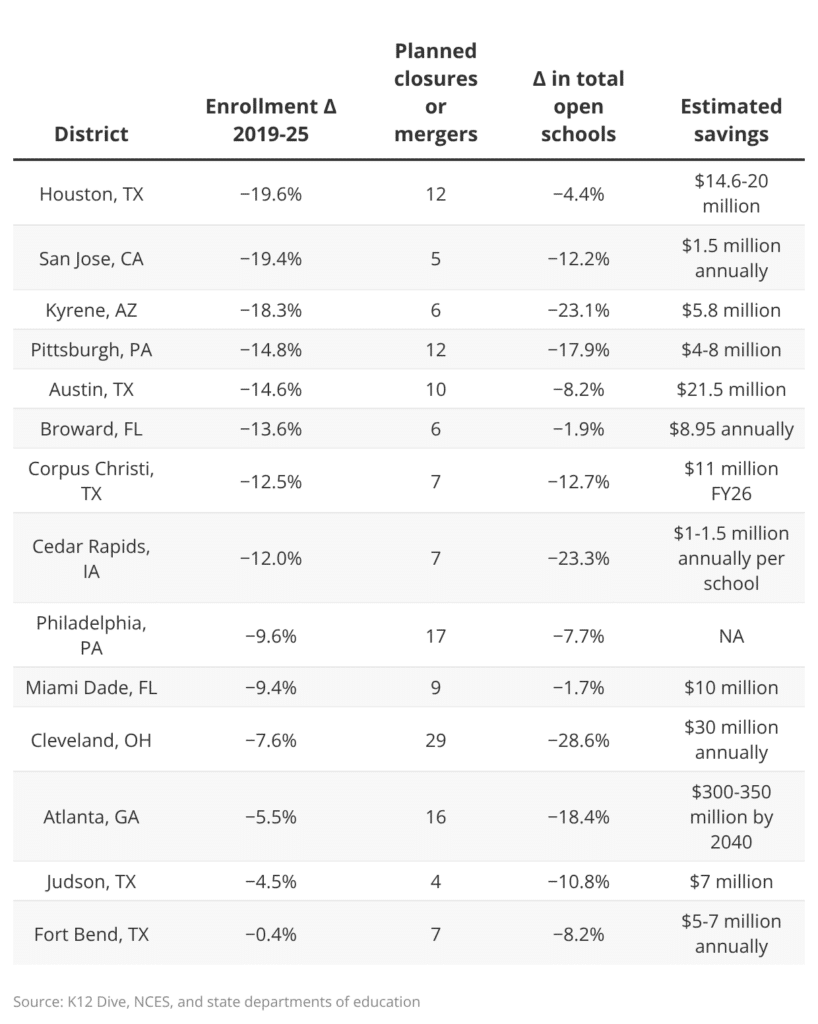
Often, public school closures occur only after districts delay them as long as possible. For example, Cleveland Metropolitan School District (CMSD) will shutter 29 schools during the 2026-27 school year, a 29% reduction districtwide. While this is a much-needed step in the right direction, 45% of the district’s enrollment losses had occurred by 2021, which means many of the school closures were overdue
Many school districts likely put off closures by using temporary federal relief funds and temporary state-level protections related to the COVID-19 pandemic to backfill their budgets. For instance, after Elementary and Secondary School Emergency Relief funds expired in 2024, Cleveland forecast a “2-year negative cash balance of $168 million,” but the district picked up the cost.
The influx of relief funding and tactics like these help explain why national school closure rates for traditional public schools between 2014 and 2024 were at their lowest since the pandemic’s onset, according to a 2025 study published by the IZA Institute of Labor and Economics.
However, some districts are taking declining enrollment projections seriously and acting more quickly. For example, student counts in Texas’ Fort Bend ISD declined by only 0.4% between 2019 and 2025, but the district estimated that it will lose additional students during the 2026-27 school year. Accordingly, the district closed seven schools–an 8% reduction in Fort Bend’s schools–resulting in an annual $5.7 million in savings. An upcoming Reason Foundation study finds that Fort Bend ISD is the most fiscally-stressed school district in the country, which makes taking these steps quickly even more important.
Students affected by Fort Bend’s closures are guaranteed open enrollment, letting them choose a new public school within the district. This is similar to a new Utah law that gives students affected by school closures three months to transfer to any public school with open seats.
Enrollment trends make it clear that many school districts will need to close schools. When they do, districts should embrace open enrollment policies to strengthen the public system. Increasing student agency in school selection can increase families’ support for public schools.
What to watch
As mentioned above, three of the nation’s largest public school districts are navigating significant budget crises as we head into the school year.
Los Angeles Unified School District, the nation’s second-largest school district, faces a possible takeover by Los Angeles County if it fails to get its finances in order. Governing reported that LAUSD could be insolvent by the end of 2027, potentially “falling $231 million into the red and unable to make payroll.” This funding shortfall is partially due to recent union negotiations that increased employee wages by $1 billion annually. The county has appointed a financial expert to help LAUSD identify options for reducing its shortfall. This is the first of three possible stages required by state law. If initiated, the second stage would allow a financial advisor to prevent LAUSD from increasing spending, while the third stage would initiate a county takeover of the district. However, Los Angeles County Superintendent of Schools Debra Duardo stated she’s confident that LAUSD will implement the necessary measures to avoid a county takeover.
Similarly, the country’s fourth-largest district, Chicago Public Schools, rejected plans backed by Chicago Mayor Brandon Johnson for major staff layoffs to balance its budget, which is already $146 million short, per Axios’ reporting. Instead, CPS approved plans supported by the Chicago Teachers Union, hoping the Illinois legislature will cover CPS’ costs with $150 million in uncommitted state funds.
Meanwhile, the sixth-largest school district, Florida’s Broward County Public Schools (BCPS), announced enrollment projections forecasting an 11% decline in student counts between the 2026-27 and 2030-31 school years, totaling almost 28,000 students. Compared to pre-pandemic enrollments from the fall of 2019, the district could lose 24% of its student population over about a decade. In response to these losses and a corresponding $90 million budget deficit, BCPS eliminated 700 unfilled positions and 300 jobs. Moreover, the district is considering repurposing empty school buildings to generate new revenue, according to a WPLG TV Local10 News report. Proposed solutions include renting out the district’s administrative office space in downtown Fort Lauderdale, moving staff into empty school buildings, and repurposing one of its closed high schools as a training facility for local fire and police departments.
The Latest from Reason Foundation
–Bureaucratic Hurdles Shouldn’t Prevent Giving Students More Public School Choice
Recommended reading
Contrary to Common Belief, The Poorest School Districts Outspend The Wealthiest
Amanda Geduld in The74
“There’s a prevailing principle in the U.S. that funding disparities are at the root of education inequality, with poorer districts receiving less money than their wealthier counterparts. But a recent study has actually found the opposite, documenting that over the past nearly 50 years high-poverty and predominantly non-white districts across all 50 states actually spent more per student on average.”
Parental Choice Is Sending Public Schools a Message. Are They Listening?
Anna J. Egalite in Education Next
“West Virginia Board of Education President Paul Hardesty recently put the new reality plainly: Public schools are “competing for enrollment, whether we want to believe it or not.” The only viable response, he argued, is to become “more accommodating, more receptive and more accessible to parents and students.” That is exactly the right mindset. And to become more responsive, public schools need better information about why families are leaving and what they are seeking instead.”
Why Other States Should Take Notice of Indy’s Education Alliance
Rep. Bob Behning at CharterFolk
“These reforms are about more than governance. They are designed to strengthen student outcomes by ensuring every public school has the resources, support, and accountability needed to succeed. One way [Indianapolis Public Education Corporation] will accomplish this is by making decisions regarding the allocation and closure of school facilities through the lens of each school’s academic performance and financial stability with the ultimate goal of building a flexible and accountable system of schools delivering academic excellence.”