



The opioid settlement funds represent one of the largest pools of public funding ever made available to address a single public health crisis. Over the next 15 to 18 years, states and municipalities will receive over $50 billion to address opioid-related harms by expanding addiction treatment, prevention, and recovery services.
How can this temporary resource be used to produce durable change, rather than a temporary expansion of state and local programs that collapse when funding ends?
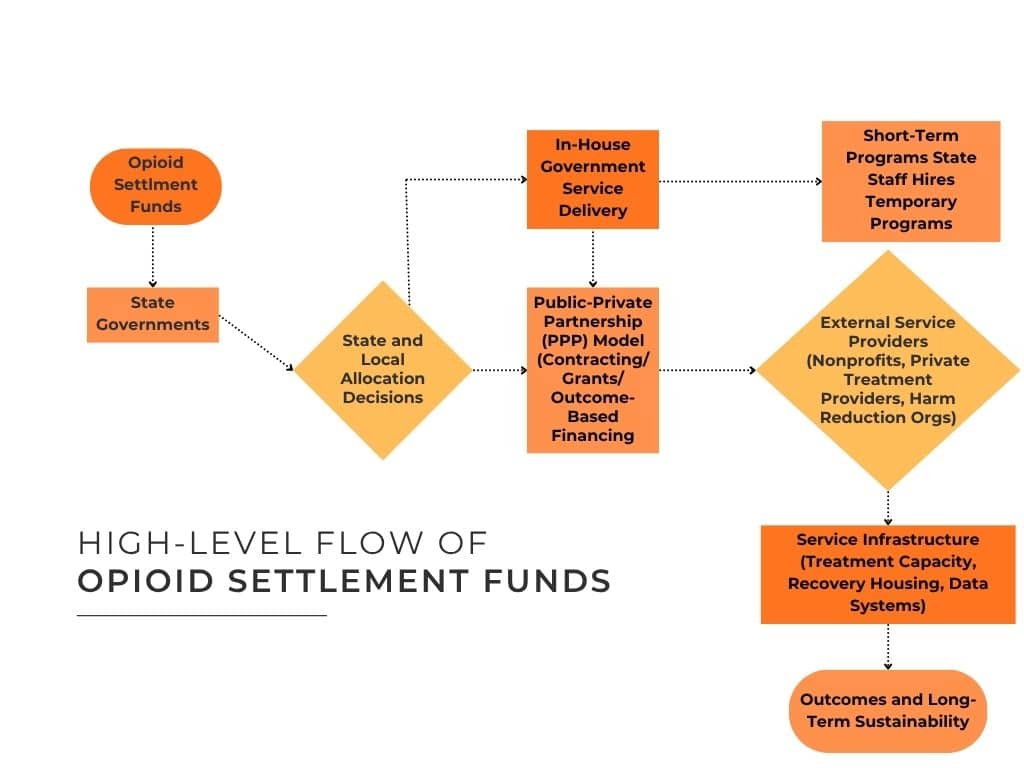
When opioid settlement funds are used to fund services that are provided “in-house”—that is, state and local governments provide them with their own staff and purchase supplies directly—governments miss an opportunity to strengthen local service infrastructure that can continue operating after the settlement funds expire. Prioritizing external providers through competitive grants, performance-based contracts, or other procurement mechanisms can lead to better results and support independent local organizations and businesses that can outlive the settlement fund.
Planning for drought
The effectiveness of settlement spending depends as much on how funds are deployed as on where they are spent—especially given that the funds are temporary and scheduled to decline annually, when accounting for inflation.
Opioid settlement funds are mostly used to provide labor-intensive services such as addiction treatment and recovery services, harm-reduction efforts, overdose prevention (including naloxone distribution) programs, data collection, planning, and coordination activities.
In-house service provision can be a trap because it offers no viable alternative once funds run out. Their temporary nature means people are hired into positions that cannot be sustained. As settlement payments decline, state and local governments must choose between either service reductions or replacing settlement dollars with their own funds. External providers, however, could use the settlement funding to launch or expand services and then transition those programs to other revenue sources such as philanthropy or state contracts.
Opioid settlement funds as catalytic capital
By prioritizing private service providers, settlement funds can serve as catalytic capital—investments that accept higher risks or lower returns to achieve positive societal impact. In this way, the settlement can be used not only to fund services but also to absorb early-stage risks and support experimentation by local philanthropic or for-profit organizations.
For nonprofit providers, access to this initial capital can also open the door to matching grants and philanthropic support from local foundations, businesses, and individual donors, emboldened by the knowledge that they aren’t funding these ventures on their own. Organizations that grow past the startup phase and demonstrate effective service delivery will be better positioned to raise additional funding and continue serving the community long after settlement contracts expire.
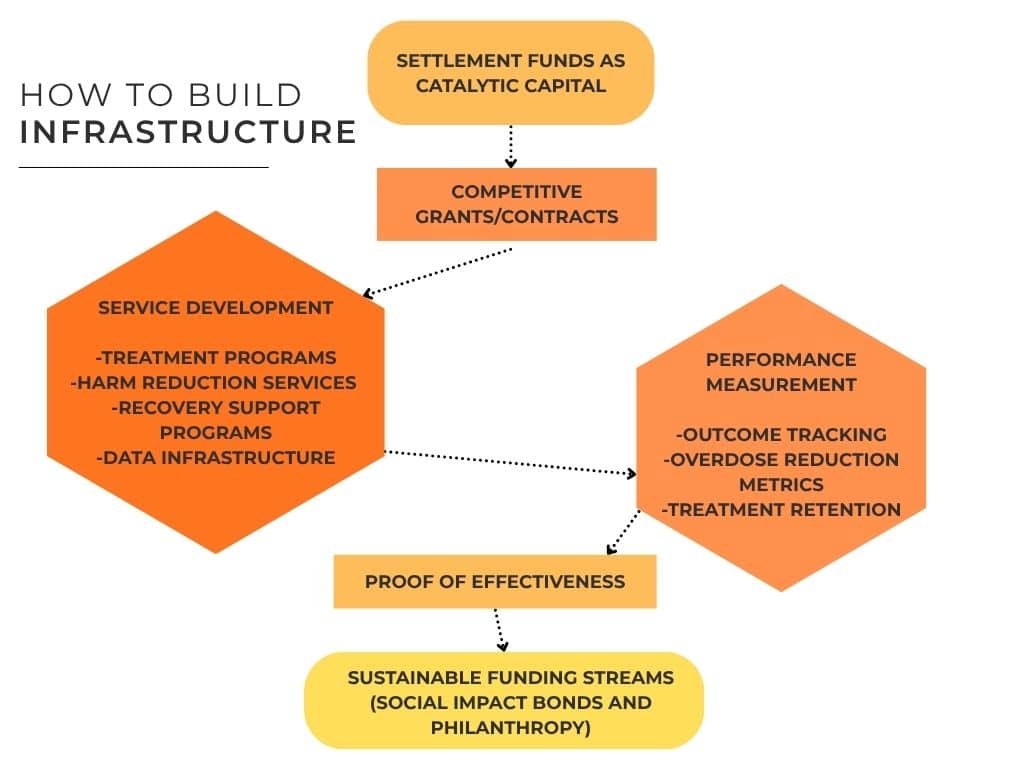
Outsourced services are likely to be more affordable and of higher quality. This is because, unlike in-house service provision, external providers are naturally disciplined through competition. Competitive procurement allows governments to compare costs, approaches, and performance. Periodically, poorly performing providers can be replaced, and funding can be redirected to organizations/treatments that have been demonstrated to deliver the best results.
Contracting also creates space for experimentation. There is no single intervention that works equally well across all communities or populations. By funding multiple providers and approaches, governments can learn what works in practice and adapt over time. Programs that prove effective can be expanded, while resources can be redirected away from those that do not deliver results.
Outsourcing also leverages local knowledge that centralized public agencies often lack. Independent providers are typically embedded in the communities they serve and are better positioned to respond to regional and cultural factors that shape service effectiveness.
Designing good partnerships
The efficacy of outsourcing is contingent on its design. The usual challenges that plague in-house government provision—weak incentives for improvement and innovation, limited accountability, and institutional rigidity—can easily be transposed to its contractors.
Good partnerships must mimic the market processes. The bidding opportunity should be well-advertised to ensure the strongest recipients receive these funds. All business forms and ownership structures should be eligible to bid, including both for-profit and nonprofit providers. The partnership must entail clear rules and well-defined accountability mechanisms.
A multitude of goals should be weighed. The purpose is not to subsidize organizations; it is to reduce opioid overdose and dependency within a community. Clear deliverables and performance expectations should be set, and recipients should be held accountable through periodic reporting, renewal decisions, and (where feasible) outcome-based payments.
Ideally, settlement fund recipients would be held accountable for outcomes, not tasks—for example, reducing overdoses in a jurisdiction rather than just counting the number of naloxone kits distributed. But that form of accountability is not always possible. One method to implement outcome-based financing is social impact bonds, in which private investors provide upfront capital for services and are repaid by the government only if predefined, measurable outcomes are achieved. These kinds of arrangements work best when success can be clearly measured.
Another important consideration is oversight. States should require standardized financial reporting for recipients of opioid settlement funds, along with independent audits and clear remedies for noncompliance. Contractors should be free to experiment, but not to misappropriate funds for unrelated purposes. Guardrails should focus on preventing supplantation, conflicts of interest, and inefficient “check-the-box” spending that fails to create meaningful change.
At the same time, effective oversight requires governments to build the capacity to manage external contracts. Monitoring contractor performance, evaluating results, and adjusting agreements over time requires a different skill set than managing in-house employees, and states should invest in the systems and expertise needed to do this well.
For example, Massachusetts’ Pay for Success supportive housing initiative demonstrates how performance-based public–private partnerships can align incentives around measurable outcomes. Launched in 2015, the program used private investment and philanthropic capital to expand permanent supportive housing for people experiencing long-term homelessness with disabling medical or behavioral health conditions. Providers ultimately housed 1,055 individuals across Massachusetts, and 85 percent of participants either remained in stable housing or exited the program positively, a key performance metric used to evaluate success. The program also produced measurable system-level effects. Participants in supportive housing had $5,267 lower average annual health-care costs compared with a similar homeless population, while shifting away from emergency and acute care toward more appropriate outpatient services. These outcomes demonstrate how outcome-based contracts and cross-sector partnerships can improve housing stability, reduce public costs, and better align service delivery with measurable public goals.
The opioid settlement funds are a unique opportunity to strengthen the local treatment and recovery infrastructure that communities will rely on long after the settlement payments end. By strategically prioritizing external service providers, state and local governments can help independent organizations launch or expand programs that can later be sustained through other revenue streams. Done well, this approach can stimulate the growth and creation of both for-profit and nonprofit organizations that use the track record, expertise, and community trust developed during the settlement period to remain viable long after the funds expire.