

The White House Office of Management and Budget’s Office of Information and Regulatory Affairs (OIRA) finally published on Sept. 4 the Spring 2025 edition of the Unified Agenda of Regulatory and Deregulatory Actions that had been due in April, as required by the Regulatory Flexibility Act (5 U.S.C. § 602(a)). The Unified Agenda is the biannual snapshot of the federal administrative state and tracks the thousands of regulatory actions across hundreds of agencies. While imperfect in many ways, it does provide some valuable insight into forthcoming federal agency actions.
The Spring 2025 edition marks the first Unified Agenda publication of the second Trump administration. Like past presidents, President Donald Trump immediately issued a customary “regulatory freeze” of all federal rulemaking activities to allow new agency leadership to evaluate the regulations being developed by their predecessors.
The Trump administration has also been aggressive in its issuance of executive orders, and two in particular are relevant to the federal regulatory enterprise: EO 14192 (2025), “Unleashing Prosperity Through Deregulation,” and EO 14219 (2025), “Ensuring Lawful Governance and Implementing the President’s ‘Department of Government Efficiency’ Deregulatory Initiative.”
EO 14192 orders regulatory agencies to identify 10 existing regulations for repeal whenever they consider promulgating a new regulation. This 10-out, one-in regulatory budget also contains a directive that, to the extent permitted by law, any new incremental costs of a new regulation be offset by the elimination of existing costs associated with at least 10 prior regulations.
Having been tasked with implementing ambitious regulatory budgeting, EO 14219 provides agencies with specific deregulatory targets. It directs agencies to identify regulations that are unconstitutional or pose “serious constitutional difficulties,” based on unlawful delegations of statutory power, go beyond the “best reading” of the statute, implicate significant matters not clearly authorized by Congress, impose significant costs on private parties not outweighed by public benefits, harm the national interest, or impose undue burdens on small businesses and entrepreneurs. Following agency review, identification, and categorization of the offending rules, agencies are to consult with OIRA to develop a “Unified Regulatory Agenda” to rescind or modify these regulations.
In its Spring 2025 Unified Agenda preamble, the U.S. Department of Transportation states that it has “taken actions to ensure that all Departmental policies align with the Administration’s policies.”
With respect to regulatory policy, it highlights, “Ensuring Reliance upon Sound Economic Analysis in Department of Transportation Policies, Programs, and Activities,” Department Order 2100.6B, “Policies and Procedures for Rulemakings,” and a memo from the Department’s Office of General Counsel on “Review and Clearance of Guidance Documents.”
Each of these policies is deregulatory in character, and together they suggest that the Department of Transportation is taking seriously its orders from the president.
I previously examined the transportation rulemakings contained in Fall 2024, Spring 2024, Fall 2023, Spring 2023, Fall 2022, Spring 2022, Fall 2021, Spring 2021, and Spring 2020 editions of the Unified Agenda for Reason Foundation. From a historical perspective, Figure 1 below shows that the current volume of regulatory activity at the U.S. Department of Transportation is unprecedented, exceeding the previous record number of newly published rulemaking projects set in Spring 1996 by nearly 50%.
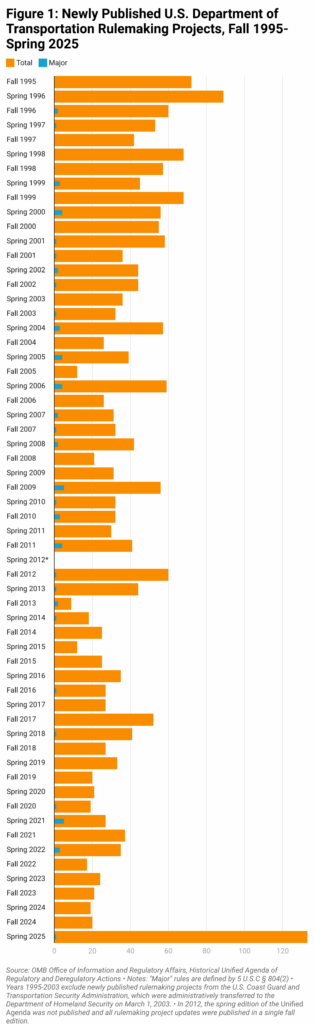
The Spring 2025 Unified Agenda lists 291 active rulemaking projects at the U.S. Department of Transportation. Of those 291, 133 are new rulemaking projects first published in the Spring 2025 edition. These new rulemaking projects are listed in Table 1 at the bottom of this article.
The Unified Agenda contains rules determined to be “significant regulatory actions,” or “economically significant” rules, which had been defined by EO 12866 (1993) as regulations that would have an annual impact on the economy of $100 million or more, or otherwise “adversely affect in a material way the economy, a sector of the economy, productivity, competition, jobs, the environment, public health or safety, or State, local, or tribal governments or communities.” Rules deemed economically significant are subject to greater scrutiny, most notably a requirement that agencies conduct a benefit-cost analysis of the proposed regulation.
With the changes brought by EO 14094 (2023), the annual cost threshold for a rule to be considered a “significant regulatory action” doubled to $200 million, and that threshold will be adjusted every three years for “changes in gross domestic product.” This adjustment was made in Section 3(f)(1) of the 2023 EO. A discussion of the rationale and implications of this change can be found in my review of the Fall 2023 edition of the Unified Agenda.
One important implication is that EO 14094 made historical comparisons of the stock and flow of “economically significant rules” more challenging. Fortunately, as part of the Congressional Review Act, Congress itself requires a separate “major” rule designation that retains the traditional $100 million threshold (5 U.S.C. § 804(2)(A)), allowing for continued like-for-like historical accounting.
Figure 1 preserves the traditional cost threshold by counting “major” rules instead of “economically significant” rules. While Trump revoked EO 14094 (2023) as part of EO 14148 (2025) and thereby restored the traditional $100 million cost threshold for “economically significant” rules, we have continued to count “major” rules to ensure continuity. There are currently 12 “major” rules under development at the Department of Transportation. Of the 133 new rulemaking projects that first appeared in the Spring 2025 edition of the Unified Agenda, only one has been designated a “major” rule. However, 34 have a “major” status listed as “undetermined,” meaning they could be later designated as “major” rules as they move through the rulemaking process and economic costs are estimated.
Transportation deregulation in the second Trump term
Given that Trump signed an executive order titled “Unleashing Prosperity Through Deregulation,” it should perhaps not be surprising that the U.S. Department of Transportation has categorized many of its newly announced rulemaking actions as “deregulatory.” That order, EO 14192, established a regulatory budget, which necessitates the categorization of rules as “regulatory” or “deregulatory.” OIRA issued a memo in March 2025 providing guidance on this process. According to the Spring 2025 Unified Agenda, of the Department of Transportation’s 133 newly announced rulemaking projects, 119 are categorized as “deregulatory,” with the remainder being categorized as “fully or partially exempt,” “not subject to, not significant,” or “other.”
Some of DOT’s deregulatory actions involve rescinding existing rules, such as the forthcoming proposed rule from the Federal Aviation Administration that would eliminate the regulatory prohibition on overland supersonic flight (2120-AM15). Others would amend existing regulations to enable new technologies, such as the National Highway Traffic Safety Administration’s planned modernization of Federal Motor Vehicle Safety Standards 102 (2127-AM72), 103 and 104 (2127-AM71), and 108 (2127-AM70) to accommodate automated driving systems. And still others focus more on what could be called regulatory hygiene by removing obsolete requirements and unnecessary language that naturally accumulates over time, such as a recently issued proposed rule to eliminate a reference to a program that was terminated in 1998.
What this shows is that DOT is likely to pursue an aggressive deregulatory agenda, broadly construed. This makes sense given the presidential requirement of 10 deregulatory actions for every regulatory action. Agencies will have a strong incentive to find deregulatory actions, however inconsequential in terms of economic impact, to demonstrate compliance with the executive order.
Yet, the other component of this new regulatory budgeting—that the costs of a new regulation be offset by the costs associated with at least 10 other regulations that would be eliminated—is likely to focus DOT on bigger-ticket items. Thus, the size of the cost savings identified in benefit-cost analyses included in the regulatory impact assessments that accompany “significant” rules will determine the internal political success of this deregulatory effort. But the quality of those benefit-cost analyses will determine this deregulatory effort’s economic success, which is ultimately what matters, and that will need to be a key focus of those seeking to realize actual reforms.
Table 1: U.S. Department of Transportation Rulemaking Projects First Published in the Spring 2025 Unified Agenda
| Agency | Stage of Rulemaking | Title | RIN |
|---|---|---|---|
| OST | Proposed Rule | Administrative Rulemaking, Guidance, and Enforcement Procedures | 2105-AF32 |
| OST | Proposed Rule | Disadvantaged Business Enterprise and Airport Concession; Disadvantaged Business Enterprise Program Implementation Modifications | 2105-AF33 |
| OST | Proposed Rule | Increasing Flexibility on Disclosure of Airline Ancillary Fees | 2105-AF34 |
| OST | Proposed Rule | Airline Refunds and Other Consumer Protections III | 2105-AF36 |
| OST | Proposed Rule | Enhancing Flexibility of Air Fare Price Advertising | 2105-AF37 |
| OST | Proposed Rule | Amendment to the Railroad Rehabilitation and Improvement Financing Program and Transportation Infrastructure Finance and Innovation Act Program Regulations | 2105-AF40 |
| OST | Final Rule | Amendments to Procedures in Regulating and Enforcing Unfair and Deceptive Practices | 2105-AF38 |
| OST | Final Rule | Revisions to Civil Penalty Amounts, 2026 | 2105-AF39 |
| FAA | Prerule | Use of Certain Restricted Category Aircraft for the Transport of Firefighters for Wildfire Suppression | 2120-AM13 |
| FAA | Proposed Rule | Prohibition of Remote Dispatch | 2120-AM10 |
| FAA | Proposed Rule | Sport Pilot Practical Test Standards Alignment | 2120-AM12 |
| FAA | Proposed Rule | Enabling Supersonic Overland Flight | 2120-AM15 |
| FAA | Final Rule | Miscellaneous Technical Amendments | 2120-AM11 |
| FAA | Final Rule | Flight Restrictions at Ronald Reagan Washington National Airport | 2120-AM14 |
| FHWA | Proposed Rule | Rescinding Requirements Regarding Geodetic Markers | 2125-AG28 |
| FHWA | Final Rule | Rescinding Requirements Regarding Bridges on Federal Dams | 2125-AG18 |
| FHWA | Final Rule | Rescinding Requirements Regarding Required Contract Provisions for Federal-aid Construction Contracts (Other than Appalachian Contracts) | 2125-AG19 |
| FHWA | Final Rule | Rescinding Requirements Regarding the Forest Highway Program | 2125-AG20 |
| FHWA | Final Rule | Rescinding Regulations Regarding Management Systems Pertaining to the National Park Service and the Park Roads and Parkways Programs | 2125-AG21 |
| FHWA | Final Rule | Rescinding Regulations Regarding Management Systems Pertaining to the Forest Service and the Forest Highway Program | 2125-AG22 |
| FHWA | Final Rule | Rescinding Regulations Regarding Management Systems Pertaining to the Fish and Wildlife Service and the Refuge Roads Program | 2125-AG23 |
| FHWA | Final Rule | Rescinding Regulations Regarding Management Systems Pertaining to the Bureau of Indian Affairs and the Indian Reservation Roads Program | 2125-AG24 |
| FHWA | Final Rule | Rescinding Regulations on Procedures for Advance Construction of Federal-aid Projects | 2125-AG26 |
| FHWA | Final Rule | National Performance Management Measures; Rescinding Requirements for the First Performance Period | 2125-AG27 |
| FMCSA | Proposed Rule | Clarification to the Applicability of Emergency Exemptions | 2126-AC77 |
| FMCSA | Proposed Rule | Fees for Use of the Commercial Driver’s License Information System (CDLIS) | 2126-AC78 |
| FMCSA | Proposed Rule | Parts and Accessories Necessary for Safe Operation; Retroreflective Sheeting on Semitrailers and Trailers | 2126-AC82 |
| FMCSA | Proposed Rule | Parts and Accessories Necessary for Safe Operation; Spare Fuses | 2126-AC83 |
| FMCSA | Proposed Rule | Parts and Accessories Necessary for Safe Operation; Liquid-Burning Flares | 2126-AC84 |
| FMCSA | Proposed Rule | Removal of Self-Reporting Requirement | 2126-AC85 |
| FMCSA | Proposed Rule | Removal of Obsolete References to “Water Carriers” | 2126-AC86 |
| FMCSA | Proposed Rule | Qualifications of Drivers; Vision Standards Grandfathering Provision | 2126-AC87 |
| FMCSA | Proposed Rule | Rescinding the Requirement for Electronic Logging Device Operator’s Manual Located in Commercial Motor Vehicles | 2126-AC88 |
| FMCSA | Proposed Rule | Electronic Driver Vehicle Inspection Reports | 2126-AC89 |
| FMCSA | Proposed Rule | Driver Vehicle Examination Report Disposition Update | 2126-AC90 |
| FMCSA | Proposed Rule | Parts and Accessories Necessary for Safe Operation; Fuel Tank Overfill Restriction | 2126-AC91 |
| FMCSA | Proposed Rule | Commercial Driver’s License Standards; Requirements and Penalties: Applicability to the Exception for Certain Military Personnel | 2126-AC92 |
| FMCSA | Proposed Rule | Parts and Accessories Necessary for Safe Operation; Brakes on Portable Conveyors | 2126-AC93 |
| FMCSA | Proposed Rule | Parts and Accessories Necessary for Safe Operation; Auxiliary Fuel Tanks | 2126-AC94 |
| FMCSA | Proposed Rule | Accident Reporting: Modification to the Definition of the Term “Medical Treatment” | 2126-AC95 |
| FMCSA | Proposed Rule | Parts and Accessories Necessary for Safe Operation; License Plate Lamps | 2126-AC96 |
| FMCSA | Proposed Rule | Parts and Accessories Necessary for Safe Operation; Tire Load Markings | 2126-AC97 |
| FMCSA | Final Rule | Parts and Accessories Necessary for Safe Operation; Certification and Labeling Requirements for Rear Impact Protection Guards | 2126-AC81 |
| NHTSA | Proposed Rule | Amendments to FMVSS No. 127; Light Vehicle Automatic Emergency Braking | 2127-AM69 |
| NHTSA | Proposed Rule | Modernization of FMVSS 108 to accommodate ADS | 2127-AM70 |
| NHTSA | Proposed Rule | Modernization of FMVSS 103 and FMVSS 104 to accommodate ADS | 2127-AM71 |
| NHTSA | Proposed Rule | Modernization of FMVSS 102 to accommodate ADS | 2127-AM72 |
| NHTSA | Proposed Rule | Uniform Procedures for State Highway Safety Grant Programs | 2127-AM73 |
| NHTSA | Proposed Rule | Corporate Average Fuel Economy Standards Amendment | 2127-AM76 |
| NHTSA | Proposed Rule | Response to Petitions for Reconsideration, Seat Belt Warning Systems | 2127-AM80 |
| NHTSA | Proposed Rule | Removing Obsolete Directives from Phase-In Reporting Requirements | 2127-AM82 |
| NHTSA | Proposed Rule | Removing Obsolete Procedures from the Consumer Assistance to Recycle and Save Act of 2009 | 2127-AM83 |
| NHTSA | Proposed Rule | Federal Motor Vehicle Safety Standard No. 204; Steering Control Rearward Displacement | 2127-AM84 |
| NHTSA | Proposed Rule | Federal Motor Vehicle Safety Standards No. 205, Glazing Materials; No. 205(a), Glazing equipment manufactured before September 1, 2006 and glazing materials used in vehicles manufactured before Nov | 2127-AM85 |
| NHTSA | Proposed Rule | Federal Motor Vehicle Safety Standards No. 206; Door Locks and Door Retention Components | 2127-AM86 |
| NHTSA | Proposed Rule | Federal Motor Vehicle Safety Standards No. 207; Seating systems | 2127-AM87 |
| NHTSA | Proposed Rule | Federal Motor Vehicle Safety Standard No. 210; Seat Belt Assembly Anchorages | 2127-AM88 |
| NHTSA | Proposed Rule | Federal Motor Vehicle Safety Standards No. 214, Side impact protection | 2127-AM89 |
| NHTSA | Proposed Rule | Federal Motor Vehicle Safety Standards; No. 216, Roof Crush Resistance; Applicable Unless a Vehicle is Certified to Section 571.216a; and No. 216a, Roof Crush Resistance; Upgraded Standard | 2127-AM90 |
| NHTSA | Proposed Rule | Federal Motor Vehicle Safety Standard No. 217; Bus Emergency Exits and Window Retention and Release | 2127-AM91 |
| NHTSA | Proposed Rule | Federal Motor Vehicle Safety Standards No. 222; School Bus Passenger Seating and Crash Protection | 2127-AM92 |
| NHTSA | Proposed Rule | Removing Obsolete Regulatory Text From Federal Motor Vehicle Safety Standards No. 301, Fuel System Integrity | 2127-AM93 |
| NHTSA | Proposed Rule | Removing Obsolete Regulatory Text From Federal Motor Vehicle Safety Standards No. 303, Fuel System Integrity of Compressed Natural gas Vehicles | 2127-AM94 |
| NHTSA | Proposed Rule | Removing Obsolete Regulatory Text From Federal Motor Vehicle Safety Standard No. 304, Compressed Natural Gas Fuel Container Integrity | 2127-AM95 |
| NHTSA | Final Rule | Response to Petitions for Reconsideration, Child Restraint Anchorage Systems | 2127-AM74 |
| NHTSA | Final Rule | Response to Petitions for Reconsideration, Fuel System Integrity of Hydrogen Vehicles and Compressed Hydrogen Storage System Integrity | 2127-AM75 |
| NHTSA | Final Rule | Response to Petitions for Reconsideration, FMVSS No. 210, Seat Belt Anchorages | 2127-AM77 |
| NHTSA | Final Rule | Response to Petitions for Reconsideration, Event Data Recorders | 2127-AM78 |
| NHTSA | Final Rule | Response to Petitions for Reconsideration, Anti-Ejection Glazing for Bus Portals | 2127-AM79 |
| FRA | Proposed Rule | Codification of Longstanding Waivers | 2130-AD00 |
| FRA | Proposed Rule | Amendments to Streamline and Modernize Signal and Train Control System Regulations | 2130-AD02 |
| FRA | Proposed Rule | Dispatcher Certification | 2130-AD03 |
| FRA | Proposed Rule | Signal Employee Certification | 2130-AD04 |
| FRA | Proposed Rule | Prosecutorial Discretion of Enforcement Attorneys | 2130-AD11 |
| FRA | Proposed Rule | Regulatory Relief to Allow Speeds Up to 45 MPH for Non-Traversable Curbs | 2130-AD14 |
| FRA | Proposed Rule | Enhancing Railroad Discretion in Sounding Locomotive Horns at Passenger Stations | 2130-AD18 |
| FRA | Proposed Rule | Removal of Unnecessary and Outdated Paperwork Reduction Act References | 2130-AD22 |
| FRA | Proposed Rule | Amendments to Brake System Maintenance and Inspection Requirements | 2130-AD24 |
| FRA | Proposed Rule | Repealing Certain Bridge Load Capacity Evaluation Requirements | 2130-AD28 |
| FRA | Proposed Rule | Qualification and Certification of Locomotive Engineers and Conductors: Incorporation of Longstanding C3RS Waivers | 2130-AD32 |
| FRA | Proposed Rule | Regulatory Relief from Locomotive Horn Sounding Pattern at Public Highway-Rail Grade Crossings | 2130-AD39 |
| FRA | Proposed Rule | Repealing Outdated Railroad Workplace Safety Requirements and Making Other Improvements | 2130-AD44 |
| FRA | Proposed Rule | Repealing Special Approval Requirement for Freight Cars More Than 50 Years Old | 2130-AD46 |
| FRA | Proposed Rule | Repealing a Track Surface Requirement | 2130-AD49 |
| FRA | Proposed Rule | Expanding Certain Locomotive Wheel Diameter Variations | 2130-AD50 |
| FRA | Proposed Rule | Permitting Use of Virtual Simulation for Periodic Refresher Training on Brake Systems | 2130-AD51 |
| FRA | Proposed Rule | Removing Stenciling Requirement for Tourist and Historic Equipment | 2130-AD54 |
| FRA | Proposed Rule | Regulatory Relief for End of Car Cushioning Units | 2130-AD55 |
| FRA | Proposed Rule | Allowing for the Electronic Posting of Reportable Injuries and Occupational Illnesses | 2130-AD57 |
| FRA | Proposed Rule | Miscellaneous Amendments to FRA’s Accident Reporting Requirements | 2130-AD58 |
| FRA | Proposed Rule | Retiring Form FRA F 6180.107 and Form FRA F 6180.150 | 2130-AD59 |
| FRA | Proposed Rule | Miscellaneous Revisions to the Qualification and Certification of Locomotive Engineers | 2130-AD60 |
| FRA | Proposed Rule | Miscellaneous Revisions to the Qualification and Certification of Conductors | 2130-AD61 |
| FRA | Final Rule | Emergency Breathing Apparatus Standards | 2130-AD01 |
| FTA | Proposed Rule | Pre-Award and Post-Delivery Audits of Rolling Stock Purchases | 2132-AB50 |
| FTA | Proposed Rule | Rail Transit Roadway Worker Protection | 2132-AB57 |
| FTA | Proposed Rule | Public Transportation Safety Certification Training Program | 2132-AB58 |
| FTA | Proposed Rule | Project Management Oversight | 2132-AB59 |
| FTA | Proposed Rule | Private Investment Project Procedures | 2132-AB60 |
| FTA | Proposed Rule | Emergency Relief Program | 2132-AB61 |
| MARAD | Proposed Rule | Processing Applications and Licensing Deepwater Ports | 2133-AC01 |
| MARAD | Proposed Rule | Seamen’s Claims; Administrative Action and Litigation | 2133-AC02 |
| MARAD | Final Rule | Seamen’s Service Awards Technical Update; Gulf of America | 2133-AC00 |
| PHMSA | Prerule | Pipeline Safety: Mandatory Regulatory Reviews to Unleash American Energy and Improve Government Efficiency | 2137-AF73 |
| PHMSA | Prerule | Hazardous Materials: Mandatory Regulatory Review to Unleash American Energy and Improve Government Efficiency | 2137-AF74 |
| PHMSA | Proposed Rule | Hazardous Materials: Harmonization with International Standards | 2137-AF75 |
| PHMSA | Proposed Rule | Pipeline Safety: Rationalize Special Permit Conditions | 2137-AF81 |
| PHMSA | Proposed Rule | Pipeline Safety: Exception for In-Plant Piping Systems | 2137-AF82 |
| PHMSA | Proposed Rule | Pipeline Safety: Codify Enforcement Discretion on Incidental Gathering Lines | 2137-AF83 |
| PHMSA | Proposed Rule | Pipeline Safety: Eliminating Burdensome and Duplicative Deadlines for Gas Pipeline Coating Damage Assessments and Remedial Actions | 2137-AF84 |
| PHMSA | Proposed Rule | Pipeline Safety: Atmospheric Corrosion Reassessment for Pipeline Replacements | 2137-AF85 |
| PHMSA | Proposed Rule | Pipeline Safety: Harmonize Class Change Pressure Test Requirements with Subpart J Pressure Test Requirements | 2137-AF86 |
| PHMSA | Proposed Rule | Hazardous Materials: Reducing Burdens on Domestic Aerosol Shippers | 2137-AG03 |
| PHMSA | Proposed Rule | Hazardous Materials: Reducing Costs to Domestic Shippers and Carriers of Limited Quantities | 2137-AG04 |
| PHMSA | Proposed Rule | Hazardous Materials: Reducing Burdens on Domestic Companies Using Battery-Powered Equipment in Trades | 2137-AG05 |
| PHMSA | Proposed Rule | Hazardous Materials: Reducing Burdens to Domestic Carriers | 2137-AG06 |
| PHMSA | Proposed Rule | Hazardous Materials: Remove Redundant List of US EPA CERCLA Hazardous Substances | 2137-AG07 |
| PHMSA | Proposed Rule | Hazardous Materials: Reducing Burdens by Allowing Continued Use of DOT Special Permit Packaging | 2137-AG08 |
| PHMSA | Proposed Rule | Hazardous Materials: Improving Efficiencies for Special Permits and Approvals Renewals | 2137-AG09 |
| PHMSA | Proposed Rule | Hazardous Materials: Modernizing Payments to and From Americas Bank Account | 2137-AG10 |
| PHMSA | Proposed Rule | Hazardous Materials: Removing Paperwork Burdens on Domestic Motor Carriers | 2137-AG11 |
| PHMSA | Proposed Rule | Hazardous Materials: Reduce Training Burdens for American Farmers | 2137-AG12 |
| PHMSA | Proposed Rule | Hazardous Materials: Remove Burdensome Outdated Rail Provisions | 2137-AG13 |
| PHMSA | Proposed Rule | Hazardous Materials: Adopt DOT Special Permits 12412 and 11646 into the HMR | 2137-AG14 |
| PHMSA | Proposed Rule | Hazardous Materials: Adopt DOT Special Permit 21287 into the HMR | 2137-AG15 |
| PHMSA | Proposed Rule | Hazardous Materials: Adopt DOT Special Permit 21379 into the HMR | 2137-AG16 |
| PHMSA | Proposed Rule | Hazardous Materials: Adopt DOT Special Permit 14175 into the HMR | 2137-AG17 |
| PHMSA | Proposed Rule | Hazardous Materials: Adopt DOT Special Permit 21478 into the HMR | 2137-AG18 |
| PHMSA | Proposed Rule | Hazardous Materials: Allow Fireworks Certification Agencies to Approve Professional Fireworks | 2137-AG19 |
| PHMSA | Final Rule | Pipeline Safety: Editorial Change to Reflect the Name Change of the Gulf of Mexico to the Gulf of America | 2137-AF72 |
| PHMSA | Final Rule | Pipeline Safety: Standards Update – API 2026 | 2137-AF90 |
| PHMSA | Final Rule | Pipeline Safety: Standards Update – ASTM A53/A53M | 2137-AF91 |
| PHMSA | Final Rule | Pipeline Safety: Standards Update – ASTM A381/A381M | 2137-AF92 |
Source: Office of Information and Regulatory Affairs, Unified Agenda of Regulatory and Deregulatory Actions, Spring 2025
Note: RIN = Regulation Identifier Number, a unique alphanumeric code assigned by the Regulatory Information Service Center to each rulemaking project listed in the Unified Agenda. An explanation of Stage of Rulemaking terms can be found on pages 10 and 11 of the Introduction to the Unified Agenda from the Regulatory Information Service Center.