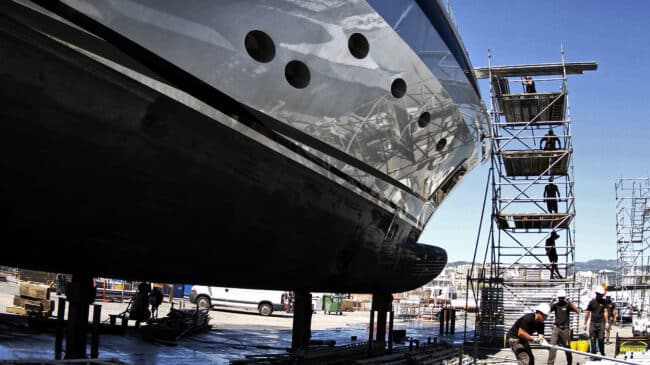

- Can central planning revitalize U.S. shipbuilding?
- NTSB identifies the most vulnerable large bridges
- Bizarre case of U.S.-Canada bridge
- Could electric hydrofoils reshape urban transportation?
- Populist attack on potential California road charges
- The Railway Safety Act bill is back
- News Notes
Can Central Planning Revitalize U.S. Shipbuilding?
Last year, President Trump issued an executive order to “Restore American Maritime Dominance.” A recent article from the Eno Center for Transportation provided an update by summarizing the Maritime Action Plan (MAP) released on Feb. 13. The 30-page MAP offers four “pillars” of action:
- Rebuild U.S. shipbuilding;
- Reform workforce education and training;
- Protect the maritime industrial base; and,
- Support national security, economic stability, and industrial resilience.
There’s a name for this kind of program: it’s called “industrial policy” and is a form of central planning that has been tried many times in U.S. history and been practiced by governments in both market-based and non-market economies. One of many major federal government efforts to revitalize our economy was the Reconstruction Finance Corporation (1932), which made low-rate loans to banks and other industries from 1932 to 1957. Franklin Roosevelt’s administration kept trying new versions of industrial policy, none of which got the economy out of the Great Depression. More recently, the Peterson Institute released an assessment, “Lessons Learned from Half a Century of US Industrial Policy.” While a few targeted efforts did have positive results, most programs providing subsidies were deemed failures—such as the Synthetic Fuels Corporation, Solyndra Corporation,
and Foxconn in Wisconsin.
The Morning Dispatch published an excellent overview of the state of U.S. shipbuilding. Commercial shipbuilding is essentially dead in this country, with the Philadelphia Naval Shipyard building its last ship in 1970. That yard was purchased by Korean shipbuilder Hanwha in 2024 and is now called Hanwha Philly Shipyard. Last August, Hanwha announced a $5 million investment in that shipyard. But the key question the article poses is this: “Can a country that builds virtually no commercial ships transform itself into a shipbuilding power?”
The world’s current shipbuilding experts are three Asian countries: China, which builds about 50% of all new ships, South Korea, which builds nearly 30%, and Japan, about 15%. That adds up to 95%. But it’s not just shipbuilding volume. Crucially important is the cost. For example, Hanwha Philly is now producing three Aloha-class ships for Matson, at $330 million each. But a comparable ship from an Asian shipyard costs about $75 million. Remember, Korean shipbuilder Hanwha now owns and operates the Philly yard. But it has to use U.S. labor and U.S. materials to build ships there, so it cannot get anywhere near to producing ships that are competitive with those it builds in South Korea.
Rather than embarking on a hopeless quest to make American shipyards competitive with Asian ones, what sensible alternatives exist? Colin Grabow of the Cato Institute Center for Trade Policy Studies suggests that the government instead focus on expanding the existing Maritime Security Program, which pays for foreign-built vessels to fly the U.S. flag and stand ready for service in the event of armed conflict. (This is analogous to the Civil Reserve Aviation Fleet program under which U.S. airlines are paid to slightly modify airliners that can be called up in a national emergency to carry out military flights.) Currently, only 60 U.S. ships are registered for the Maritime Security Program.
Frankly, I see no reason in principle for the U.S. military not to consider outsourcing naval ship production to South Korean shipbuilders. They are world-class shipbuilders, and they could be relied upon to comply with a set of design and performance requirements specified by the U.S. Navy. No, this would not start with an aircraft carrier, but perhaps for a small order of patrol boats. Sensitive technical equipment could be installed after the ships were delivered to the U.S. Navy. Instead of pouring untold billions into subsidizing U.S. shipbuilding, let’s think outside the box and buy the ships we need from cost-effective providers.
NTSB Identifies the Most Vulnerable Large Bridges
As part of the focus on major bridge vulnerability triggered by the collapse of Baltimore’s Key Bridge in 2024, the National Transportation Safety Board (NTSB) last month released a report identifying 12 bridges at high risk for ship/bridge collisions. The shaky dozen are as follows:
- Coronado Bridge in San Diego
- Four bridges in Louisiana (Crescent City, Huey Long, Veterans Memorial, and Sunshine)
- Chesapeake Bay Bridge in Maryland
- Casciano Bridge in New Jersey
- Seaway International Bridge in New York
- Detroit Ave. and Carnegie Ave. bridges in Ohio
- Walt Whitman and Ben Franklin Bridges between Pennsylvania and New Jersey.
These bridges are each vulnerable to a catastrophic ship/bridge collision similar to the one in Baltimore. Of the above dozen, only two are currently planned to be replaced: Casciano in New Jersey and Chesapeake Bay in Maryland. These 12 bridges are those that have reported thus far to the American Association of State Highway and Transportation Officials’ survey of the owners of 68 bridges that may be above the “acceptable level of risk,” NTSB reported. Its report notes that all these bridges were designed long before the Federal Highway Administration started requiring vulnerability assessments for new bridges in 1994.
The NTSB has recommended that owners of all bridges over the risk threshold implement a comprehensive risk reduction plan. That could be either or both physical protections (such as “dolphins” protecting bridge piers) or operational limitations, such as restrictions in the waterways or requiring tugboat assistance for larger ships.
Politico’s story on the NTSB report has a dismaying subtext, typified by the following statement by John Hanson, CEO of the Delaware River Port Authority: “You can’t solve a national maritime problem by placing the burden on local bridge budgets.” That seems to be a not-so-subtle message to Congress to include massive new bridge funding in the forthcoming surface transportation reauthorization bill.
What about self-help? I went online to see which of these 12 problem bridges charge tolls, whose revenue streams can be bonded to cover large investments in upgrading and modernization. Today, only five of the 12 charge tolls, though four others used to but no longer have access to that important revenue and finance source. Just three have apparently never had tolls.
If Congress does provide some kind of new bridge funding for seriously at-risk bridges, the least it could do is make such assistance available only to self-help bridge owners who charge tolls to help pay for needed improvements.
The Bizarre Case of the New Bridge Between the United States and Canada
On Feb. 9, President Trump threatened the planned opening of the new Gordie Howe Bridge between Detroit and Windsor, Ontario. He demanded that the Canadian government, which funded and built the new bridge, give at least half-ownership of the bridge to the U.S. government. The U.S.-Canada bridge agreement had been negotiated years ago by Michigan Gov. Rick Snyder, a Republican. The rationale for the new bridge was congestion on the aging Ambassador Bridge between Detroit and Windsor.
To understand what’s behind this, you need to know the story of the privately owned Ambassador Bridge, which I researched in writing my 2018 book, Rethinking America’s Highways. Because it was to be an international crossing, it required a Canada-U.S. agreement. It was privately financed based on its projected toll revenues, and it was completed and opened to traffic in 1929. Its private ownership has changed hands several times over the decades. Given how long ago it was designed, it has only two lanes in each direction. It remains the only truck route between Detroit and Windsor. Trucks cannot use the Detroit-Windsor Tunnel since it is sized only for passenger vehicles.
Needless to say, the Ambassador Bridge’s owners have long enjoyed their monopoly on Detroit-Windsor truck traffic. They have opposed any plans on the U.S. side of the border to add another truck-capable crossing. So I was hardly surprised to learn, via a New York Times article, that Matthew Maroun, part of the family that owns the Ambassador Bridge, met with Secretary of Commerce Howard Lutnick shortly before Trump spoke out with demands for half-ownership of the Gordie Howe Bridge. The Maroun family has owned the Ambassador Bridge for decades, and it has a history of filing legal challenges against the Gordie Howe Bridge.
White House press secretary Karoline Leavitt told a reporter, “The fact that Canada will control what crosses the Gordie Howe Bridge, and owns the land on both sides, is unacceptable to the president. It’s also unacceptable that this bridge isn’t being built with more American-made materials.” Ironically, during his first term, President Trump promoted the Gordie Howe Bridge in a joint statement with Canadian officials as “a vital economic link between our two countries.”
Could Electric Hydrofoils Reshape Urban Transportation?
I read The Economist every week to obtain a global perspective on governments, politics, economics, and sometimes interesting new technologies. The lead article in the Science & Technology section of the Feb. 14 issue unveiled a new transportation technology: the electric hydrofoil. According to the writer of this article, this invention “could reshape urban transportation by shifting traffic from clogged roads to underused waterways.”
Before pointing out some problems with that proposition, I will say (as an engineer with two MIT degrees and a first job at helicopter developer Sikorsky Aircraft), the technology for electric hydrofoils is impressive. Its computer-guided foils remain underwater at all times, but they raise the craft out of the water for greatly reduced friction and much less energy needed. That appears to make these craft relatively low-cost to operate as well as much quieter than non-electric hydrofoils. So I congratulate electric hydrofoil startups such as Sweden’s Candela. The article names a half-dozen other startups developing electric hydrofoils. They will likely be competitors in replacing ferries, including hydrofoil ones.
My concern as a transportation policy guy is the claim that e-hydrofoils could play a major role in urban transportation. What one needs to assess this claim is extensive data on existing urban/suburban travel patterns, starting with commuting. Bland statements in the article, such as “Nearly half of the world’s population lives in coastal regions,” and that “water-borne transit… is an obvious solution,” and that waterways are a city’s “forgotten highways,” are divorced from urban transport reality.
To be sure, if your city consists of 14 islands, like Stockholm, e-hydrofoils might be suitable for a modest fraction of urban trips. But the vast majority of urban (and especially suburban) travel can only take place on land, even in metro areas like Seattle and San Francisco that are located on large bays. Most of Manhattan is surrounded by water, and ferries serve a fraction of commuters. But what about where the vast majority of Americans live and work: places like Los Angeles, Dallas, Houston, Atlanta, Orlando, Chicago, Pittsburgh, etc.?
The idea, per the article, that a $22 billion global market exists for e-hydrofoils strikes me as unrealistic, and I doubt very much that “on passenger routes in cities, electric hydrofoils may be about to take off.”
The Populist Attack on Potential Road Use Charges in California
By Baruch Feigenbaum
The per-gallon fuel tax, California’s primary transportation funding source, is living on borrowed time. The ongoing growth of more-fuel-efficient vehicles, hybrids, and electric vehicles in California suggests that the gas tax will not be a sustainable way to build, maintain, and expand highways, roads, and bridges.
There’s a fairly strong consensus among transportation professionals that, sooner or later, states will have to replace per-gallon fuel taxes with some kind of road user charge. But instead of being constructive about how and when to do this, many Republican legislators are attacking road charges with claims such as “Politicians want to track how far you drive and tax you for every mile.”
The underlying reality is that those who use roads and bridges should pay for building and maintaining them. That has been the case since Oregon legislators invented the per-gallon gas tax in 1919 as their highway funding user charge. That principle is still very sound, but the need to replace per-gallon taxes with a more durable road user charge is something Republicans and Democrats should both support.
The Southern California News Group recently noted that Assembly Transportation Committee Chair Lori Wilson introduced a bill (AB 1421) explaining that the state’s Road Charge Technical Advisory Committee is finishing up its research and will be making recommendations to the legislature by the end of this year. What it proposes should not be controversial, since it is building on what has been learned from five small pilot programs looking into the viability of replacing fuel taxes with road charges.
Republican legislators claimed that what will be proposed would be a big-government tax increase and a means of spying on drivers. But Assemblywoman Wilson’s bill merely requests policy recommendations for ensuring that California will have the funding needed to keep its roadways in good shape in the coming decade. The recommendations would be non-binding.
Given the importance of ensuring sound highways, Republican legislators should be working with their Democratic colleagues to find common ground on creating an effective road user charging system to replace obsolete per-gallon fuel taxes.
A starting point for such a replacement user fee would be to set it to generate the same initial level of funding as the current state fuel tax, while retaining the fuel tax’s inflation index. The new road charge should be a replacement for the fuel tax, not an addition. All previous California road charge pilot projects envisioned them as a replacement for fuel taxes, not an additional charge. This change would ensure proper ongoing funding for roads and bridges, regardless of changes in vehicle propulsion in the coming decades.
Republicans who are concerned about a road charge being implemented in addition to the current fuel tax should point to strong bipartisan support that already exists to replace the fuel tax, not add a road charge on top of it. That premise was explicit in the California road charge pilot projects, which most participants understood and agreed with.
If legislators are concerned that road charges will be easier to increase than fuel taxes, to support things like bailing out transit agencies or expanding trails and sidewalks, they should make sure that the law authorizing road charges requires the revenues to be dedicated to paying for the roads that generate them.
Also, legislators should be diligent in protecting drivers’ privacy. For example, every state that tests road user charges offers a low-tech odometer-reading method of reporting miles driven; this could be performed during an annual vehicle inspection or during routine maintenance. Some states are also looking at prepaid options for drivers.
Oregon’s permanent road user charge program has state-of-the-art privacy protections. It uses private vendors to process mileage data and requires that any location data be deleted within 30 days. Legally, all Oregon mileage data is confidential and exempt from public records requests.
California roads and highways need maintenance, repair, and modernization. Fuel taxes will not ensure this in the coming decades. The best path forward is to continue to study mileage-based road charges so that per-gallon fuel taxes can be replaced in a timely manner.
A version of this column first appeared in the Orange County Register and Southern California News Group newspapers.
Railway Safety Act Reintroduced in Congress
By Marc Scribner
In late February, a bipartisan group of senators led by Sen. Jon Husted (R-OH) introduced the Railway Safety Act of 2026. A companion bill was introduced in the House the following week. Despite three years having passed from the original introduction of the Railway Safety Act, the sponsors have been unable or unwilling to address major legislative deficiencies. As written, the bill would not improve rail safety and could perversely make freight transportation more dangerous in the United States. Congress should again discard the Railway Safety Act and instead work to advance serious safety policy.
The original 2023 bill was championed by then-Sen. J.D. Vance of Ohio, who introduced it less than a month after the East Palestine, Ohio, train derailment and just a week after the National Transportation Safety Board (NTSB) issued its preliminary report on the accident. While it was touted as a response to East Palestine, the bill was in reality a hastily assembled concoction of previous legislative proposals backed by unions and other special interests.
When the NTSB issued its final report on the East Palestine incident in June 2024, the legislation proved largely unresponsive, and in some cases contrary, to the NTSB’s findings and recommendations. Here’s how the eight core provisions touted by sponsors of the Railway Safety Act of 2026 line up with the NTSB final accident report.
1. Mandates the use of defect detection technology to make railroads stop trains when something is wrong which could have prevented the East Palestine derailment. The bill requires hotbox detectors to be deployed an average of every 15 miles, compared to every 25 miles currently (Sec. 107)
- The bill mandates the installation of bearing defect detectors every 10, 15, or 20 miles depending on population density and complementary wayside equipment characteristics.
- This highly prescriptive provision plainly violates the NTSB recommendations to first conduct a thorough study of defect detection technologies and their use (R-24-002) before mandating any changes (R-24-003).
2. Expands the list of hazardous materials that are subject to higher safety standards, like vinyl chloride carried by the East Palestine train, and require speed restrictions, better braking and route risk analysis (Sec. 102)
- This provision is unresponsive to the NTSB’s findings or recommendations because the NTSB found that cargo and operational characteristics such as train speed played no role in the derailment and subsequent release of hazardous materials.
- While the NTSB recommends expanding the definition of “high hazard flammable train” to account for survivability differences between tank car specifications and to include hazardous materials other than flammable liquids (R-24-014) that can contribute to cascading hazardous materials releases (such as combustible liquids and Division 2.1 flammable gases), this provision would include in the definition of “high-hazard train” non-combustible substances that could not initiate or propagate a cascade of hazardous materials release.
3. Improves emergency response by notifying states about the hazardous materials being transported by rail through their communities and strengthening railroad emergency response plans (Sec. 102)
- The part of the provision on notification is moot because the Pipeline and Hazardous Materials Safety Administration promulgated a final rule in June 2024 to require railroads that carry hazardous materials to generate, maintain, and provide to parties involved in emergency response the information needed to enhance emergency response and investigation. The NTSB considers this matter closed.
- The part of the provision requiring the federal government to take over certain responsibilities from local first responders was not recommended by the NTSB.
4. Prevents improper railcar inspections and mandates a new requirement that ensures railcars are properly maintained (Sec. 105)
- The NTSB investigation found “[t]here was not enough evidence to determine whether a mechanical inspection conducted before the derailment failed to identify signs of bearing failure; the bearing may not have been showing visible problems at the time of the inspection,” so this provision is unresponsive.
5. Increases civil penalties for rail safety law violations from $100,000 to $10 million to ensure safety laws are taken seriously (Sec. 109)
- The NTSB is silent on civil penalties as a matter of policy and federal statute prohibits NTSB reports from being entered into evidence in civil actions for damages, so this provision is unresponsive to the NTSB investigation.
- However, Norfolk Southern reached a $310 million settlement with the federal government in May 2024, including a $15 million civil penalty. In addition, Norfolk Southern agreed to pay another $600 million in compensation to settle class action lawsuits tied to the incident and response. Thus, real-world events have proven this provision to be wholly unnecessary.
6. Requires two crewmembers to operate a train to prevent a situation where only one person is on the train in an emergency (Sec. 108)
- This provision is entirely nonresponsive to the NTSB’s findings or recommendations because the train involved had a crew of three at the time of derailment and the NTSB explicitly found that crew handing played no role in the derailment or broader incident.
- Further, there is no evidence that two-person crews are safer than single-person crews (or vice versa), which the Federal Railroad Administration itself has conceded.
7. Ensures firefighters are made whole after responding to major derailments. (Sec. 204)
- This provision was mooted by subsequent legal settlements, as well as being unresponsive to the NTSB’s findings.
8. Expands the existing Hazardous Materials Emergency Preparedness grants to allow fire departments to purchase the personal protective gear that keeps them safe (Sec. 203)
- This provision isn’t responsive to the NTSB’s findings or recommendations but could be defended (or opposed) independent of the East Palestine derailment.
The Railway Safety Act is clearly not a coherent policy response to the East Palestine derailment, specifically, or to rail safety concerns more broadly. Both the Senate and the House have, to date, chosen wisely to reject this legislation.
To be sure, Congress could play a valuable role in advancing rail safety if it stays focused. Lawmakers should conduct careful oversight of the various regulators at the U.S. Department of Transportation (DOT) to ensure that any new regulatory requirements proposed in response to the East Palestine incident or any other event are determined through a careful assessment of the evidence, supported by robust technical, risk, and cost-benefit analyses. New technologies, especially those related to automated inspections, should be embraced.
Importantly, Congress should keep in mind that rail safety rules with high costs and little benefit may make our transportation system less safe if they cause rail traffic to be diverted onto the highways, where truck accident fatality rates are six times greater than rail’s, and injury rates are 17 times higher. All too often, the impulse in Washington to “do something” fails to address the problem at issue and also creates new ones.
NC Shortlists Teams for $3.2 Billion I-77 Express Toll Lanes
The North Carolina DOT last month announced four short-listed teams for implementation of elevated express toll lanes on 11 miles of I-77, between Uptown Charlotte and the South Carolina border. As Eugene Gilligan reported in Infralogic (Feb. 23), the four teams are headed by (1) ACS, Kiewit, and Meridiam, (2) Plenary, Sacyr, and Shikun & Binui, (3) Acciona, Stichting Pensioenfonds, and Balfour Beatty, and (4) Cintra, John Laing, Star America, and Global Sustainable Infrastructure Partners IV. The project is intended as a design-build-finance-operate-maintain P3 with an operations term of 50 years.
Brightline West Rail Project Won’t Finish in Time for 2028 Olympics
Equipment World reported that the 218-mile high-speed rail (HSR) line from Las Vegas to Rancho Cucamonga in San Bernardino County has a revised completion date of late 2029. An earlier schedule had the rail line being finished before the 2028 Summer Olympics in Los Angeles. Originally estimated to cost $12 billion, the project’s budget is now $21.5 billion. The article noted that Brightline West is now seeking an additional federal loan for $6 billion. Though referred to as connecting Las Vegas and Los Angeles via high-speed rail, the western terminus of the line (Rancho Cucamonga) is 41 miles from downtown LA and requires passengers to transfer to a much-slower Metrolink commuter rail line to get there.
South Africa Looking Into Truck Toll Lanes
Moneyweb reported that the South African National Roads Agency (Sanral) is considering the introduction of “special toll roads” for heavy trucks. Heavy trucks have far greater impact on highway pavement than automobiles, but the reasoning is that users of personal vehicles should not bear the extra cost of beefing up regular highway lanes. The alternative is building heavy-duty truck lanes, paid for by tolls. Board chairman Themba Mhambi told legislators that “We do not want ordinary members of the public to suffer [from roadway damage], so our focus is going to be on freight traffic that ordinarily should not be on [regular] roads.” Truck toll lanes have been proposed a number of times in the United States since 2002, but none have been implemented.
Caltrans Plans HOV to HOT Conversions in San Diego County
The state DOT is planning to convert the carpool lanes on I-5 and I-805 to high-occupancy toll (HOT) lanes. Caltrans District 11 deputy chief Allan Kosop says that the HOV lanes are regularly congested, partly by non-HOVs illegally using those lanes. He told KPBS that, “We always knew at some point they were going to need to evolve from HOVs to express lanes, so that’s always been a part of the vision. We’ve determined that now is the time to make that switch.”
Panama Supreme Court Rules China-Run Ports Are Unconstitutional
On Jan. 29, the Supreme Court of Panama ruled that certain provisions of the ports concession held by CK Hutchison’s Panama Ports Company are unconstitutional. The decision came after a review by the comptroller of the Panamanian government, which raised concerns over the 25-year extension of the concession in 2021. The Wall Street Journal noted (Jan. 31) that the termination of Hutchison’s license upsets its plan to sell more than 40 ports (including those two) to BlackRock and Mediterranean Shipping Company. The decision was based on a provision in the Panama-U.S. treaty that bans foreign governments or state-run firms from being involved with the Canal.
Nebraska Becomes Third State With Full NEPA Assignment Authority
On Feb. 26, Nebraska DOT and the Federal Highway Administration signed an agreement under which NDOT received full “NEPA Assignment Authority.” That means NDOT can carry out environmental assessments (EAs) and environmental impact statements (EISs), rather than this process being carried out by the federal government. Nine state DOTs have some version of this shift (e.g., for categorical exclusions), but at this point, only three have full Section 327 NEPA Assignment Authority.
Australia Begins East Coast High-Speed Rail
Infralogic reported (Feb. 17) that Prime Minister Anthony Albanese had announced that the first stage of a planned east coast HSR system would begin with a 119-mile line linking Sydney with Newcastle. The estimated cost of this link is $63.6 billion in U.S. dollars. When I went online for more plans, the map I found had a northward extension to Brisbane and a southwesterly extension to Canberra and on to Melbourne. With a few online map queries, I estimated rail miles for each of these future routes. The cost per mile of the Sydney-Newcastle starter segment is $534 million. Applying that number to the 403 miles Newcastle to Brisbane and the links to Canberra (204 mi.) and from there to Melbourne (316 miles), my ballpark estimate for the 923 additional miles came to $493 billion. And that is in current US dollars. I’m not surprised that the P.M. has not announced a cost estimate for the whole eastern network.
First Express Toll Lanes on an Ordinary Highway
On Feb. 16, Kansas Gov. Laura Kelly went to Overland Park to celebrate the opening of the first express toll lanes in Kansas. They are also the first ones added to a non-limited access highway (US 69). The project is 6 miles long, with one express lane each way, added in the former median. Pricing is congestion-related with morning, evening, and night/weekend rates. US 69 is not a limited-access highway, which makes this project unique, besides being the first express toll lanes in Kansas.
Argentina Continues with Highway Concessions
The reformist Argentine government has launched Stage III of its 9,000 km federal highways concession program. The latest (and last) stage encompasses 2,423 km of limited-access highways, for which the government is seeking bids for public-private partnership (P3) concessions. This last stage includes eight highways for which the winning bidders will be responsible for (re)construction, operation, administration, and maintenance, according to Infralogic (Feb. 23). After completion of this final stage, more than 9,000 km of federal highways will be under P3 concessions.
Cube Highways Negotiating Purchase of India Highway Concession
Rouhan Sharma reports that Cube Highways is negotiating to acquire 207 km of HKR Roadways from Kotak Special Situations Fund. (Infralogic, Feb. 10). Back in 2024, Sharma notes, Vinci Highways sought to acquire HKR Roadways but was not successful.
North Carolina Express Toll Lanes Opened on I-485
$346 million worth of express toll lanes opened to traffic on I-485 in Charlotte on Feb. 28. The 18 miles of ETLs run from I-77 to Highway 74. The project, managed by NCDOT, was built over a seven-year period. While variable tolls are in the plans, the initial rates will be fixed prices, with NC QuickPass users receiving a 50% discount.
Penn Station Redevelopment P3 Under Way
Three teams have been shortlisted for the P3 redevelopment of Penn Station in New York City, reports Public Works Financing. The teams are being led by 1) Macquarie, 2) Fengate, and 3)Halmar. Amtrak is managing the procurement process, and the agency is hoping to get the redevelopment started by the end of 2027.
Another Electric Vehicle Write-Off
After reports of multi-billion-dollar write-offs on EVs from Ford and GM, auto industry people were not surprised last month when Stellantis revealed its own write-off: $26 billion. That beats both Ford ($19.5 billion) and General Motors ($7.6 billion).
California Drops $4 Billion High-Speed Rail Litigation
At the end of 2025, California Attorney General Rob Bonta filed a notice of dismissal, ending the state’s lawsuit against the U.S. DOT and the Federal Railroad Administration over the Trump administration’s cancellation of $4 billion worth of federal grants for the HSR project. The HSR project’s current focus is a route in the Central Valley, far less ambitious than the original 500-mile route between Los Angeles and San Francisco.
Possible Tolled I-42 Being Studied in Northwest Arkansas
A small group of states, for many years, has called for creating a new I-42, an east-west route that would partly be joint with I-40 but in other stretches would be created by upgrading US 412. The Northwest Arkansas Regional Planning Commission last month passed a resolution in favor of a toll feasibility study for the portion of US 412 in Northwest Arkansas.
Why U.S. Railroads Are the World’s Best
That’s not the title of a well-researched article by Andrew Miller. Its title is “Why Are American Passenger Trains Slow?” compared to those in other countries. But in assembling the data comparison, especially railroads in Europe and the United States, Miller explains the rationale for our railroads prioritizing freight over passengers. The article, from American Affairs, was released on Feb. 20.