
A version of the following public comment was submitted to members of the Texas House Committee on Transportation on August 17, 2026.
Texas DOT (TxDOT) places the total economic value of ports and maritime activity in Texas at nearly $713.9 billion in 2023, 28% of the state’s gross domestic product; the port activity supports 2.5 million jobs and $196.7 billion in wages and salary income. The Texas Port Mission Plan puts annual waterborne trade value at $403.61 billion, with 67% of that being exports.
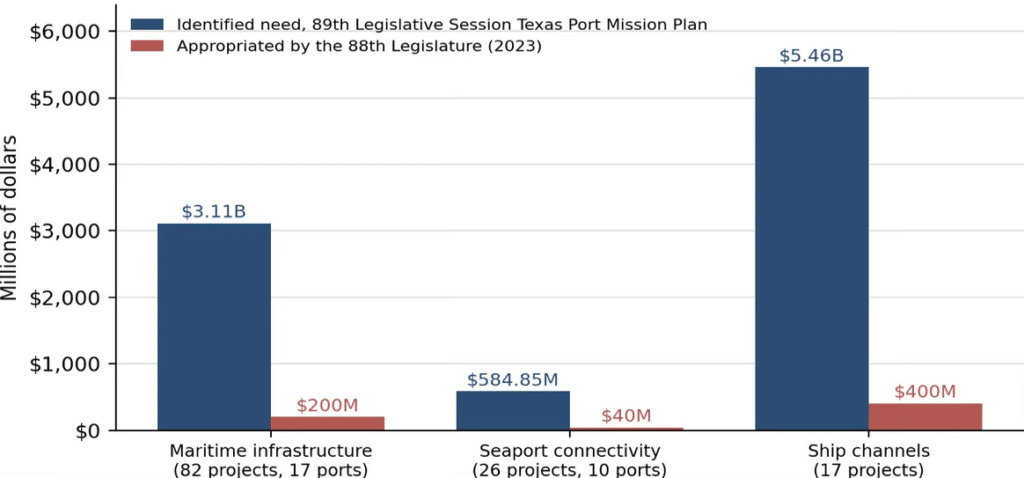
Texas has a comprehensive inventory of its needs. The 89th Legislative Session Texas Port Mission Plan identified $9.2 billion in port project needs across three categories: $3.11 billion in maritime infrastructure across 82 projects at 17 ports, $584.85 million in seaport connectivity across 26 projects at 10 ports, and $5.46 billion in ship channel work across 17 projects. The 88th Legislature appropriated $640 million in 2023, $200 million through the Maritime Infrastructure Program, $40 million through the Seaport Connectivity Program, and $400 million to the Ship Channel Improvement Revolving Fund (SCIRF).
Figure 1: Texas Port Needs Vs. Appropriations
Maritime Infrastructure (turning basins, connectivity projects like internal roadways or railroad improvements, bulkheads, and storage facilities) covers a wide variety of Texas port needs. The plurality of that $3.1 billion backlog is concentrated in docks, berths, wharfs, and terminals. Together, those categories make up about 63% of the $3.1 billion.
Seaport Connectivity is the one category where a state dollar is the most cost-effective, but it’s also the cheapest category by a wide margin. Seaport Connectivity means last-mile roadway width, truck queueing capacity, gate throughput and the like, but this also connects to infrastructure the state already maintains through Texas’ highway systems.
Channel Capacity is the largest needs category. The Port Mission Plan counts seven federally authorized deepening projects with a $2.54 billion federal share and a $1.92 billion local share. The non-federal sponsor, Texas navigation districts, needs to produce $1.92 billion in matching funds. The Ship Channel Improvement Revolving Fund (SCIRF) helps navigation districts borrow to meet local shares but has little value until the Sabine-Neches Waterway deepening and the Brazos Island Harbor Channel deepening projects begin to pay back their loans into SCIRF.
All three of these backlog categories, Maritime Infrastructure, Seaport Connectivity, and Channel Capacity, are hard to solve but can be mitigated through the use of private capital where feasible. This isn’t a new idea in Texas, given the same Port Mission Plan states that 98% of Texas ports and navigation investments are funded by private port sources, but meeting the existing backlog may require a different approach.
Public-private partnerships (P3s) have been widely used in other states for new terminals and for rehabilitation and expansion of berths alike. For example, the Port of Baltimore, Maryland used P3 delivery for a $1.64 billion (adjusted for inflation) port rehab and operation project. The project called for upgrading existing berths and wharfs to accommodate deeper draft vessels, dredging an existing berth from 45 to 50 feet, and dredging access channels leading up to the berth, among other things. The Port also partnered with Ports America to operate the Seagirt Terminal for 50 years, including a $141 million (also adjusted for inflation) deal for Ports America to build a new berth there. Ports America, likewise, also has to pay an annual rent of $3.2 million with a variable assessment of $15 per container over 500,000.
Leveraging P3s can help bridge the gap between current system needs and private capital that is already invested in and has an interest in serving Texas ports. Texas has built a great base of operators, contractors, and construction firms to handle port expansion projects; it just needs to actively work to leverage that experience for its port infrastructure.