

Introduction
The federal government started providing large-scale transportation funding with matching dollars for states to construct the Interstate Highway System. Since then, most federal transportation aid has been awarded by formula. This complex formula-aid funding is distributed based on congressionally determined criteria, including population, highway lane-miles, and bridges. These formulas are typically crafted as part of multi-year surface transportation reauthorization bills that guide policy and funding.
Beginning in 1970, the U.S. Department of Transportation (DOT) began awarding a small amount of discretionary transportation funding on an intermittent basis. Starting in 2009, as part of the American Recovery and Reinvestment Act, these awards, supported by the general fund and known as discretionary grants, became a sizable annual share of federal transportation funding. These grants’ qualifying criteria supersede congressional criteria, allowing the White House to circumvent the congressional selection process to address special, important projects.
Discretionary grant funding grew over time to hundreds of billions of dollars. In 2015’s Fixing America’s Surface Transportation (FAST) surface transportation reauthorization bill, discretionary funding was 10%–13% of the total, an increase from 8%–10% in the Safe, Accountable, Flexible, Efficient Transportation Equity Act: A Legacy for Users (SAFETEA-LU) of 2005.
In the Investment and Jobs Act (IIJA) of 2021, discretionary grant funding grew to $200 billion and was spread across 101 programs. An amount that fell within the range of a rounding error 15 years before, funding for discretionary programs ballooned to comprise approximately one-fifth of total transportation spending by 2022.
Further, the Department of Transportation processed the grant programs very slowly. Transferring spending decisions to the White House, combined with the inability to reward funding, has created a bipartisan consensus that discretionary grants should be reduced in size.
Figure 1 compares the United States Department of Transportation’s formula funding to discretionary funding across the 21st century.
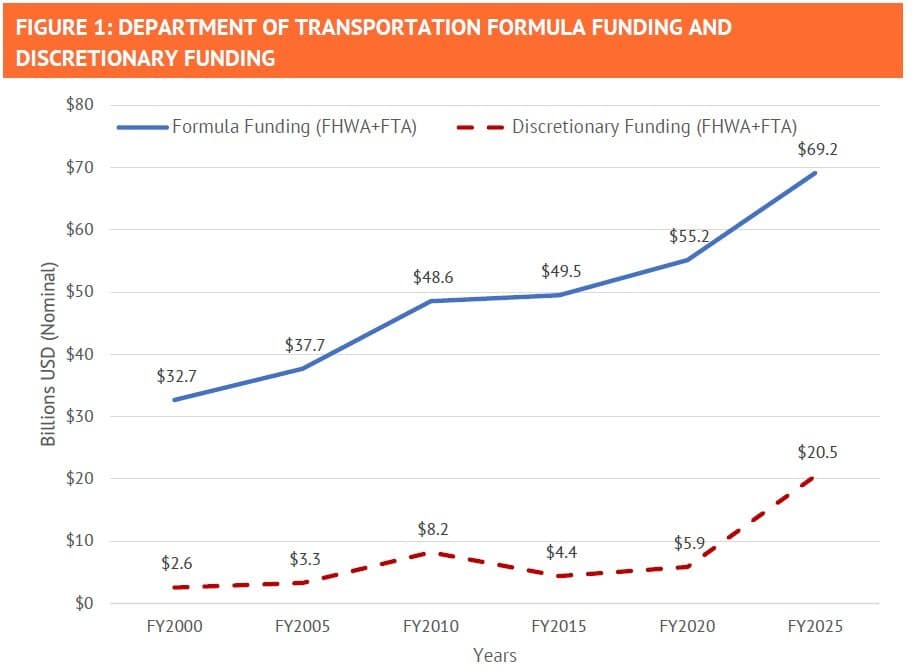
While reducing the size would help, more significant problems plague this program, which should also be addressed. In theory, discretionary grants should be an advantage over formula programs because the grant recipients receive funding based on quantitative metrics—for example, how much a new roadway reduces congestion or how much a reduction in transit headway time increases ridership—instead of congressionally created formulas, which are often written to benefit politicians on the revenue and/or transportation committees.
In reality, the discretionary grant program metrics have often been just as political as formula funding, with preference from executive branch decision-makers shown to projects whose representatives are in congressional leadership positions, on the revenue and transportation committees, or meet some other political objective.
For example, past project guidelines have tweaked the criteria to reward rural districts (to increase support), active transportation projects (because congressional leadership preferred these projects), and economic development projects (to build infrastructure not funded by another federal program). In other words, discretionary grants allow the White House, instead of taxpayers’ congressional representatives, to control an increasing amount of transportation infrastructure funding, at times even diverting those funds from transportation entirely.
Improving the discretionary grant funding process calls for determining how it went awry over the years and returning it to a small, focused, useful program.
To this end, the following sections of this brief examine the relevant history of discretionary grant funding, detail common criticisms, and outline basic criteria for identifying the best projects.
The appendix details a comprehensive descriptive list of the IIJA’s 101 discretionary grants measured against the recommended criteria.
Full policy brief: Reining in discretionary grant funding