



Introduction
Among the first challenges people face upon release from prison is obtaining identification documents required to obtain a job, rent an apartment, or open a bank account. Without a photo ID, birth certificate, or Social Security card, formerly incarcerated individuals cannot access the employment, housing, and financial services that facilitate successful reentry. Reintegrating people released from incarceration into society poses a significant policy challenge in the United States. There are approximately 1.3 million people currently incarcerated in state and federal prisons. The vast majority of them will eventually return to their communities, joining the 5 million Americans who have previously served time in prison. Upon release, the formerly incarcerated continue to face a wide array of restrictions on their legal rights, civic participation, and employment. These challenges contribute to high recidivism rates, with approximately half of those released from state prison returning within three years. This cycle of reoffending and reincarceration not only imperils public safety but also diminishes economic productivity, separates families, erodes civic culture, and siphons more taxpayer dollars into incarceration year after year.
Academic research has long sought to understand the causes of criminal behavior and, relatedly, the factors that lead people to stop engaging in criminal behavior. The relationship between employment and crime has received particular attention, in part because employment is one factor which may be readily influenced by public policy interventions. There is strong evidence that people who find stable and gainful employment are less likely to reoffend. However, simply providing people released from prison with employment does not consistently reduce long-term unemployment or reoffending.
States have pursued a wide variety of programs to prepare inmates for reentry and the workforce, including basic, secondary, post-secondary education, vocational training, prison labor, and work release programs. Research indicates that these programs can improve post-release employment outcomes, especially among people who enter prison with minimal education or professional experience. However, the impact of policies and programs intended to prepare prisoners for reentry and employment may suffer due to a variety of other legal and social barriers that the formerly incarcerated experience upon their return to the community. Public policy should broadly aim to minimize unnecessary legal and administrative barriers faced by former criminal offenders who actively pursue reintegrative goals like securing gainful employment, making stable housing arrangements, and establishing community ties. Identification documents are one such critical barrier (Figure 1).
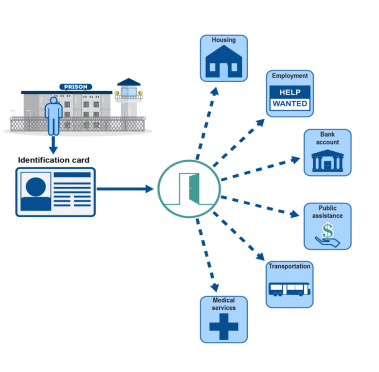
Note: The types of identification documents required to access these benefits and services may vary.
Obtaining a state-issued photo identification card typically requires multiple documents to verify an applicant’s identity. A birth certificate and Social Security number are among the most common forms of documentation used for this purpose. If a person does not have a certified copy of their birth certificate or know their Social Security number, they may need to obtain those documents before applying for a photo identification card. Yet, obtaining a copy of one’s birth certificate or a replacement Social Security card also requires identity verification through supporting documents, like a photo identification card or passport. These circular requirements can be very challenging to fulfill, especially for people recently released from prison. State correctional agencies can facilitate the reentry process by assisting inmates with obtaining these essential documents prior to release.
This report examines state laws that require correctional agencies to help inmates obtain state-issued photo identification cards, Social Security cards, and certified copies of their birth certificates. Reason Foundation also reviewed published administrative rules and procedures and contacted correctional agencies in states without relevant statutes to determine whether such assistance is provided in practice.