
In This Issue:
Articles, Research & Spotlights
- California Set to Give $14 Billion Pension Boost to High-Earning First Responders
- Education Bill Pulls Crucial Funding from Connecticut’s Pensions
- Pension Funds Are for Retirement, Not Housing Policy
News in Brief
Quotable Quotes on Pension Reform
Data Highlight
Articles, Research & Spotlights
Lawmakers Set to Give More Lavish Pension Benefits to California’s Highest-Paid Workers
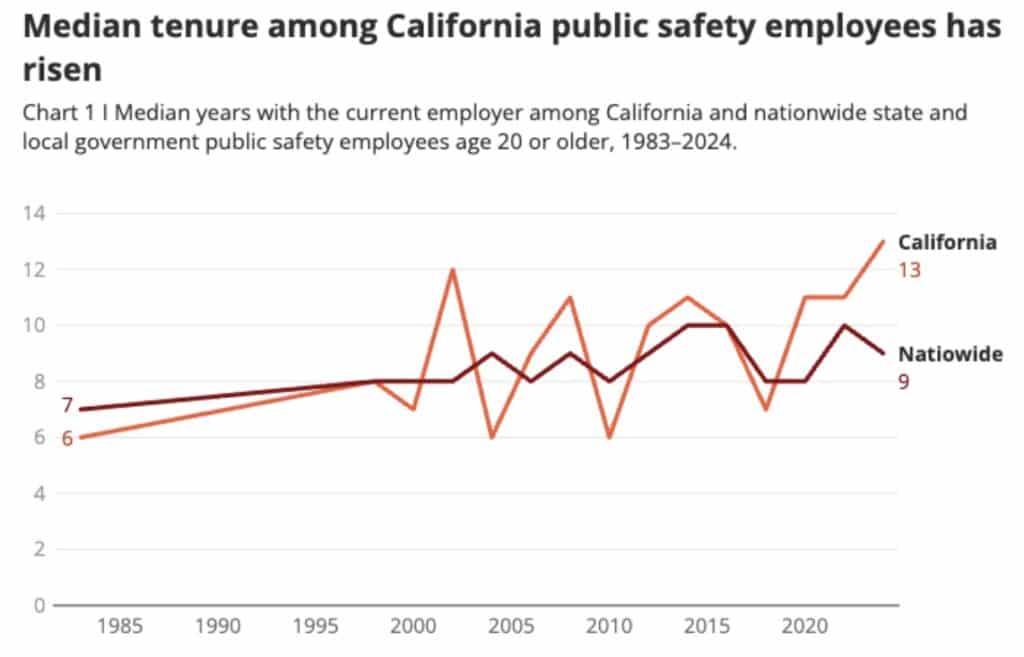
In a potential setback to a landmark 2012 pension reform, a bill, Assembly Bill 1383, currently under consideration in the California Senate would grant a public pension benefit increase to the state’s first responders. Proponents argue the change is needed to address recruitment and retention concerns among police and fire departments, but recent analysis by Reason Foundation’s Mariana Trujillo suggests California is not experiencing a public safety retention or recruitment crisis. Data from the Census Bureau indicate that public safety workers in the Golden State remain on the job longer than they have going back to the 1980s, and stay at much higher rates than the national average. Reason Foundation’s analysis of AB 1383 shows that the bulk of the projected $14 billion price tag derives from granting additional pension benefits to high-earning first responders making over $160,000 annually. California lawmakers should stay the course on reducing pension debt and improving the state’s pension funding, rather than seeking ways to grant richer benefits to the highest earners.
Commentary: Lawmakers Set to Give More Lavish Pensions to California’s Highest-paid Workers
Commentary: CalPERS’ Good Investment Returns Aren’t an Excuse for More Costly Pension Increases
Commentary: Data Show California Does Not Have a Public Safety Staffing Crisis
Connecticut’s Pre-K Endowment Diverts Pension Dollars
Connecticut’s new Early Childhood Education Endowment aims to subsidize childcare, but its financing structure poses significant risks to the state’s pension system and long-term fiscal health. The plan redirects budget surpluses that were previously used to pay down $31.5 billion in unfunded pension liabilities, a move estimated to increase future public pension costs by up to $900 million. Beyond pension concerns, a Reason Foundation analysis suggests the endowment will likely fail to generate enough revenue to meet its ambitious spending goals for decades. Furthermore, bypassing established fiscal guardrails sets a dangerous precedent for moving significant state spending outside the traditional budget process.
Cities’ Pension Dollars Are Not for Building Affordable Housing
Likely future D.C. Mayor Janeese Lewis George has proposed “leveraging” city pension funds to finance affordable housing, a strategy increasingly popular among urban policymakers. However, Reason Foundation’s Mariana Trujillo warns that this approach is misguided because pension assets are dedicated retirement savings, and prioritizing policy goals over market returns risks leaving taxpayers to cover inevitable funding gaps. Such investments create “concentration risk,” potentially leaving both the city’s pension health and tax revenue vulnerable to a single local economic downturn. Furthermore, housing affordability is largely a result of zoning and regulatory hurdles rather than a lack of available investment capital.
News in Brief
U.S. Public Pensions Reach Best Funded Status Since 2009, But Gains May Be Fragile
The seventh annual State of Pensions report from Equable Institute found the national funded ratio reached 85.0% in the 2026 fiscal year, up from 81.2% the prior year, driven by a fourth straight year of above-target investment returns and record employer contribution rates. The report, covering 253 statewide and municipal systems, also highlights two structural risks behind the headline number. First, 27.1% of public pension assets are now valuation-priced rather than market-priced, and second, pension funds are increasingly concentrated in the same handful of large companies and dependent on continued AI-driven market gains to sustain their recovery. Total unfunded liabilities still remain at an estimated $1.13 trillion. Read the report here.
Quotable Pension Quotes
“A pension plan is a mathematical contract: contributions plus investment returns must equal or exceed future payouts, full stop. AB 1383 doesn’t touch the math. It just assumes someone else will fix it later.”
––Jay Rogers in California Globe, “California Proves Pension Reform Was Never a Settlement,” July 29, 2026.
“A defined-contribution plan sets the state’s contribution upfront and puts the money into an employee’s individual retirement account. Tier IV already moved Connecticut partway in that direction. Sweetening the guaranteed-pension side now would undo the reform taxpayers were promised in 2017.”
–– Yankee Institute Manager of Research and Analysis Meghan Portfolio in “CT State Employee Unions Backed Pension Reform. Now They Want to ‘Fix’ It,” Aug. 7, 2026.
“Many states reporting strong funded status are relying heavily on the accuracy of private equity and real estate valuations. And all states are — intentionally or not — now relying on an A.I.-driven economy to propel them forward and prevent a funded status regression.”
–– Equable Executive Director Anthony Randazzo quoted in “State of Pensions 2026,” Advisor Magazine, July 23, 2026.
Data Highlight
Reason Foundation’s analysis of California’s public safety worker tenure reveals that the state is not experiencing a first responder retention crisis, as some lawmakers have asserted to justify the proposal to give workers additional pension benefits. See the full analysis here.