

A recent joint press release from the offices of Sen. Richard Blumenthal (D-Conn.) and Rep. Debbie Wasserman Schultz (D-Fla.) trumpeted a bill that would provide $500 million in funding for a Centers for Disease Control and Prevention (CDC) initiative targeting an “alarming rise” in youth vaping. However, both the press release and the proposed initiative get the entire direction of youth e-cigarette consumption backward. Youth vaping is declining, not rising.
Reintroduced in August for the fourth time, the Preventing Opportunities for Teen E-Cigarette and Tobacco Addiction (PROTECT) Act would fund CDC research on youth and young adult vaping, including the product types and flavors they use, exposure to marketing, and levels of nicotine dependence. It would also fund a public education campaign coordinated with the Food and Drug Administration (FDA) and the Office of the Surgeon General, develop clinical and school guidance, and evaluate e-cigarette prevention strategies.
“Youth vaping in our schools and communities is an epidemic, fueled by Big Tobacco aggressively targeting yet another generation of young people,” stated Sen. Blumenthal, one of PROTECT Act’s sponsors, in the press release.
Contrary to these claims, youth vaping among high schoolers has actually plummeted by 74 percent since its peak in 2019. Middle school vaping similarly dropped by 75 percent over the same time period, according to the National Youth Tobacco Survey.
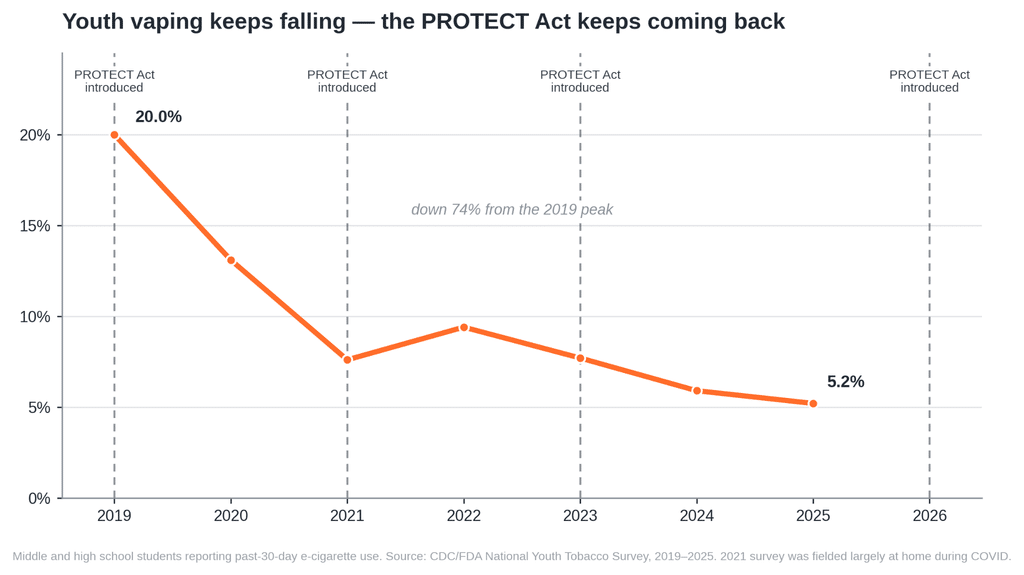
The most recent data from the 2025 National Youth Tobacco Survey (NYTS) shows 7.1 percent of high schoolers and 2.6 percent of middle schoolers use an e-cigarette at least once a month. In 2019, those figures were 27.5 percent and 10.5 percent, respectively. Youth vaping stands at its lowest level in 12 years.
Each time the PROTECT Act has been introduced–in 2019, 2021, 2023, and 2026–youth e-cigarette use has stayed flat or declined. There isn’t a youth vaping epidemic, and that should be celebrated.
Aside from senators asking taxpayers for substantial resources to fight a problem that is declining in both substance and salience, the PROTECT Act is largely redundant, and the proposed public information campaigns could be counterproductive.
On the first point, much of the research the PROTECT Act seeks to fund is already conducted via numerous surveys, including the NYTS, Monitoring the Future survey, National Survey on Drug Use and Health, Youth Risk Behavior Surveillance System, and the Population Assessment of Tobacco and Health Study.
The PROTECT Act’s promise of more anti-vaping educational campaigns and prevention strategies could also prove counterproductive. There is an ongoing problem, recognized by the FDA itself, that much of the public, including smokers, believes that vaping nicotine is just as or more harmful than smoking. If these misperceptions continue to be pervasive, it means that many smokers who might have switched to safer products like e-cigarettes will fail to do so and go on to suffer from smoking-related diseases. Analysis published in the journal Nicotine & Tobacco Research found that misperceptions of the risks of e-cigarettes rose following the roll-out of anti-vaping campaigns.
In the abstract, there is little that’s objectionable in discouraging those under the age of 21 from using e-cigarettes, and there are already substantial investments by the FDA and others in doing so. But there are young adults aged 21 and over who smoke cigarettes who would benefit from switching to e-cigarettes. Educating the public about the potential harms of e-cigarettes while failing to make clear that they are a dramatically safer alternative to regular cigarettes presents a one-sided and inaccurate picture of the relative risks of different nicotine products.
On July 30, the Journal of the American Medical Association (JAMA) published recommendations for U.S.-based clinicians from an expert panel of the Society for Research on Nicotine and Tobacco (SRNT), concluding that: “The significant burden of cigarette smoking, coupled with scientific evidence supporting e-cigarettes for smoking cessation, clearly indicates that it is appropriate to include e-cigarettes in discussions of evidence-based pharmacologic treatment for smoking cessation to reduce the harms of cigarette smoking.”
Founded in 1994, SRNT is one of the world’s longest-standing academic anti-smoking bodies and is cited as an expert source in the Family Smoking Prevention and Tobacco Control Act (TCA), which gave the FDA authority to regulate tobacco products and mandates the agency to encourage innovative products. If the PROTECT Act is going to fund the development of clinical guidance, will that guidance also include the harm reduction potential of e-cigarettes for young adults who are currently smoking, along the lines suggested by SRNT?
While youth e-cigarette use at any level is a problem, there is nothing in the data to suggest that it’s increasing and certainly not to the level to justify an extra $500 million in federal funding. Such a program might worsen the already widespread misperceptions that e-cigarettes are as dangerous as traditional cigarettes.