

A new analysis of federal survey data published this week in the New England Journal of Medicine Evidence suggests “comprehensive restrictions on the sale of flavored products” and price increases could prevent youth from using e-cigarettes and nicotine pouches.
While the study’s authors are correct that preventing youth nicotine use should remain an important part of public health policy, sharp tax increases or outright bans on products that adult smokers use to quit or stay off of cigarettes will most likely serve to keep adult smokers smoking and could further exacerbate the problem of the illicit nicotine market. Furthermore, the evidence suggests flavors aren’t why youths begin using nicotine. In fact, youth use of vapes of all flavors has plunged in recent years, making bans wholly unnecessary.
During the time period covered by the NEJM Evidence study, the Food and Drug Administration (FDA) hadn’t authorized a single flavored vape for sale. But most states are awash with all kinds of flavored e-cigarettes, mostly coming from China. Of all e-cigarettes sold in the U.S., an estimated 54 percent to 86 percent lack FDA authorization, and almost all come in the fruit and sweet flavors the authors suggest banning. Companies willing to flout FDA regulation today are unlikely to be deterred by a blanket ban on flavors tomorrow, as long as demand for these products remains high.
But let’s look deeper: If flavors significantly drive youth vaping, a market saturated with affordable, available, and accessible flavored products might reasonably be expected to increase youth vaping. Instead, youth vaping has plummeted during the same time period that illicit, unauthorized flavored vapes became ubiquitous.
The figures analyzed in NEJM Evidence come from the 2025 National Youth Tobacco Survey (NYTS). In 2019, the NYTS found 27.5 percent of high school students and 10.5 percent of middle school students reported vaping in the past month. In 2025, those figures were 7.1 percent and 2.6 percent. Overall, youth vaping has fallen by roughly three-quarters in six years.
Nicotine pouch use increased among high school students between 2022 and 2025, from 1.4 percent to 2.3 percent, but the Food and Drug Administration (FDA) found it statistically stable between 2024 and 2025. Meanwhile, cigarette smoking is at a historic low of 1.4 percent.
This doesn’t mean youth vaping or pouch use will never increase in the future, even significantly. But if such an increase were to occur, flavor availability is unlikely to be the culprit, because flavors are already available and have been for years.
The case for banning flavored nicotine products rests largely on the observation that most youth who vape or use nicotine pouches use them in flavors other than tobacco or menthol. According to the National Youth Tobacco Survey, 89.4 percent of youth who vape use flavors other than tobacco. But that figure doesn’t tell us why the youth who vape started in the first place. It tells us which flavors young vapers choose once they vape. Adults who switch from cigarettes to vaping also overwhelmingly prefer non-tobacco flavors, and there’s evidence to suggest that vapes in non-tobacco flavors are more effective in helping smokers stay off of cigarettes than regular vapes.
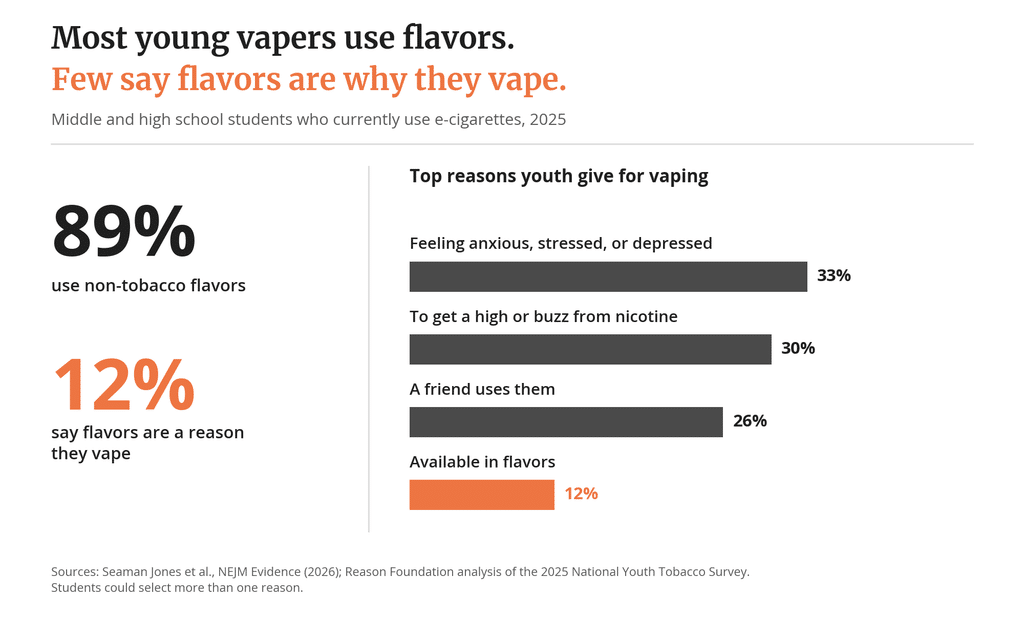
The NYTS survey also asks students why they vape, offering 13 possible reasons. Among current youth vapers in 2025, 33 percent cite feeling anxious, stressed, or depressed, with 30 percent citing getting a buzz from nicotine, and 26 percent say a friend uses them. Only around 12 percent cite the availability of flavors. Among students who have ever vaped, about half say they first tried it because a friend did, and roughly 40 percent because they were curious. About 10 percent point to flavors. Self-reported reasons have limits but shouldn’t be discounted when considering the motivations for youth nicotine use.
Raising prices and banning flavored vapes and pouches would not just affect youth. They would remove or significantly raise the cost of products that are dramatically safer than cigarettes and help smokers quit. Millions of adults have already switched from cigarettes to flavored vapes and pouches.
The risk of banning the preferred vape flavors of adults is that some may go back to smoking cigarettes or that some of America’s 24 million or so smokers who may yet switch to a flavored vape or pouch never do so. A 2025 study of Canadian sales data found that provincial e-cigarette flavor restrictions led to a nearly 10 percent increase in cigarette sales. A study of U.S. sales found that flavor restrictions led to about 11 to 15 more cigarettes sold for every e-cigarette pod no longer sold.
What the NEJM Evidence paper demonstrates is that, far from being a problem requiring a prohibitionist response, flavored vapes and nicotine pouches can be made readily accessible to adults without seeing significant youth use.