

For decades, debates about criminal justice reform have centered on incarceration rates, sentence lengths, and police activity levels. These metrics are easy to track and politically salient, but they often fail to capture what communities actually want from their justice systems: accountability for serious harm and actual, not theoretical, safety. One underused but powerful measure—clearance rates—can offer policymakers a way to evaluate whether reforms are working before they consider reverting to more punitive responses.
Clearance rates measure the proportion of reported crimes that law enforcement agencies “clear,” either by arrest or by “exceptional means,” such as identifying a suspect who is deceased or otherwise cannot be apprehended. While imperfect, clearance rates speak directly to whether crimes are being solved. For legislators, clearance rates can be used as a way to assess institutional performance that aligns public safety with fairness and legitimacy.
Low clearance rates can send the signal that authorities are lax about crime, with important implications for deterrence. According to the U.S. Department of Justice, “Research shows clearly that the chance of being caught is a vastly more effective deterrent than even draconian punishment.” Indeed, the evidence is well-established that long sentences are not the only or even best way to address crime. When people can expect to get away with crime, the deterrent effect of high penalties will be limited.
Rather than asking how many people are arrested or incarcerated, a figure that has not historically correlated with crime rates, clearance rates interrogate whether the system is effectively responding to harm. Accordingly, high arrest volumes can coexist with low clearance rates, especially when enforcement is concentrated on low-level offenses. Conversely, jurisdictions that reduce arrests for minor conduct can maintain—or even improve—clearance rates for violent crime if investigative capacity and community trust are preserved.
The relationship between clearance rates and community trust is critical. Research and practitioner experience suggest that communities are more willing to cooperate with law enforcement when they believe the system is focused on serious harm and operates fairly. Over-policing of minor offenses can erode that trust, making witnesses less likely to come forward and victims less likely to report crimes. In this way, clearance rates are not merely a technical measure but a reflection of institutional legitimacy. For policymakers, the choice is not between being “tough on crime” and pursuing reform, but whether reforms are designed to improve the system’s ability to solve serious crimes while reducing unnecessary criminalization.
Clearance rates on the decline
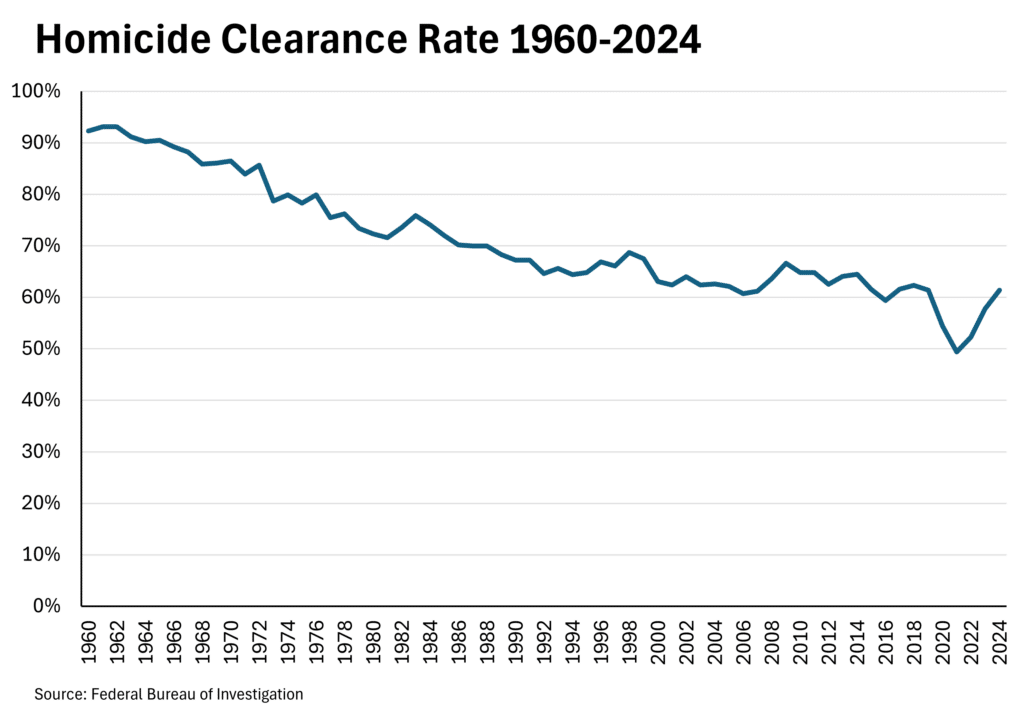
Clearance rates for violent crimes have declined for decades. The national homicide clearance rate fell from over 90% in the mid-1960s to a historic low of 54% in 2020, with similar declines for rape and aggravated assault. While clearance rates have rebounded modestly from pandemic-era lows to approximately 64% for homicides in 2024, they remain significantly below historical benchmarks.
Our nation’s police forces are spread among around 18,000 federal, state, and county police forces, and each is independent. Most agencies have 10 or fewer people, while some departments range up to more than 30,000, and they cover areas from urban to rural. These complexities make it hard to fully tease out what improves clearance rates and to craft policies that work across jurisdictions.
While it is hard to pinpoint why cases aren’t solved and reasons vary among jurisdictions, guns have played an outsized role in clearance rates, perhaps contributing to the declines over time. According to the Council on Criminal Justice, “Since 2020, more than three-quarters of homicides have been committed with guns. This marks an increase from 1980 to 1990, when firearms were used in fewer than two-thirds of reported homicides.”
Moreover, gun cases are just harder to solve. Jeff Asher, a prominent crime data analyst and co-founder of AH Datalytics, explained in an interview in the Atlantic why: “They take place from farther away. You often have fewer witnesses. There’s less physical evidence.” Asher also points out that most murders that are easy to solve (murders evincing clear evidence right away, such as a person caught standing over a victim while stabbing) are non-firearm murders. Because of the greater investigative load in gun cases, he concludes, “a higher share of gun violence can lead to a lower clearance rate.” In the face of gun trends, historical approaches to clearing cases are not holding up.
Clearance rates can also vary widely across jurisdictions, even among those with similar crime levels. Research shows that local policy choices, management practices, and resource allocation matter greatly. States and cities that invest in investigative capacity, particularly for shootings and homicides, tend to outperform those that spread resources thinly across large volumes of low-level enforcement.
A closer look at clearance rates points to some promising policy options, including adopting best practices for police agency performance; allocating resources to complex and violent investigations; and reducing policing of low-level and nonviolent offenses so that police agencies can concentrate on the investigation and resolution of serious crime. Reason Foundation analyzed clearance rate data and introduced 10 policy recommendations to improve the system. Read the recommendations below, or the whole policy brief here.
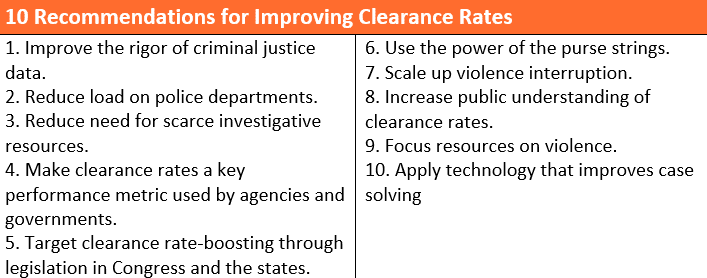
Encouragingly, a growing number of state and federal lawmakers are beginning to focus on clearance rates in their reform efforts, introducing bills that both track this metric and invest strategically in improving it.
Tailored resource allocation is key
Simply throwing money at police agencies and expecting improvements in clearance rates is unrealistic. While it may seem that more resources alone would increase case clearances, that does not appear to be the case. A more tailored approach is necessary to boost case solvability.
Consider that most police agencies spend the bulk of their time responding to calls for service and a paltry percentage of their time solving serious crimes. According to one study of various city police departments, less than 1% to up to 4% of officers’ time is spent on violent crimes; the largest block of time, roughly a third of officer time, is devoted to “responding to noncriminal calls.” Many jurisdictions are looking to deploy evidence-based load-lighteners. These evidence-based methods include sending alternate responders, such as social workers, to some kinds of calls for service instead of police; diverting people from the criminal legal process into services and rehabilitative programs; and simply improving lighting and relieving environmental blight in neighborhoods to reduce crime.
Clearance rates are also quite sensitive to workload. When officers and detectives are overwhelmed with minor cases, serious investigations suffer. Reforms that reduce arrests and prosecutions for low-level offenses can, if paired with strategic reinvestment, free up time and attention for complex investigations. Without reinvestment, however, reforms may leave agencies understaffed or misaligned with contemporary priorities.
With a homicide clearance rate that rose to 79% in 2024, beating out many other cities both in and out of the state, Dallas, Texas, serves as an illustration of how narrowing system focus to serious crime—while diverting lower-level cases—can strengthen overall system performance. While some of the success can be attributed to police department reforms, like improved technology and enhanced efforts to respond robustly to homicides, Dallas clearly enjoys an advantage in that various components of the criminal justice system are aiming toward the same goals. Dallas District Attorney (DA) John Creuzot has focused on violent crime prosecution while expanding the use of diversion into the county’s mental health program and specialty court programs. The office reports rosy outcomes, including a 20% recidivism rate after one year, and 15% recidivism after two years, for its mental health diversion, vastly better than most recidivism rates across the system. The Dallas DA also reports that completion of Dallas’ specialty court programs results in a whopping 91% reduction in recidivism, compared with a still-healthy 76% reduction in recidivismfor people completing its pretrial diversion programs. These gains by the prosecutor feed the improvements in clearance rates realized by the police department reforms, exemplifying how concerted efforts compound success.
Evaluating recent legislative efforts
Legislators should move beyond focusing on arrest, incarceration, and recidivism rates and meaningfully engage with the needed work of effectively responding to crime rather than trying to hit arrest or other target metrics.
A crop of bills pending in Congress and state legislatures takes an approach that values solving violent crimes over making more arrests and allocates resources to investigations and best practices, while downplaying outmoded tactics that don’t affect the salient violent crime clearance rates.
The most basic bills would require collecting, reporting, and analyzing violent crime clearance rates. For example, Illinois has a new law requiring the reporting of clearance data on nonfatal shootings and homicides beginning in July 2026.
Nationally, a bipartisan bill called the VICTIM Act, an acronym for “Violent Incident Clearance and Technological Investigative Methods Act,” was introduced in 2024, though it did not move ahead in the process. The legislation called for allocating $360 million in funds to go to state, local, and tribal police agencies for hiring detectives and investigative personnel; training personnel to investigate, solve, and respond to violent offenses, as well as to address needs of victims and family members; implementing technology solutions to enhance crime-solving; and providing mental health resources and assistance with housing and other costs for victims. Some states started adopting similar models.
Missouri recently enacted a wide-ranging law that includes reporting requirements and sets up a grant program for departments to use to shore up violent crime clearance rates. The sponsor of that legislation, state Sen. Nick Schroer (R-St. Charles County), has vowed to seek an appropriation of funding for the grants in the next legislative cycle. Recent polling by Arnold Ventures shows 85% of Missouri voters approve of the clearance rates grant program, and 61% would be more or much more likely to vote for a candidate who will fully fund the grants.
Tennessee has been dedicating funds to a variety of strategies to reduce and solve violent crimes since 2022, when it created its Violent Crime Intervention Fund (VCIF) with $100 million in initial funds, but the fund is not specifically tied to clearance rate reductions. In its 2023-2024 session, Tennessee considered, as an amendment to an apparently unrelated bill about local agencies assisting each other, language explicitly establishing violent crime clearance rate reduction grants, yet with no attached funding, and that bill stalled. It is not clear whether this provision will be refiled in the current session. Meanwhile, in 2025, Gov. Bill Lee announced $75 million in VCIF funding for that funding cycle, but these appear to be formula grants based on violent crime rates for each agency.
Unfortunately, many states that have thus far passed statutes similar to the VICTIM Act did not include an appropriation with the passage of the bill. Texas and Arkansas recently enacted laws that include clearance rates grant programs, which are also unfunded.
New York has a pending bill that would establish grants and pony up an appropriation of $300 million over 10 years to support statewide investigative capacity and improve evidence processing practices. Pennsylvania, Utah, and Michigan are mulling similar state-level grant programs that would support clearance-rate-boosting measures such as investigative staff and training, although none directly addresses the appropriation of funding beyond a small appropriation of $250,000 included in the Utah bill for implementation.
Georgia established a cold case unit in the Georgia Bureau of Investigation in 2023 with $5.4 million behind it in an effort to close old cases and bring comfort to families of victims of unsolved homicides.
Whether it is reporting and analysis of violent crime clearance rates, establishing cold case units, or providing direct support to agencies lagging in their effectiveness, there are myriad legislative approaches states have tried to make police agencies better at solving violent crimes. Data quality also plays a role in the ability to reliably improve clearance rates, since clearance rates depend on accurate crime reporting and consistent definitions. States can require standardized reporting and regular public disclosure, enabling comparisons over time and across jurisdictions.
The optimal approach involves pairing reforms that reduce low-level enforcement with investments in investigative capacity. This includes funding for detective staffing, training in evidence-based investigative techniques, and support for forensic and analytical resources. The goal is not to do more with less, but to do better with smarter allocation. This concept is consistent with the drafting of the violent crime clearance rates improvement grants discussed above.
Legislatures should support community-based strategies that enhance cooperation with investigations. Victim services, witness protection, and procedural justice initiatives all contribute indirectly to clearance by making it safer and more credible for people to engage with the system.
As with all policies, but particularly because of the complexity of the criminal justice system, legislative reforms should encourage coordination across agencies rather than siloed performance measures.
Finally, clearance rates should inform—not dictate or replace—broader reform debates. A decline in clearance rates may be viewed as a signal to investigate implementation challenges and contextual factors. Likewise, stable or improving clearance rates can reassure the public that police practices are improving. Note, for example, limited but promising evidence that legalization of marijuana in various states was followed by better violent crime clearance rates. Thus, there is good reason to think that reallocating police resources away from drug and status crimes and into best-practice investigatory strategies for solving violent crimes would be highly successful.
Conclusion
In an era of polarized crime politics, pushing the conversation toward clearance rates offers a pragmatic way forward. Clearance rate reforms focus attention on solving serious harm, respecting community concerns, and providing legislators with a metric that aligns accountability with restraint. Used wisely, clearance rates can help ensure that criminal justice system reforms deliver on their core promise: greater safety, achieved through effectiveness rather than excess.