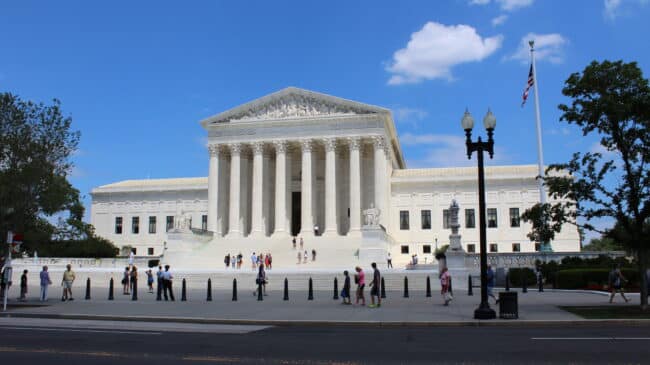

Last week, the Supreme Court ruled that the federal government cannot strip Americans of their Second Amendment right to bear arms simply because they use marijuana. In a rare unanimous 9-0 decision in United States v. Hemani, the court upheld Ali Hemani’s right to possess a firearm as a regular marijuana user, affirming the U.S. 5th Circuit Court of Appeals. Prior to the decision, all marijuana users, even those prescribed medical marijuana cards, were banned from possessing firearms. Although the decision is a win for marijuana users who want to own firearms, the Supreme Court made it clear that its decision was narrow, which might allow the federal government to introduce onerous restrictions that are tied to various types of use.
After two appeals decisions last September began unraveling the federal ban on gun ownership by marijuana users, the growing disagreement among the circuits looked likely to pull the Supreme Court into the fight. In anticipation of oral argument, Reason Foundation filed an amicus brief in January with the Cato Institute in support of the Second Amendment right to bear arms among marijuana users. As we outlined, historic restrictions on gun possession were categorically different from modern restrictions enforced via the Gun Control Act of 1968—and the Supreme Court agreed.
The facts were perfectly tailored to test the statute’s outer limits. Hemani, a Texas-born dual U.S.-Pakistani citizen, cooperated with federal agents searching his family’s home on suspicion of terrorism. After federal agents found marijuana and cocaine, Hemani proceeded to hand over a firearm he kept in his residence and volunteered that he used marijuana about every other day in a later interview. Months later, the government charged him under 18 U.S.C. § 922(g)(3)—not with terrorism, but solely for owning a gun while being an “unlawful user” of a controlled substance. For that admission alone, he faced up to 15 years in prison and a lifetime of disarmament.
Writing for the majority opinion with six other justices, Supreme Court Justice Neil Gorsuch held that the prosecution was unconstitutional. The reasoning echoes the exact framework that lower courts have been wrestling with since New York State Rifle and Pistol Association v. Bruen and United States v. Rahimi: Once conduct falls within the Second Amendment’s text, the government must show that its laws fit the nation’s historical tradition of firearm regulation—the new “history-and-tradition” test. To justify its actions, the government leaned on founding-era “habitual drunkard” laws. But the court found that the applicability of those old laws was inconsistent with modern restrictions on controlled substances.
As Justice Gorsuch explained, the argument made by the Department of Justice (DOJ) collapses on the “why” aspect of historic laws. A habitual drunkard in the 18th and 19th centuries was not someone who simply drank often—he was someone so incapacitated that he could not manage his own affairs. That distinction matters because heavy drinking was very common in early America, including by the very founders who wrote the Second Amendment. The court recounted the founders’ farewell dinner, at which 55 guests worked through some 54 bottles of Madeira, plus dozens more of wine, porter, and cider, days before the Constitution was signed. If regular intoxication were the trigger to disarm, half the founding generation would have forfeited their muskets.
The DOJ’s argument collapses on the “how” aspect as well. From the habitual drunkard standard, vagrancy, civil commitment, and surety laws generally required some process—a conviction, a probate hearing, or an appearance before a justice of the peace—before anyone lost his liberty. Section 922(g)(3) strips the right to bear arms automatically, the moment drug use begins, with no process to determine whether a particular defendant is a danger to themselves or others.
The Supreme Court then made the point libertarians have been pressing for years—the federal government is in a poor position to call marijuana users categorically dangerous when it has spent a decade normalizing their conduct. Prosecutors were told to generally ignore marijuana use that was consistent with state laws in 2013, following the Cole Memo. As of today, 42 states have legalized some form of cannabis use. And after oral argument in this very case, the federal government moved certain marijuana products to Schedule III of the federal Controlled Substances Act. As the court’s majority explained, Washington can hardly insist that the American people—who now use marijuana more regularly than they drink alcohol—are too dangerous to keep a gun at home as marijuana users.
Dual users of guns and marijuana should proceed carefully before celebrating, because the decision was narrow by design. The Supreme Court did not touch the ban on gun ownership for felons, did not grant ownership for addicts or possession while intoxicated, and explicitly left open the question of whether the government could still prosecute a marijuana user with individualized proof that his use makes him a danger to himself or others. The court also stated that the recreational use of substances that were not regularly used during the founding, like cocaine and heroin, could categorically strip the right to bear arms among users.
Two concurrences are worth watching. Justice Clarence Thomas wrote separately to question the current powers granted by the Commerce Clause—an obscure legal topic that many argue allows Congress to regulate anything it wants. In its brief, the DOJ argued that its regulation of firearm ownership is granted through the Commerce Clause. However, Thomas believes that the Commerce Clause grants Congress only the power to regulate explicit economic activity, such as the sale and purchase of firearms that cross state borders.
In the infamous 1942 case, Wickard v. Filburn, an Ohio farmer was banned from growing wheat on his own property to feed his own animals, a ban justified under the Commerce Clause. Thomas used his concurrence as a call for the court to revisit and restrict Commerce Clause powers, not only for gun regulations, but for all products.
Justice Ketanji Jackson, with Justice Sonia Sotomayor joining, also used their concurrence to discuss an explicit legal topic. Jackson observed that the history-and-tradition test introduced by Bruen, which instructs courts to find historic examples of regulations to justify current regulations, is inconsistent with all other protections of constitutional rights. Jackson saw this as a reason to revive means-end scrutiny for Second Amendment protections, which allows the court greater flexibility to rule in ways it deems pragmatic. But with the current “originalist” majority of the justices, we might instead see the court begin to apply history-and-tradition scrutiny to other rights, such as speech and religious freedom.
Soon, the Bureau of Alcohol, Tobacco, Firearms and Explosives (ATF) will be updating its regulations on gun purchases and ownership. Likely, a casual marijuana user who keeps a firearm at home will no longer automatically forfeit his right to bear arms merely by admitting to use. But the statute is not dead, and much of the enforcement framework on use circumstances persists. Moreover, anyone using a federally controlled substance outside of prescribed medical use still assumes real legal risk if they own firearms.