

With the conclusion of the 2026 midterm elections, the Democratic Party has pulled off an anticipated landslide victory. Unlike previous elections, the polls in this midterm were quite reliable at predicting the winners, only erring in a small number of Democratic upsets. Yet, as the debate over gambling regulation intensifies, many want to know whether the polls were outperformed by the accuracy of prediction market forecasts. Superior predictions are one of the key justifications for governing prediction markets under a more permissive regulatory structure than traditional online gambling, and the 2026 midterms served as an early test of whether these promises would be realized.
The day after the election, Kalshi reported that it had correctly predicted 479 of 487 midterm races that had been called, which is historically impressive. However, pollsters like AtlasIntel correctly predicted its winners with 100% accuracy, albeit surveying far fewer candidates. Many other polls also touted incredible accuracy, like the New York Times/Siena poll, which predicted 18 of 19 winners.
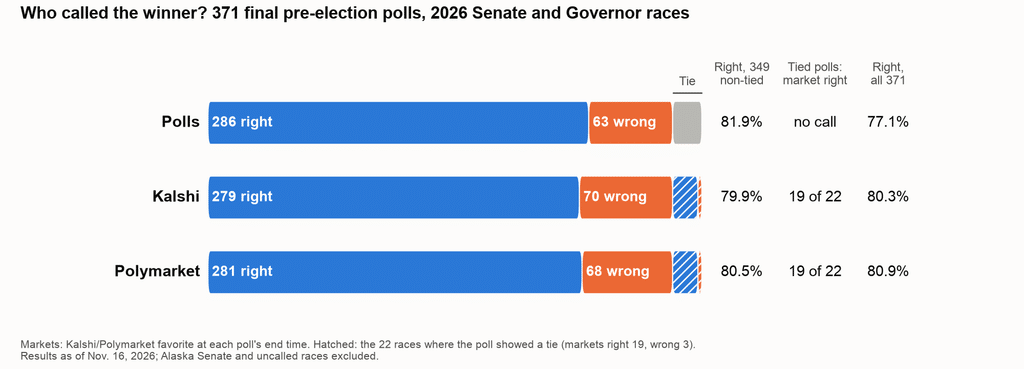
To compare the performance between election polls and prediction markets, we collected the last poll each major pollster published before the election and compared those results to the prediction market prices that were offered by Kalshi and Polymarket at those times. We then determined which forecasts failed to predict the election winner. The results were roughly even, with the prediction markets’ edge coming entirely from races the polls called a tie in this midterm.
Among 97 pollsters as of November 16, we collected 371 polls that ended between Sept. 8 and Nov. 2 (full data available here or below), for which a winner had been announced by the time of publication. Omitting 22 polls that reported a tied outcome, out of 349 total surveys, there were 279 (79.9%) correct predictions for Kalshi, 281 (80.5%) for Polymarket, and 286 (81.9%) for the various polls. Although these results slightly favor the polls by about two points, among the races that the polls said were tied, both Kalshi and Polymarket correctly predicted 19 of 22 (86.4%) elections. Across all 371 polls, counting a tie as no call, the polls got 286 right (77.1%), Kalshi 298 (80.3%), and Polymarket 300 (80.9%), giving the markets a slight overall edge, owed entirely to the tied polls. (Alaska’s Senate race and about ten House races remained uncalled at publication and are excluded. If current leaders hold, these figures shift by less than a percentage point, each.)
Prediction markets are supposed to introduce free-market principles into forecasting. Sophisticated traders are financially motivated to acquire as much information as possible to win their bets, creating a decentralized (or “Hayekian”) production of information that should, in theory, outperform any centralized source, including individual polls.
According to experts like Robin Hanson, when a small minority of sophisticated investors are given more financial incentive to conduct research, through higher trade volume (or more market participation), we expect the markets to be more accurate. This is the same mechanism that informs the accuracy of stock prices. This alleged relationship between market accuracy and trade volume is one of the strongest arguments for liberalizing prediction markets to foster more participation, which gives more financial incentive to sophisticated traders to correct prices after less-informed participants push the market price away from the true price. Yet, in this election, we saw that three of the five U.S. Senate and gubernatorial elections that the markets failed to accurately predict—(1) Iowa’s senator, (2) South Carolina’s senator, and (3) Texas’ governor—were among the highest trade volumes, suggesting that elections that the markets deem as close actually attract the most participation. Mississippi’s Senate race and Kansas’ governor race went against this pattern: Mississippi ranked 20th and Kansas 26th of the 31 races in trading volume. Moreover, we will need more wrong predictions from future elections to further evaluate whether trade volume correlates with prediction accuracy.
Although we did not witness a major increase in accuracy from prediction markets relative to polls in this election, possibly due to high margins of victory, they did substantively increase the breadth of predictions. Polls are too expensive to conduct for every U.S. House of Representatives seat election. Indeed, Kalshi predicted 340 of 343 (99.1%) smaller races correctly that no major poll attempted to measure, though keep in mind most seats are safe even in blowout elections. Because some elections are deemed more important than others, polls focus their resources on elections that they consider most relevant. The production of information that otherwise would not exist might be the best justification for prediction markets, which were incredibly accurate despite lacking any public polls for the market participants to reference.
Whether valid or not, polls can influence voter turnout, so some experts have suspected interference to promote candidates of choice in prior elections. Prediction markets can also affect voter turnout, but they are much harder to manipulate because high-profile elections would require millions of dollars in bets that would likely be lost if an interferer attempts to push the price away from the true market equilibrium. If sophisticated traders notice an unjustified price change, they will bet against it to exploit the arbitrage opportunity, bringing the price back to its true equilibrium. This also justifies a competitive market of multiple prediction markets, as each market pushes the others toward the same price because participants trade on the platform that offers the highest payout for their specific bet.
As prediction markets and polls compete in the information-generation market, prediction markets should also make polls more accurate. Individual polls are centralized actors that compete against one another to form a decentralized market that is more informative than any individual actor. Moreover, pollsters have been known to change their methodology in the past when their results are disproportionately out of sync with their peers, and we can expect prediction market forecasts to have a similar effect as a competitor. Indeed, their emergence might partly explain why the polls were more accurate than usual this season.
This analysis is not without its limitations. States of the world change between polls and the election, so failing to accurately predict an election result does not necessarily mean a poll was flawed—it could have accurately projected the election if it had happened on that day. That means the closer a poll is taken to election day, in general, the more the election result can determine its accuracy. However, prediction markets may have an advantage in predicting final results, as traders might be able to anticipate future events that would not affect opinion polls. We also did not factor in the strength of predictions in either the polls or the markets. For example, a poll surveying +1 points for a candidate counts as a correct call even if the race was won by +7 points.
With the unusual accuracy of the election polls in the 2026 midterms, likely due to landslide results, it is difficult to evaluate their performance relative to prediction markets. However, prediction markets provided more information this season, offering impressively accurate forecasts for about 340 elections that the polls did not have the resources to survey. Prediction markets were also correct in 19 of the 22 races the polls called a tie.
To definitively determine whether prediction markets offer more accurate forecasts than polls, we will have to wait for another election season where the polls are exceptionally wrong, and see if the prediction markets depart from those surveys. Prediction markets made accurate forecasts without polls in many elections this season, so future elections will help us determine whether polling errors interfere with or are ignored by the markets.
Data disclosure: Data were collected with Claude 5.11492.5 (1403e2) by scraping internet archives of the prediction market prices at the time of the polls’ closing times for the comparison figures, or at 6:00 pm ET on Nov. 3 for the unpolled races.