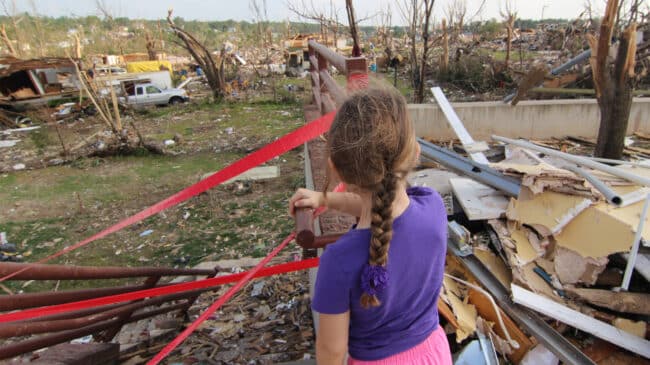

The distribution of federal disaster aid has drawn renewed scrutiny as approval rates have varied sharply across states. Since President Donald Trump returned to office, about 23% of aid requests from Democratic-led states were approved, compared to nearly 89% for Republican-led states. In some cases, requests were denied even when federal officials agreed the damage deserved help.
Under the current system, the Executive Branch has broad authority to approve or deny disaster aid requests. That means the final decision over whether communities receive support is not governed by fixed rules or timelines, but by discretionary judgment at the federal level. The problem is not any one political outcome. The problem is a system that leaves decisions that should be as data-driven as possible vulnerable to political discretion.
Concerns about political influence over disaster aid decisions are not new. Economists and policy analysts have long documented how political incentives shape the allocation of disaster aid. A 2020 review found that federal disaster spending often followed electoral considerations more than actual need, a pattern visible from New Deal programs to modern Federal Emergency Management Agency (FEMA) declarations.
No matter the reason for these differences in how disaster aid is approved across states, the system produces the same result: recovery becomes slower, less consistent, and harder to plan. That lack of consistency affects recovery at every stage, especially in housing, where rebuilding depends not only on federal decisions, but on how quickly systems at every level can respond.
Housing recovery is usually the slowest and most fragile part of disaster response. Delays or unclear federal decisions slow down rebuilding at every step. Local governments can’t start repairs without clarity regarding funding. Insurance companies respond to prolonged uncertainty by raising premiums, tightening coverage, or delaying payouts, and people who lost their homes compete for limited housing, which pushes rents higher. Lower-income families feel these pressures the most, often for years.
The FEMA was created in 1979 to help coordinate disaster response. The idea was simple: big disasters can overwhelm states, so the federal government steps in to help. But over time, the process for declaring disasters has become less predictable. There are no binding timelines for these decisions, and no requirement that presidential determinations follow FEMA’s recommendations. The process ultimately depends on judgment at the federal level. This setup leads to uneven results, no matter who is in office.
Disaster recovery is not handled through a single, straightforward process. It moves through multiple agencies, programs, and funding streams, each with its own requirements and timelines. This complexity makes coordination harder and delays aid reaching communities, a problem researchers have pointed out for years.
Federal decisions are only one piece of the recovery process. Those decisions are further constrained by local rules that determine how quickly housing can be rebuilt. Even when funding or emergency authority exists, zoning restrictions, permitting requirements, historic review, shoreline rules, infrastructure assessments, and limits on temporary or replacement housing can prevent damaged units from coming back online. Delayed federal decisions can stall funding while local approvals can slow construction, and insurance uncertainty can delay investment. Each layer extends the timeline, and together they determine how much housing is restored and how quickly.
Puerto Rico demonstrated a different version of the same problem after Hurricane Maria. Although Congress approved billions in disaster recovery funding, disbursement was delayed for years by administrative and bureaucratic obstacles, sparking national controversy and multiple federal investigations. The consequences extended far beyond infrastructure. Housing reconstruction moved slowly, and many residents were unable to access assistance. Strict documentation requirements, including proof of homeownership, led to widespread denials of FEMA aid in a context where informal housing arrangements are common. As a result, some residents were forced to abandon damaged homes altogether. The effects were long-lasting, contributing to displacement and persistent housing vacancy across parts of the island.
Maui faced a different set of constraints, driven more by state and local rules than federal decisions, but the result was the same. In 2023, wildfires forced thousands of people out of their homes on the island of Maui, including in the town of Lahaina, where housing was already scarce. Recovery depended on both funding and how quickly the recovery process could move homes through approvals and back into construction. More than a year later, the Grassroot Institute of Hawaii reported that few buildings had been rebuilt and many Lahaina residents were still waiting, slowed down by state and county approvals, unclear guidance, and permit issues. The report listed several hurdles, including historic reviews, infrastructure checks, shoreline rules, and limits on temporary housing. Maui County did make some changes, such as setting up an emergency permitting office and relaxing some rules, but many obstacles stayed in place. The slow recovery showed the limits of the recovery process as much as the damage itself. Housing reconstruction stalled, and roughly 90% of Lahaina burn-area residents were still displaced more than a year after the fires.
In Puerto Rico and Maui, recovery slowed because too many layers of approval could not keep up with the need to rebuild. The recovery process is structured in a way that produces these delays.
Large disasters often exceed what states can handle on their own, and federal support plays an important role in recovery. But that role should not extend to controlling the timing and distribution of aid through discretionary decisions. The federal government can provide funding, coordination, and technical support without acting as the central gatekeeper of recovery. Clear rules and set thresholds would make recovery more predictable and consistent, instead of leaving critical decisions to discretion. Those thresholds could be tied to measurable factors such as housing loss, displacement, and the extent of infrastructure damage, rather than left to case-by-case judgment.
A more resilient system would also rely less heavily on post-disaster federal intervention in the first place. States that face recurring disasters should maintain stronger reserves and planning systems before emergencies occur, rather than depending primarily on federal approval after the fact. Private insurance markets also play an important role in recovery, particularly when pricing and coverage better reflect long-term risk. A system that places all recovery responsibility on federal disaster aid encourages risks and creates delays that become even more damaging when housing supply is already limited.
A better system would make those rules operational. States would keep stronger disaster reserves so recovery could start right away. Federal help would kick in automatically when damage passes certain limits. Timelines for action would be set ahead of time. Housing recovery would be a top priority, with faster permits and pre-approved rebuilding plans that don’t require waiting for federal approval.
Housing recovery needs certainty and speed. The first weeks and months after a disaster determine whether a community can recover. If that time is spent waiting for federal approval, the long-term effects go far beyond the original damage.
The real problem is how the system is set up, not any one decision. Disaster recovery should follow clear, predictable rules instead of relying on individual judgment. Communities recover faster when decisions are made closer to the ground.