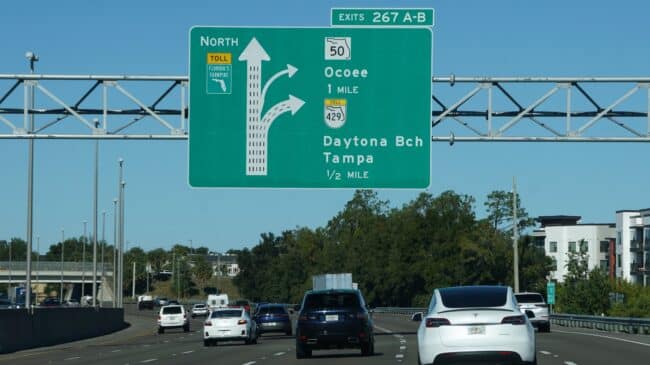

Traffic congestion is a never-ending problem in large U.S. regions. While new non-priced lanes can help reduce congestion, they are not a long-term solution as they become congested within two to five years after opening. Variably priced managed lanes, which use dynamic pricing that rises or falls with demand to help manage traffic flow and maximize person-throughput, offer a non-congested alternative for automobiles, buses, and vanpools.
Since the mid-1990s, metro regions have been adding priced managed lanes built alongside existing general-purpose (non-tolled) lanes or created by converting existing high-occupancy vehicle (HOV) lanes.
The toll prices for using these lanes rise based on congestion in the general-purpose lanes (and, to a lesser extent, the managed lanes), ensuring that the managed lanes provide meaningful time savings. Transit vehicles (as well as carpools in some regions) can use these lanes free of charge, making service speedier and more reliable. On many highways, the tolls collected on managed lanes can provide a significant portion of the funds needed to build and maintain them.
Orange County, California, pioneered the first managed lanes on State Route 91, opening in December 1995. By 2010, there were four additional projects: I-495 high-occupancy toll lanes in Virginia, the I-595 express lanes in Florida, North Tarrant Express Phases 1 and 2W, and the LBJ TEXpress Lanes in Dallas. Today, there are more than 60 projects in operation.
While there are numerous managed lane facilities, many exist on isolated portions of a freeway system. Drivers benefit from the priced lanes on an individual facility, but if they need to use a different limited-access highway, they have to rejoin the congested general-purpose lanes. Drivers are less likely to use a managed lane if it only benefits them on a small part of their trip. Transit operators face a similar dilemma since managed lane access for only part of the trip does little to enhance service reliability when they encounter congestion during the remaining parts of their trip.
As a result, many state departments of transportation and metropolitan planning organizations, which are responsible for planning transportation projects, have moved from building managed lanes on a corridor basis to constructing managed-lane networks throughout their regions. These networks include not just the mainline lanes but also on- and off-ramps connecting limited-access highways to other limited-access highways. Managed lane networks are concentrated in regions with large, fast-growing populations. These regions also tend to have the worst traffic congestion, commuters willing to pay to avoid congestion, and significant transit usage (both the share of commuters and number of riders).
At least 16 regions are building managed lane networks, including Atlanta, Charlotte, Dallas, Denver, Houston, Los Angeles, Miami, Minneapolis, Nashville, Salt Lake City, San Diego, San Francisco, Seattle, Tampa, and Washington, D.C. Within 10 years, the U.S. is expected to have almost 100 managed lane projects across 20 states.
Not all the freeways in a region are good fits for managed lanes. But in many metro areas, a loose guide is that based on traffic projections and predicted demand, at least 60% of freeways can benefit from adding a managed lane.
To qualify as a managed lane network, 60-75% of freeways must have managed lanes. Seventy-five percent is the goal because it is the point at which at least 50% of commuters can reach their intended destination by using the managed lane network.
Some managed lane segments will be more financially self-sustaining than others. Tolls may cover 100% of the capital and operating costs for some corridors, while others may require subsidies from other corridors or from fuel taxes. Some will support more transit service than others, with multiple bus lines operating with headways as low as 15 minutes on some corridors.
Some regions, including the Northern Virginia suburbs of Washington, D.C., have built an extensive network, with managed lanes on almost every freeway. Others, including Atlanta, have built out parts of their network but need to complete several other major corridors. Still others, including Nashville, are still planning their first corridor but have plans for an extensive network.
Some regions have built most or all of their lanes as toll concession public-private partnerships (P3s). Given that traffic forecasting is as much an art as a science, P3s are helpful because they transfer revenue risk to the private sector partner. If a recession or other calamity reduces traffic counts and thus toll revenue, taxpayers are not at risk of covering the shortfalls. Dallas and the Northern Virginia suburbs of Washington, D.C. have built numerous projects as P3s.
Not all projects make sense as public-private partnerships, and some managed lanes are financed, maintained, and operated by state transportation departments. However, P3 concessionaires can provide other transportation improvements either through concession payments or direct construction or operation of roadway and transit improvements.
Some areas have also comprehensively integrated bus service into the managed lanes. While most regions operate express bus service in the managed lanes, some have added bus rapid transit service, which includes stations in the highway median, to foster easier access and land-use features designed to spur transit-oriented development. The Minneapolis METRO Orange Line, the Los Angeles Metro Silver Line, and a forthcoming line on State Route (SR) 400 in Georgia all include bus rapid transit. The Minneapolis line serves more than 2,000 riders a day, quadrupling ridership from an express bus line that operated before the managed lane opened.
Managed lanes have been a game-changer for managing traffic congestion in large metro areas. The next step is creating a managed lanes network in all large metro areas to ensure drivers across the region benefit. Metro areas from Miami to Seattle would be wise to follow Northern Virginia’s lead by implementing managed lane networks.