

To safely fund pension benefits, pension plan administrators use and rely on assumptions about the returns they expect to generate on investments. When those assumptions are too optimistic, the shortfall falls on taxpayers and the workers counting on a benefit. Administrators for Arkansas’ teacher pension plan recently rejected a proposal to scale back this assumption, planning on higher returns than markets are likely to deliver. But the funding rules and contribution limits are set in state law, and lawmakers can still enact reform while the plan is in a stronger position, rather than wait until a bad market forces their hand.
The Arkansas Teacher Retirement System (ATRS) is the state’s largest retirement system, with more than $23 billion in investments and over 70,000 active members. In a meeting earlier this year, the system’s Board of Trustees addressed a proposal to trim the system’s assumed rate of return (ARR) from 7.25% to 7.20%. In a fund the size of ATRS, five basis points can have a huge impact on funding and contribution calculations. The motion failed, and the rate stayed put, with proponents citing “the stability” of the fund.
The Arkansas teacher pension was 84.4% funded as of the close of fiscal year 2025, with assets of $22.8 billion against total liabilities of roughly $27 billion. The system’s actuary, Gabriel Roeder Smith & Co. (GRS), told trustees that the defensible range for the assumed rate of return is 6.75% to 7.25%. The current rate is at the high end of this recommendation and significantly higher than the national average ARR of 6.9%. The trustees have already shown a willingness to act with caution, cutting the assumed rate from 8% to 7.5% in 2017 and again to 7.25% in 2021.
This time, though, the vote was not tipped by new information or an actuarial model. Trustee Danny Knight, who moved to hold the rate steady, cited the war in Iran, the coming midterm elections, and “turmoil in each area of this country” as reasons to keep the rate steady. However, by lowering the assumed rate of return, a system actually becomes less reliant on future markets, building a margin that is resilient to shocks from war, elections, and turmoil. Indeed, the actuaries note that if GRS could make things less risky for ATRS, “we would always recommend that.” A rate cut would serve to do exactly that.
The risk of missing the 7.25% assumption is already high. Reason Foundation’s Pension Solvency and Performance Report estimates ATRS has roughly a 52.75 percent chance of missing its target over the next 10 years.
This year’s returns illustrate the problem. ATRS had a 9.4% return on a market value basis. This is significantly above the assumed rate of return. However, pension funding uses a smoothed figure to reduce year-to-year noise. Using that standard, the Fiscal Year 2025 return was 5.78%, which is nearly a point and a half short of the 7.25% assumption. While this is just one data point, the 24-year average return for ATRS is 6.9%. Even over decades, the assumption has been far too optimistic.
For funding purposes, the ATRS discount rate, which is the figure used to calculate pension liability, is set equal to the assumed rate of return. This means the rate cut trustees rejected would also have lowered the discount rate applied to the plan’s liabilities. According to ATRS financial disclosures, a one-point reduction in the discount rate, from 7.25% to 6.25%, would raise ATRS’s net pension liability from $3.58 billion to $6.98 billion.
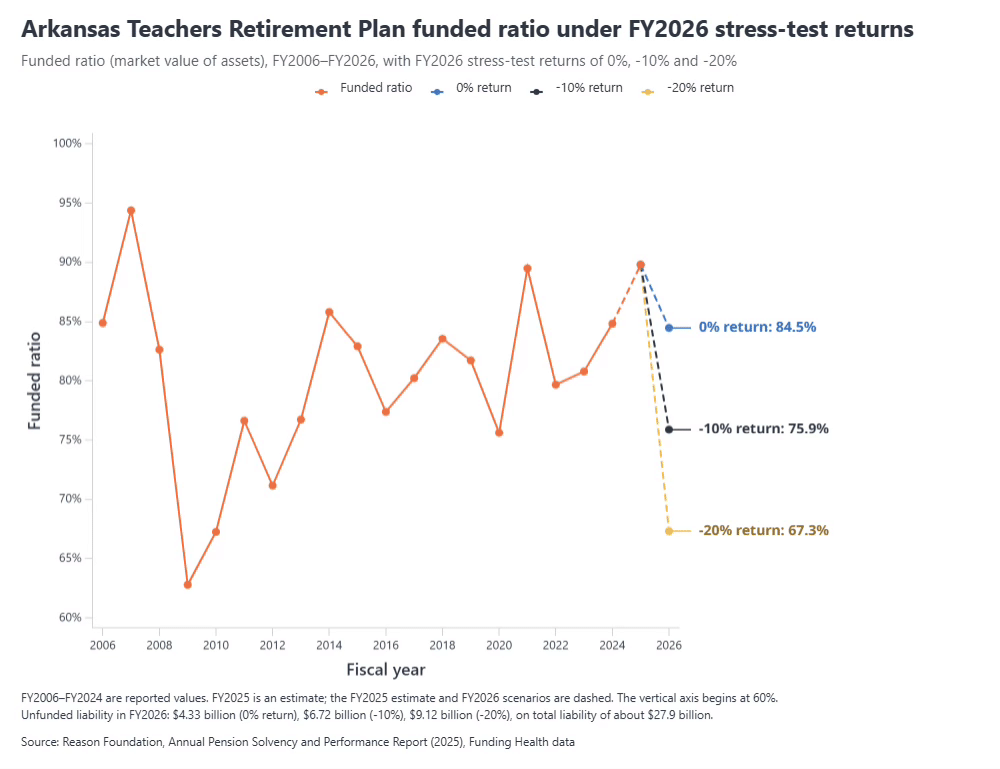
The system is especially vulnerable to large-scale market downturns. Reason Foundation’s stress-test modeling of ATRS uses three different 2026 scenarios to show what could happen to the plan’s $27.9 billion total liability. A year with 0% returns would leave the unfunded liability at $4.33 billion and the funded ratio at 84.5%. A year with a 10% loss would push the unfunded liability to $6.72 billion and the funded ratio down to 75.9%. A bad year with a 20% loss, similar to the 2007 financial crisis, would increase the unfunded liability to $9.12 billion and the funded ratio down to 67.3%. A single down year, at the harder end of what markets have brought before, would erase more than a decade of progress toward improving the funding of crucial benefits promised to Arkansas teachers.
A lower assumed rate builds exactly the cushion needed to help weather the bad times. Assuming less from the market means contributing more today, creating a stronger asset base when a rough year arrives. A plan with a more conservative assumption better absorbs a shock, starting from a stronger position and leaving less ground to make up afterward. By cutting the rate now, the system can build a cushion from a good position, rather than waiting for a bad year to force the adjustment on worse terms. A lower rate would raise the plan’s calculated liability today, but it locks in a funding target that the plan is more likely to hit, rather than one with a 53% probability of falling short.
Whatever the ATRS board decides on its return assumption going forward, a larger issue remains for the state’s legislature to address. ATRS’ employer contribution rate is capped by statute at 15% of payroll and is not automatically tied to the amount needed to fund the promised benefits. The system’s actuary already estimates that a rate closer to 15.9% would be needed to keep the plan’s amortization schedule on track and to pay down the unfunded liability as planned. While funding policy is at the discretion of state lawmakers, ATRS setting a lower return assumption would appropriately convey the scope of this problem and encourage them to provide the additional funding needed.
After several good years of investment returns and valuable progress in improving the system’s funding, now is the perfect time to align ATRS’ assumptions with national averages. Doing so would better communicate the long-term funding needs of Arkansas teachers, so lawmakers can act with clear information as they address ongoing funding challenges.