
In This Issue:
Articles, Research & Spotlights
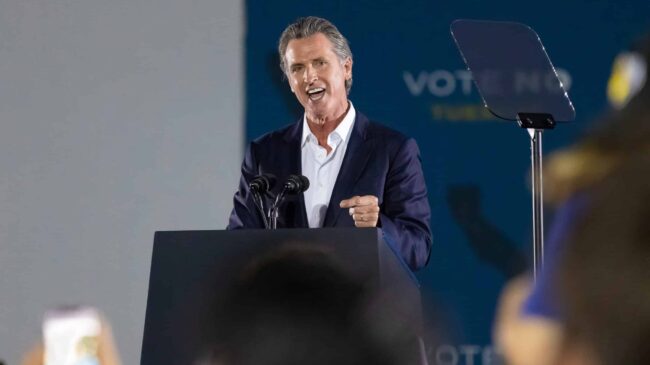
- Gov. Newsom Vetoes Pension Increase for California Police and Fire
- North Dakota’s Pension Reform Shows Early Signs of Success
- Flexible Benefits Can Stabilize Pension Funding
News in Brief
Quotable Quotes on Pension Reform
Reason Foundation in the News
Articles, Research & Spotlights
Newsom Vetoes Pension Increase for California Police and Fire
California Gov. Gavin Newsom vetoed Assembly Bill 1383 last month, rejecting a bill that would have lowered the retirement age for police and firefighters from 57 to 55, raised the pensionable earnings cap, and let unions bargain for formulas as high as 3% per year of service. The bill passed the Senate 33-0 and the Assembly 69-2. In his veto message, Gov. Newsom pointed to the lessons of the state’s pension crisis spurred by unfunded benefit increases that eventually led to the Public Employees’ Pension Reform Act (PEPRA), which is helping reduce the state’s long-term public pension costs. Reason Foundation contributed to the discussion with actuarial analysis that put the bill’s 30-year cost at $11.8 billion, with most of it driven by the higher compensation cap. With the California Public Employees’ Retirement System, CalPERS, still $179 billion short of fully funding pension promises already made to workers and retirees, the governor’s veto keeps PEPRA’s guardrails in place.
North Dakota’s Pension Reform Is Showing Early Signs of Success
In a public comment to North Dakota’s Employee Benefits Program Committee, Reason Foundation’s Brayden Myers found that the state’s 2023 public pension reform, House Bill 1040, is delivering on its goals. The closed Main Plan’s funded ratio rose to 71.3% in the July 2025 valuation from 67.7% a year earlier, and its unfunded liability fell. The North Dakota Public Employees Retirement System (NDPERS) projects full funding in 2056 if the new actuarial funding policy and assumptions hold. Meanwhile, 2,485 new employees had enrolled in the defined contribution plan by Sept. 30, 2025, and 74.3% chose to contribute above the default rate.
Flexible Benefits Can Stabilize Pension Funding
Traditional defined benefit pension plans fix benefits and shift all funding risk onto employer contribution rates, making budgets hard to manage. Reason Foundation’s Rod Crane examines two systems that offer flex benefits for post-retirement. South Dakota’s fixed 6% employee and 6% employer rate are paired with a cost-of-living adjustment that changes to what those contributions can support. That has kept the actuarially determined contribution between 10.5% and 11.9%, below the 12% statutory rate. Wisconsin shares investment gains and losses with retirees and has kept its rate within roughly 13.6% to 14.4%. Both protected most of retirees’ purchasing power over 2015-2025, with about 72% of inflation covered for South Dakota and about 87% for Wisconsin’s core annuity.
News in Brief
New Study Finds Maturing Public Pensions Have Become Regular Equity Sellers
A new National Bureau of Economic Research working paper by Aleksander Andonov, Kristy Jansen, and Joshua Rauh examines what happens when pension funds pay out larger benefits than they take in from contributions. The authors combine aggregate U.S. data on public pension funds and find that rather than adjusting target asset allocations or building larger buffers, plans with more negative cash flows cover shortfalls mainly by selling equities, absorbing about $0.67 of every dollar of cash-flow stock that way. The plans also sold equities when returns were negative, which the authors view as a sign that the trades represent liquidity needs rather than rebalancing. They note that pension funds have become regular sellers in equity markets rather than stabilizing, contrarian investors. Read the paper here.
Quotable Pension Quotes
“I still recall — before PEPRA’s passage in 2012 — the alarming forecasts, the fierce criticism of public employees, and the growing pressure to eliminate defined benefit plans altogether… This is an era of California history I do not wish to repeat.”
––Gov. Gavin Newsom, in “Newsom cites pension crisis as he vetoes bill to enhance retirement for police and firefighters,” CalMatters, Sept. 20, 2026.
“I don’t want to, in any way, portray that once we think we get this thing to 100% funded, and we make a payment that gets it there, that that means you’re done … There’s risk going forward with this.”
––Steve Russo, executive director of the Indiana Public Retirement System, in “Indiana officials expect saving $1B a year as teacher pension plan hits funded status,” Indiana Capitol Chronicle, Sept. 25, 2026.
“The legislation was passed in 2023 establishing a defined-contribution plan for new employee hires (hired after Jan. 1, 2025) and requires actuarially determined contributions targeting full funding of the unfunded liability by 2045. Given North Dakota’s history of underfunding the plan, we had previously anticipated NDPERS becoming a source of cost pressure over time but now expect the cost trajectory will be more sustainable.”
––Kenneth Biddison and Scott Nees, S&P Analysts, on North Dakota’s credit outlook in a research update, May 27, 2026.
Reason Foundation in the News
“California’s Richest Pensioners Revealed as Fat Cats Raking in $400K for Doing Nothing” in the New York Post’s California Post quoted Reason Foundation’s Zachary Christensen on the scale of California’s pension debt.
“With veto of AB 1383, Newsom saves California from the next pension crisis,” an Orange County Register opinion piece on Gov. Newsom’s veto cited Reason Foundation’s analysis of AB 1383.