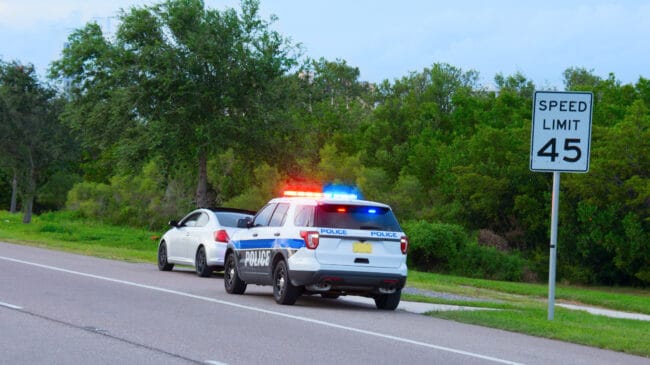




Local governments across the United States collect substantial revenues through law enforcement fines and forfeitures. While monetary penalties serve legitimate purposes in the criminal justice system, their use becomes exploitative when governments rely on law enforcement and courts as essential revenue sources, creating conflicts of interest that undermine public safety and erode public trust.
Despite widespread agreement that reform is necessary, limited data has been a persistent barrier to effective policy change. Policymakers seeking to understand the scope of the problem in their own states have often lacked basic information about how much revenue local governments collect, which jurisdictions are most reliant on it, and whether existing reforms are working to correct perverse incentives.
A new Reason Foundation report, Taxation by Citation: A 50-State Data and Policy Report on Local Government Fines and Forfeitures, aims to address that gap through a novel dataset of audited local government financial statements covering more than 10,000 cities and counties, as well as a systematic review of existing reform efforts.
Prior to this report, the Census Bureau’s Annual Survey of State and Local Government Finances was the only national source of data on local government fines and forfeitures. Census data are valuable for national and state-level estimates, but they have significant limitations for identifying specific problem jurisdictions. Individual government values are frequently imputed rather than directly reported; the Census Bureau’s revenue classification system does not always align with how governments record their own finances, and the most recent data lag by several years.
To address the limitations of the Census data, Reason Foundation compiled audited financial statements for 8,054 cities and 2,478 counties, covering fiscal year 2023. This dataset is made fully accessible through the interactive report, with complete financial statements available for every government included in the analysis.
State-level findings (Census Bureau data, FY 2022)
Local governments across the 50 states collected $8.3 billion in fines and forfeitures in fiscal year 2022. While fines represent just 0.38% of general revenue on average, reliance is heavily concentrated in a small number of jurisdictions.
Arkansas, Illinois, New York, Tennessee, and Georgia lead all states in the share of local general revenue derived from fines and forfeitures, each exceeding 0.65%. Eight of the 10 states with the highest reliance are in the South or South-Central region. Nebraska, Connecticut, Vermont, New Hampshire, and Hawaii rank at the bottom, each well below the national average.
Arkansas leads all states at 0.78% of local general revenue, followed by Illinois (0.73%), New York and Tennessee (0.69% each), and Georgia (0.66%).
In raw dollar terms, New York and California each collected more than $1 billion in FY 2022. The top 10 states alone accounted for more than $5.8 billion, about 70% of total local fines and forfeitures revenue nationwide.
New York also leads on a per-capita basis at $75.81 per resident—about 1.4 times more than the next-highest state, Illinois, at $53.76. The national weighted average was $24.77 per resident.
Local government findings (audited financial statements, FY 2023)
Census data provide a useful national picture but cannot reliably identify specific high-reliance jurisdictions. The audited financial statement dataset addresses this shortcoming. Because the accounting standards for financial statements exclude fines and forfeitures from the general revenue denominator, reliance ratios can exceed 1.0 if fine revenue surpasses the government’s entire conventional tax-derived revenue base. The full report’s technical appendix explains the methodology in detail.
Among the governments in this dataset, 275 jurisdictions across 25 states reported fines exceeding $0.10 for every dollar of general revenues in their 2023 fiscal years. High reliance on fines and forfeitures is concentrated heavily in Louisiana, Georgia, Tennessee, Illinois, and Oklahoma, which together account for nearly three-quarters of high-reliance cities.
The 42 cities that collect more than 50 cents in fines for every dollar of general revenue are concentrated almost entirely in the South and South-Central United States, with the densest cluster in Louisiana.
McNary and Port Vincent, both in Louisiana, top the list of fines for every dollar of general revenue at 291% and 275%, respectively. Seven of the top 10 cities are in Louisiana. Henderson, Louisiana, and Poulan, Georgia (ranked 7th and 8th nationally), are profiled as case studies in the full report.
On a per capita basis, 41 cities collected more than $500 per resident in fines in FY 2023. The geographic pattern is similar, though extreme per capita outliers appear in Ohio and New York as well as the South.
Linndale, Ohio, leads all cities at $8,885 per resident, followed by Robeline, Louisiana ($2,987), Ocean Beach, New York ($2,970), and Georgetown, Louisiana ($2,933).
Cities in Louisiana account for four of the top 10 for per-capita fines and forfeitures.
At the county level, high per capita fine collections are concentrated in Georgia, Texas, South Carolina, and parts of the West. Georgia and South Carolina dominate the highest per capita figures, with several counties exceeding $500 per resident.
Taliaferro County, Georgia, leads all counties at $762 in fines and forfeitures per resident, followed by Turner County, Georgia ($515), and Lee County, South Carolina ($484).
Georgia accounts for five of the top 10 counties. Turner County is profiled as a case study in the full report.
Why it matters
Fiscal dependence on enforcement revenue produces measurable changes in policing behavior. Research shows that counties and cities increase traffic citations following revenue shortfalls, and that jurisdictions collecting higher shares of revenue from fines have lower crime clearance rates. When resources are diverted toward revenue generation, other public safety priorities suffer.
The U.S. Department of Justice’s 2015 investigation of Ferguson, Missouri, found that city officials routinely pressured police to increase citation revenue, fueling a pattern of unconstitutional policing. Similar dynamics have emerged in jurisdictions across the country, from Brookside, Alabama, to Mantua, Utah.
The full report features five case studies (Henderson, Louisiana; Poulan, Georgia; Turner County, Georgia; Seat Pleasant, Maryland; and Stringtown, Oklahoma) showing what structural fiscal dependence looks like in practice and why it has proven so difficult to dislodge.
The reform landscape
The report includes the most systematic review of state-level reform efforts to date, examining quota bans, fine revenue caps, and other oversight frameworks. The analysis assesses the specific design features, legislative histories, and practical track records of each approach, identifying loopholes and enforcement failures that have allowed revenue-oriented policing to persist even in states that have pursued reform.
About half of all states have enacted police quota bans, prohibiting local law enforcement agencies from requiring officers to meet specific numerical targets for arrests, citations, or traffic stops. However, definitional ambiguities, broad exceptions, and the absence of meaningful enforcement mechanisms have left law enforcement officer behavior largely unchanged.
A smaller number of states have addressed fiscal incentives more directly. Alabama, Georgia, Missouri, Oklahoma, Texas, Utah, and Maryland have each enacted revenue caps designed to eliminate financial incentives to issue citations, with widely varying results.
Missouri’s Macks Creek Law, which caps fines, bond forfeitures, and court costs arising from municipal ordinance violations and minor traffic violations at 20% of general operating revenue for all municipalities statewide, has been revised multiple times over three decades in response to persistent evasion, including after the Ferguson investigation exposed its limitations.
Alabama’s 10% cap on traffic ticket revenue, enacted in 2022, is the strictest in the nation but narrowly applies only to traffic citations. The cap was a direct response to the scandal in Brookside, a town of roughly 1,250 residents, whose fines and forfeitures revenue grew by more than 640% between 2018 and 2020, ultimately accounting for half of its budget. At the height of its enforcement push, Brookside recorded more misdemeanor arrests than it had residents.
Utah’s cap, enacted the same year, produced measurable compliance but similarly covers only traffic fine revenue.
Reform efforts to date have followed a consistent pattern of responding to specific scandals without addressing the underlying fiscal incentive. As a consequence, these reforms have largely failed to achieve their goals. Durable reform requires both well-designed revenue caps and the enforcement infrastructure to make them stick.
Policy recommendations
The report concludes with six recommendations for more durable reform to reduce the use and abuse of fines and forfeitures:
- States should adopt comprehensive caps on fine revenue with robust enforcement mechanisms. Caps that limit how much fine revenue local governments may retain are the most direct way to reduce the fiscal incentive for revenue-oriented policing. Existing state caps have been undermined by narrow definitions that invite evasion. Effective caps must cover all enforcement revenue, use a denominator anchored to audited financial statements, and include mandatory reporting and diversion of excess revenue to purposes outside the collecting government’s control.
- States should strengthen and enforce quota bans. About half of the states prohibit police quotas, but most of these laws lack meaningful enforcement mechanisms, contain broad exceptions for performance evaluations, and fail to address informal pressure to meet numerical targets. States should adopt the expansive definitions of prohibited quotas, establish centralized reporting systems for officers to flag violations, and impose consequences for those who violate the law.
- Eliminate municipal courts in small jurisdictions. Cities with their own courts collect between 62% and 98% more in fines and forfeitures than comparable cities without their own courts. In small jurisdictions, the same officials who control the budget also control the court. States should consider requiring that minor offenses in jurisdictions with populations below a minimum threshold be adjudicated in independent county or regional courts.
- Mandate comprehensive data collection and reporting. The opacity surrounding fines and forfeiture practices has allowed abuses to persist and made it difficult to assess whether reforms are working. The data presented in this report required substantial effort to compile precisely because no centralized, standardized reporting infrastructure exists. States should require local governments to submit annual certified reports on enforcement revenue to a state oversight authority, with results published in a publicly accessible database.
- Fully fund court systems from general revenues. When courts depend on the fines and fees they collect to cover their own operating costs, including, in some cases, judicial salaries, they face the same perverse incentives as the police departments that generate the cases they adjudicate. States should work toward funding local courts from general revenues rather than user fees, with intermediate steps including state assumption of specific court functions and the elimination of the most problematic fee categories.
- Build rigorous evaluation into reform legislation. Most existing research on fines and forfeitures relies on observational methods, making it difficult to confidently determine whether specific reforms have actually changed enforcement behavior or improved public safety outcomes. Reform legislation should include a statutory requirement for independent external evaluation using experimental or quasi-experimental methods, with findings submitted to the governor and legislature within a defined timeframe and published publicly.
The full report is available here.