
- What went wrong at LaGuardia
- More FAA facility evacuations
- A better approach to airport security
- O’Hare’s airline capacity battle
- Who should pay for ATC modernization?
- FAA’s office relocation problem
- News Notes
- Quotable Quotes
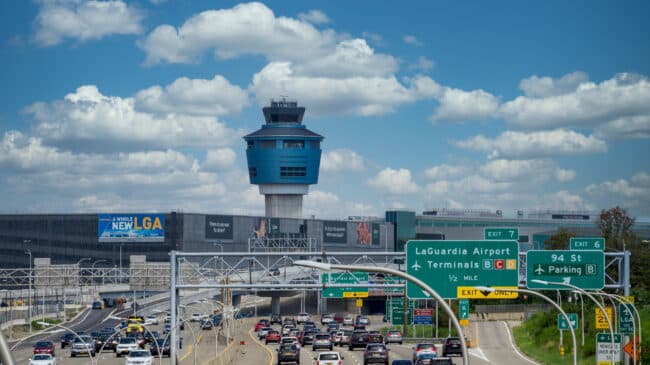
What Went Wrong at LaGuardia Airport Last Month
When the Washington Post invited me to write an op-ed about the March 22 collision between an Air Canada Express regional jet and an airport fire truck, I drew on what I knew about the runway safety system ASDE-X to explain what it did and did not do. The Post did extensive fact-checking, and you can find the op-ed online.
Since then, I’ve learned more details and can provide a deeper explanation of what happened and why. To begin with, it’s important to know that LaGuardia (LGA) has a record of accidents and near misses. A good overview was written by Will Guisbond in The Air Current. Reading that, you may wonder why a fatal accident had not occurred there previously.
As I write this, the National Transportation Safety Board (NTSB) is in the early stages of its investigation, so I will not be drawing on them for this article. My sources are engineers who worked on and are very knowledgeable about the technology at LGA (and other busy airports), intended to prevent runway collisions. One of the most important is ASDE-X, a system that collects real-time data on runway and taxiway activities to alert controllers to potential collisions, etc. That system is installed at 35 busy airports, beginning with Milwaukee in 2003. It uses several types of radar and multilateration to track aircraft and ground vehicles. These data are “massaged” to predict incursions that could result in collisions.
I’ve had extensive discussions with a now-retired Federal Aviation Administration (FAA) systems engineer who was one of the designers of ASDE-X. Because the system is intended to alert controllers to impending collisions, preceded by incursions, during the design phase controller work groups weighed in on setting parameters in the system that trigger alerts. The basic collision warnings and alerts are adjustable by setting time and distance parameters of ASDE-X “safety cells.” Those cells are designed to consider as many as 300 possible situations. During ASDE-X development at FAA Tech. Ops. in Oklahoma City, the FAA agreed with controller work groups to adjust the parameters of time and distance to avoid false alarms that would be recorded as controller errors. Because every airport is different, these parameter adjustments took place at every airport where ASDE-X was deployed. In many cases, the adjustments would completely eliminate any chance of generating a false alarm.
My informant believes that in the LGA tower, the ASDE-X parameters had been turned down so low for many years that a collision warning either did not occur or occurred too late to enable action by the regional jet pilot or the driver of the fire truck.
A second factor is that the fire-rescue truck that the airliner crashed into was not equipped with a transponder or squitter transmitter to ensure that ASDE-X would “see” it. Third, the hold-line status lights at the edge of the runway were lit up red, and the fire/rescue truck should not have moved forward while they were in that condition.
So, where should blame be placed for this horrible accident? First, I fault the FAA as the safety regulator for not properly overseeing how ASDE-X was being used, with turned-down parameters aimed at preventing false alarms, but which also interfered with needed alarms. Second, there may be controller error in initially allowing the truck to begin moving, even though the red hold line and runway status lights were still lit. And third, LaGuardia officials failed to equip their airport ground vehicles with transponders or squitters to ensure that they would be tracked by ASDE-X. Many serious accidents have multiple causes, and this one is no exception.
One other takeaway from this tragedy was suggested to me by a former senior Department of Transportation (DOT) official I’ve been friends with for many years. He wrote:
“Quite apart from confirming FAA’s abdication of regulatory responsibility for ensuring that ASDE-X delivers all of the surveillance it’s capable of delivering, [your informant’s] account of the process by which it was adopted and deployed should be made Exhibit A in the case for separating ATC from the FAA—just outrageous. Imagine what an intrepid investigative reporter could do with a story like that.”
More FAA Facility Evacuations; Same Cause
The March 13 evacuation of the FAA’s Potomac TRACON (a consolidated TRACON, the newest one in the FAA’s inventory) was due to a “chemical odor” caused by a burned-out (and smoldering) electronic circuit board. The same thing happened again at the same TRACON on March 27. Since this TRACON handles arrivals and departures at five airports (Reagan National, Dulles International, Baltimore-Washington, Richmond, and Andrews), whenever it is shut down, flights cannot land, and only limited flights can take off at any of those airports.
After I wrote about the first evacuation in last month’s issue, an FAA public affairs guy called me to say that my citation of an FAA maintenance policy dubbed “fix on fail” is incorrect—there is no such policy, he said. When I relayed this message to the retired FAA systems engineer who’d explained this to me, he was incredulous. He explained that the FAA, in April 2006, adopted an official maintenance policy called Reliability Centered Maintenance (RCM) and referenced the FAA’s Order 6000.207. RCM is used in a large variety of industries reliant on major systems with numerous parts that can fail. But it requires discipline (which the FAA lacks) in tracking and calculating risk and the consequences of failures. Replace on failure is a basic tenet of RCM.
My retired FAA source explained that although the agency officially adopted RCM, it has never followed through with the kind of ongoing maintenance and replacement program it calls for. That requires understanding the operational impact of a failed component. Consequently, the term “fix on fail” is the FAA’s de facto policy. One reason for this is a 2,500-person shortage of maintenance technicians. The FAA could request a larger budget to address this shortfall, but since the White House Office of Management and Budget (OMB) rides herd on federal agency budgets, the FAA apparently never pushes hard for that kind of increase in its technician workforce.
Ironically, Potomac TRACON is the FAA’s newest and most advanced TRACON. It began operations in Dec. 2002 and was fully up-to-speed, handling all five airports, in mid-2003. If this kind of component failure is taking place at the FAA’s newest TRACON, it is highly likely that similar problems will occur and disrupt operations at any of the FAA’s other 25 TRACONs, all using identical equipment. The STARS automation equipment and its voice switch equipment were designed in 1995, so they are many years past their original life cycle.
So to repeat, due to the FAA’s severe shortage of maintenance technicians and logistics experts, the nominal RCM policy cannot be followed. The de facto fix-on-fail policy takes place because the FAA is unable to hire anywhere near the inspection and maintenance workforce it would need to properly implement RCM. I have written many times about the FAA’s aging facilities and equipment. That reality means we can expect more facility evacuations due to odors caused by overheating electronic components far past their expected life.
One more note, since the FAA flak denied there is any FAA “fix on fail” policy. The Government Accountability Office did a report on the FAA moving to RCM (GAO-07-81R). The summary of that report explains that “RCM analyses are used to identify which of three approaches is most appropriate for preventing equipment failure: (1) periodic maintenance, at regular intervals, (2) condition-based maintenance: monitor but only service when warranted, or (3) “run-to-fault maintenance, meaning equipment is allowed to fail because maintenance would have no effect on whether (or when) equipment fails.” The body of this report says that “run to fail” has been called “fix on fail.”
Reforming TSA Beyond the Screening Partnership Program
By Marc Scribner
As the Department of Homeland Security shutdown continued into its third month, the hours-long airport security checkpoint lines and accompanying media coverage have subsided since March 27, when President Trump ordered Transportation Security Administration (TSA) officers to be paid to address a national security emergency. The public spotlight was quickly refocused on TSA when the Fiscal Year 2027 budget request was released by the White House on April 3, which proposes to replace TSA screening at small airports with TSA-hired contractors. This proposal and the underlying problems with TSA deserve closer scrutiny.
TSA’s more-detailed budget justification accompanying the White House’s request proposes to expand the Screening Partnership Program (SPP) to all category III and IV airports. The SPP allows airports to apply to TSA to use certified private screening companies in lieu of TSA-provided passenger and luggage screening. Category III and IV airports are those with the smallest passenger volumes that face the lowest security threats (with the highest-risk airports being categorized as X, I, or II), as determined by TSA. TSA estimates that mandating the SPP at small airports would reduce the agency workforce by 4,528 employees and, on net, save $51.97 million per year.
Unsurprisingly, this proposed move was hailed by some supporters of private screening and denounced by opponents. Largely missing from this debate was an analysis of the problems with TSA’s overall structure and the SPP specifically. A better understanding of these dynamics might give erstwhile screening privatization advocates pause before cheering the White House’s proposal and lead them to instead advocate for more comprehensive reforms.
The SPP was authorized by the Aviation and Transportation Security Act along with TSA in Nov. 2001, just two months after the Sept. 11 terrorist attacks. Prior to this law, legal responsibility for security screening at airports was assigned to airlines and regulated by the Federal Aviation Administration. The law reassigned legal responsibility for screening to TSA.
SPP evolved out of a pilot program that tested contracting with private screening companies under TSA supervision at five airports (one for each of the risk-based airport categories) over two years. All five airports that participated in the pilot were accepted into the permanent SPP (49 U.S.C. § 44920) when it went live in Nov. 2004.
To enter the SPP, an airport must first submit an application to TSA. TSA then has 60 days to approve if it determines approval would not compromise security, cost-efficiency, or screening effectiveness. If an application is approved, TSA then has 120 days to enter into a contract with a pre-qualified private security company to provide screening services at the airport.
The SPP operates under a 10-year federal contract vehicle, through which qualified screening companies competitively bid for TSA task orders to provide security at approved airports, generally over a five-year period. While airports may recommend a preferred screening company, TSA is under no obligation to make awards based on these recommendations. The agency clearly states this on the SPP application. Companies awarded airport screening contracts by TSA must adhere to the same standards and requirements that apply to TSA and its workforce, including on employee compensation.
As it stands, airports have little say in the SPP process. They cannot hire, fire, or negotiate with contractors on pay and performance. The role of airports is purely advisory. Once an airport expresses interest in the SPP, the most airport management can do is hope TSA does its job in selecting a competent contractor on the airport’s behalf. These dynamics likely explain why just 20 airports—about 4.5% of commercial service airports—are currently enrolled in the SPP.
The White House proposal to require all small commercial airports to participate in the SPP will engender backlash from the American Federation of Government Employees union that represents the 4,500 TSA screeners who would be dismissed. It would also likely be opposed by the airport industry, which values the choice of opting for SPP screening, especially given the SPP’s known deficiencies. Alienating the most important stakeholder group—airports—is unlikely to deliver an outcome that advocates of screening privatization desire.
A better approach would be to address the flaws of TSA governance and the design of the SPP. The TSA’s dual mandate to both provide and regulate airport security represents an inherent conflict of interest. This is why Annex 17 to the Convention on International Civil Aviation—of which the United States is an original signatory—dictates that aviation security regulators shall be independent from security providers (Standard 3.5.1) and that contracted security providers shall adhere to national aviation security regulations (Standard 3.5.3).
To adopt these global best practices, TSA should be reformed into a stand-alone security regulator. With respect to legal responsibility for airport security screening, it should be reassigned from federal employees to the airports themselves. This model is common around the world, such as in the European Union and Japan. Airports could choose to self-provide security or contract with private screening companies.
What then for the SPP? Security providers—whether private contractors or the airports themselves—should be subject to a similar qualification program and be subject to TSA oversight. But rather than qualified companies being assigned to airports as part of a TSA competitive bidding process, airports would run their own procurements and negotiate contracts. Under this model, airports could terminate contracts with companies that fail to provide adequate service, and TSA could revoke certification (and the ability to contract with airports) of companies that fail to adhere to screening requirements.
Ending TSA’s role in screening contracting raises the issue of payment responsibility, since TSA is currently responsible for paying SPP contractors. Here, Congress could convert the existing 9/11 Security Fee imposed on airline tickets into a local airport-security user fee. Airlines would continue to collect these charges, but rather than remitting revenue to the Treasury Department, revenue would be remitted directly to the enplaning airports. TSA would regulate the use of these funds, much as FAA does with the passenger facility charge for airport capital projects.
Finally, to ensure airport buy-in, the SPP’s existing statutory provision (49 U.S.C. § 44920(g)) that indemnifies airports from claims to damages related to acts of negligence or wrongdoing by private screening companies should be maintained. TSA would continue to provide security oversight, including auditing, over these companies, and exposing airports to liability that they are presently shielded from would likely lead them to oppose reform.
I sympathize with those encouraged by the White House’s support for airport security screening contracting. But without addressing the fundamental problems with TSA and its Screening Partnership Program, advocates of screening privatization are likely to be disappointed. To advance the goal of ending TSA’s near-monopoly on airport screening and with these considerations in mind, Reason Foundation has written draft legislation we are calling the TSA Reform Act.
A Better Solution for the O’Hare Capacity Battle
The increasingly bitter American vs. United scramble for flights at O’Hare (ORD) in Chicago is now pushing against what the FAA considers to be a safe level of arrivals and departures. Aviation Week (March 23-April 5) reported that FAA initially proposed a cap of 2,800 daily flights, compared to published summer schedules totaling 3,080 daily operations. But during a recent session with ORD carriers, FAA Administrator Bryan Bedford suggested that 2,500 daily flights would be wiser. Also adding to the debate, the Chicago Department of Aviation stated that ORD can safely handle around 2,800. The latest FAA proposal, as I write this, is for 2,680.
There is something wrong with this kind of horse-trading. The FAA is the aviation safety regulator, not a political mediator. It should have no say in which airlines operate how many daily flights. Its job is to set forth, based on safety analysis, the maximum safe hourly capacity and then let the airport (ORD) work out a defensible way to allocate that capacity to airport users. The best way to accomplish this is with runway pricing. A pricing model for LaGuardia Airport was developed and tested in 2007 under the FAA’s NEXTOR program. It drew on experts from a number of universities and aviation professionals. Two of that project’s architects, George Donohue and Karla Hoffman of George Mason University, wrote a policy brief for Reason Foundation explaining the project and its findings.
The project team worked with the Port Authority of New York and New Jersey and senior people from airlines serving LGA. The project modeled a pricing system that, for each of several periods of the year, defined total daily operations. Then LGA airline schedulers and airport officials took part in developing flight schedules based on a hypothetical pricing algorithm that could change the rate every 15 minutes. The airline schedulers and the hypothetical pricing board went through many scenarios to adjust flights based on varying runway fees, in each case ending up with an array of proposed flights for every 15-minute period from 5:15 AM to 11:15 PM.
So how did airline schedulers respond to the pricing? Obviously, they shifted some flights to lower-priced periods, but the largest change was “up-gauging”—replacing regional jets with larger-capacity aircraft. That way, they were able to serve about the same number of passengers as before runway pricing, and they enjoyed far less taxiway congestion due to the pricing. The policy brief goes into more detail and has a number of graphs and tables to illustrate the project’s findings. The model also assumed that this process would be repeated four or more times a year, consistent with airlines altering their schedules at various points in the year.
The bottom line is that this pricing model worked when operated by actual airline schedulers and airport officials. It is also worth noting that during her term as Transportation Secretary, Mary Peters revised federal policy to allow runway pricing—and that change survived a court challenge.
The battle over capacity at ORD should be settled by (1) FAA defining the maximum safe capacity for each season of the year and (2) FAA facilitating a process under which airlines seeking to serve ORD together with Chicago Aviation Authority people would develop and implement a pricing system for this airport, drawing on the excellent FAA research summarized by George Donohue and Karla Hoffman.
Who Should Pay for ATC Modernization?
In recent weeks, I’ve seen a number of articles about the alleged need for Congress to come up with another $19 billion for air traffic control (ATC) modernization, in addition to the supposed “down payment” of $10.5 billion Congress gave the FAA last year. That $10.5 billion came from “general revenue”—i.e., it was added to the federal credit card known as the national debt, which last month reached an all-time high of $39 trillion (up from $19 trillion only 10 years ago). Other than the claim that every other interest group is demanding such borrowed money, it’s hard to see why either current taxpayers or our grandchildren should be paying for things that benefit a single industry—air travel.
Many people may not realize what a departure this is from U.S. aviation infrastructure policy over the last 50 years. In 1970, Congress created the Airport and Airways Trust Fund, based on then-new aviation user taxes. It was intended to fund capital investment in airports and air traffic control. The Facilities & Equipment (F&E) item in the FAA’s operating budget was, unfortunately, diverted to fund annual support for FAA operations, with only the leftovers available for actual investment in modernizing/replacing ancient ATC facilities. Because of the limited annual amount, ATC equipment upgrades have to be doled out in bits and pieces over 15 years or so. Annual expenditures from the F&E account have been flat for the past decade, despite the growing backlog of obsolete equipment still in service.
Instead of borrowing more money from our grandchildren, the more sensible alternative would be to double the existing FAA user taxes (primarily the airline ticket tax). It brings in about $11 billion per year, so doubling it would yield an extra $11 billion every year going forward. Two years of that revenue would provide more than the $19 billion that the FAA and Congress are planning to borrow from future generations.
And here’s one more point in favor of having aviation users pay for aviation system improvements. Airlines compete to some extent with passenger railroads, which receive subsidies from the federal and state governments. Once airlines start depending on general taxpayer subsidies, they will appear to taxpayers as feeding at the public trough, just as mass transit and Amtrak do.
To clarify things, the FAA, in its role as the aviation safety regulator, should be supported by general federal taxes, as are all the other safety regulatory agencies. If or when the Air Traffic Organization is converted into an ATC utility, it could adopt the International Civil Aviation Organization (ICAO) user tax model, which is used worldwide for international flights. (The ICAO charging principles call for weight/distance en-route charges and weight-based or priced landing fees.)
Becoming dependent on (borrowed) federal general-fund money is a losing proposition in the medium and long-term. That’s because the Social Security system is projected to become insolvent in 2032 (just six years away)—and nearly all federal subsidies are highly likely to be discontinued due to a huge Social Security bailout.
Either for principle or practicality, FAA and ATC modernization must not tie itself to hoped-for federal bailouts. They won’t be possible a few years down the road, so let’s bolster users-pay right now.
Addressing the FAA’s Office Relocation Problem
A headline in a PoliticoPro story stated the problem: “FAA Move Faces Big Hurdle: Insufficient Space in New Home.” The U.S. Department of Transportation wants all the D.C.-based staff of DOT agencies (including the FAA) to relocate to the DOT’s headquarters buildings in the D.C. area known as Navy Yard. The problem is that the FAA has more D.C.-based staff than can be accommodated in the Navy Yard facilities. It seems obvious that some fraction of those FAA staff will have to relocate elsewhere, since the two current FAA office buildings on the Mall—the Orville and Wilbur Wright buildings—are decrepit and likely to be torn down.
Ideally, the FAA should identify a coherent subset of its D.C.-based staff that works together as a unit and relocate them to somewhere other than the Navy Yard. You may guess that I’m talking about the FAA’s Air Traffic Organization (ATO). In keeping with ICAO principles set forth in 2001, air traffic providers (which we dub ANSPs this century) should be organizationally separate from the national aviation safety regulator. Whole books by U.S. aviation experts (such as Managing the Skies by Clinton Oster and John Strong, as well as Institutional Reform of Air Navigation Service Providers by Rui Neiva) amply explain the wisdom of arm’s-length separation between ATC provision and aviation safety regulation. The United States is just about the only modern developed country that has failed to implement this separation. Now is the time.
I have been trying to find the headcount of D.C.-based ATO staff, but so far without success. Politico puts the total FAA staff that needs to be moved at 3,407, but that’s a number from last year and does not account for retirements since then. Economist Dorothy Robyn, who served as GSA’s Commissioner of Public Buildings last decade, suggested the following in an email last year:
“The implications for the Public Building Review Board are GSA shouldn’t simply move ‘the FAA’ from Orville and Wilbur to the DOT HQ. It needs to distinguish between the people who work for the ATO and those who work for the safety regulatory part of the FAA. The ATO could and preferably should be moved outside of Washington, DC. It is a purely operational entity, and it need not (and preferably should not) be proximate to Congress. The ATO already has a big control center [TRACON] in Warrenton, VA, and there may be enough space there to accommodate the ATO folks currently housed in Orville and Wilbur.”
NASA Dumps Multi-Billion Dollar Lunar Space Station
Late last month, the space agency announced the cancellation of Gateway, a long-planned mostly-not-crewed lunar space station. Its inclusion in the Artemis program added several billion dollars and would have made getting astronauts to the lunar surface more complicated. The billions of dollars in savings (including fewer $4B apiece SLS launches solely for Gateway) will be shifted to the newly emphasized Moon base, to be built in three stages over the next 10 years, according to Aviation Week space expert Irene Klotz. Several years ago, Robert Zubrin called Gateway a useless “lunar orbit toll booth.” We can thank NASA Administrator Jared Isaacman for this welcome change.
FAA to Require Radar Separation of Helicopters at Busy Airports
In a directive released on March 18, the FAA suspended use of visual flight rules to separate helicopters from fixed-wing aircraft arrivals and departures. In last year’s regional jet/helicopter collision at Reagan National Airport (DCA), visual separation was allowed—and proved fatal to all on board both aircraft. The new rule also applies to Terminal Radar Service Areas surrounding towered airports with high levels of traffic, according to Aviation Daily (March 19, 2026).
Is ADS-B/In Too Costly for General Aviation?
Last month, the Senate overwhelmingly passed the ROTOR Act, which includes complying with the long-standing NTSB policy of requiring all aircraft that are equipped with ADS-B/Out to also be equipped with ADS-B/In. General aviation interests imply that this would be a costly burden on private pilots. But if you look online for the “ForeFlight Sentry Mimi ADS-B Receiver,” you will see that it is available for just $399. It weighs less than 2 ounces. Anyone who can afford to own and fly a Cessna should be able to afford that.
Rio de Janeiro Airport to Expand Under New Ownership
Aviation Daily reported that Galeao International Airport (GIG) has been acquired by global airport company Aena for $557 million. The GIG concession runs until May 2039. AENA’s Brazilian airport portfolio now totals 18, making it the country’s largest airport provider. Reporter David Casey notes that GIG, despite handling 17.8 million passengers last year, has capacity for much more traffic. He suggests that a key factor in GIG’s growth is the planned move of Gol Linhas Aereas, which plans to launch international routes from GIG to Lisbon, Paris, New York, and Orlando, using newly acquired Airbus 330 wide-body aircraft. He concludes by suggesting that the conditions for a GIG hub “may finally be aligning.”
FAA eVTOL Integration Pilot Program Under Way
DOT and FAA have launched an electric vertical take-off and landing (eVTOL) demonstration project involving at least eight aircraft. It is taking place in 26 states, as Ben Goldstein reported in Aviation Week (March 23-April 5). Eight startup companies, mostly eVTOL developers, are taking part. This is the first time that an array of eVTOLs and other advanced air mobility craft are operating in real airspace and interacting with the ATC system. Among the participants is Electra, to make point-to-point flights with its Ultra-STOL aircraft that can take off and land within 150 feet.
Atlanta Councilman Seeks Privatized ATL Screening
City Council member Byron Amos announced late last month that he would ask fellow Atlanta City Council members to seek a feasibility study on joining TSA’s Screening Partnership Program. Hartsfield–Jackson Atlanta International Airport, he reminded the Atlanta Journal-Constitution, is the world’s busiest, and that it must not “continually be held captive by our federal government or by TSA.” ATL was one of the worst-hit U.S airports during the period when TSA screeners were not being paid.
First NYC Vertiport Is in Design Stage
Skyports Infrastructure is underway with designing its planned NYC Downtown Skyport, a vertiport aimed at the emerging eVTOL market. Infralogic’s Eugene Gilligan says the company expects the design to be completed by year-end or early 2027. It is working with electric utility ConEd on infrastructure for the vertiport’s charging system. The project was awarded to Skyports following a 2023 procurement by the New York City Economic Development Corporation. Group ADP is the company’s partner on the project. The property formerly served as the city-owned Downtown Heliport.
SpaceX Reveals Orbital Data Center Specifics
Jeff Foust reported in SpaceNews that CEO Elon Musk is planning a “megafab” to produce high-end computer chips needed for both terrestrial and orbital data centers. The facility will be designed to produce one terawatt of processors per year. He also announced that SpaceX had filed with the Federal Communications Commission for a constellation of up to one million satellites to be used as orbital data centers. He also showed an illustration of an AI Sat Mini that would be used initially in the orbital data centers.
Near Collision at Newark Airport
On March 17, an Alaska Airlines 737 and a FedEx 777 cargo plane nearly collided as they were landing on intersecting runways at Newark Airport (EWR) in New Jersey. A controller alerted the Alaska crew to perform a go-around to avoid a runway collision, and the FedEx aircraft landed safely. The two aircraft came within 300 feet of each other. The NTSB announced that it has begun investigating how this dangerous situation came about.
$5 Billion Expansion of Madrid Airport
Airport company Aena is planning a $5 billion expansion of Madrid-Barajas Airport (MAD), reported David Casey in Aviation Daily. The aim of this major project is to prepare MAD for long-term growth. Planned projects include the expansion of Terminals 4 and 5, adding a new passenger processing building, and renovating the departure areas of Terminals 1, 2, and 3. Other elements of the plan include improvements in ground transportation, including new metro links and improvements in access roads and parking facilities. MAD’s four runways are considered adequate for future years.
Australian Competition Commission Urges Airports Review
The Australian Competition and Consumer Commission (ACCC) has called for the government’s Productivity Commission to review increased infrastructure investments at the country’s four largest airports, amounting to $1 billion in 2025 capital investment among Brisbane, Melbourne, Perth, and Sydney airports. ACCC expressed concern that this level of spending will likely lead to increases in airport revenue from parking and other functions. An ACCC commissioner was quoted as saying, “Large capital programs are likely to push upward charges paid by airlines, which may result in higher airfares for passengers as these costs are recouped.”
AFCO to Develop Salt Lake City Cargo Facility
Infralogic reported (March 25) that Aviation Facilities Company (AFCO) has been selected to develop a new cargo facility for Salt Lake City International Airport (SLC). The project is a public-private partnership (P3), under which AFCO has entered into a long-term ground lease at SLC. The company will develop, lease, and manage the multi-tenant cargo facility, with both airside and landside access. AFCO is owned by infrastructure investment fund Ardian.
Moscow Airport Confiscated From Owner
The Economist (Feb. 21) reported that Moscow’s Domodedovo Airport was recently confiscated from its owner and auctioned off for less than $1 billion, compared with its former value of $5 billion. The buyer was a subsidiary of Sheremetyevo Airport, which the magazine says “is linked to Arkady Rotenberg, one of Mr. Putin’s cronies.
“The majority of commercial airports across Europe use private services for security screening. Frankfurt Airport in Germany and Heathrow Airport in the United Kingdom work with private firms, but no one considers these major hubs to be any less safe. In America, airports are allowed to apply to run their own security with private companies, and they’ve had success. San Francisco International Airport operates under this model and routinely ranks as one of the best in America. A big part of that is because it’s so easy for passengers to move through security. Yet the process of applying for the Screening Partnership Program is difficult and nontransparent. Even when it’s approved, the TSA is still required to be involved. Expanding the program and making it easier to join would be a good place to start for a broader privatization push.”
—Editorial Board, “Privatize Airport Security,” The Washington Post, Feb. 23, 2026
“The Pilot and Aircraft Privacy Act [PAPA] has been introduced to prohibit airport operators from utilizing ADS-B technology to collect user fees that support airport operations. . . . [T]he real purpose of the bill [is] the proposed inclusion of burdensome and time-consuming federal requirements that an airport would have to comply with before imposing landing fees on general aviation aircraft—regardless of the technology or process utilized to collect such fees. These provisions are clearly aimed at making it as difficult as possible for an airport operator to charge general aviation for the use of airport facilities. Since airports are required by federal law to be self-sufficient, if adopted these provisions would shift costs to other airport users or to local taxpayers, effectively imposing a federal mandate to subsidize general aviation operations.”
—Kevin M. Burke, ACI—North America and Todd Hauptli, American Association of Airport Executives, open letter to House Transportation & Infrastructure Committee leadership, March 9, 2026