
- Priced managed lanes come of age
- Conflicting measures of U.S. traffic congestion
- Serious bipartisan NEPA reform passed in the House
- What now for electric vehicles?
- Feds OK automated railroad track inspection
- L.A. Metro needs a better strategy
- Quotable Quotes
- News Notes
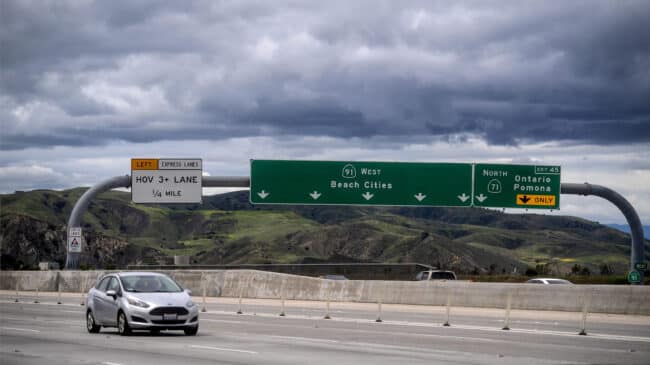
Priced Managed Lanes Come of Age
December was the 30th anniversary of the opening of the world’s first priced managed lanes project: State Route 91 in Orange County, California. As the inventor of the concept, I was present at the groundbreaking (I still have my hard hat) and the ribbon-cutting.
While a number of state departments of transportation (DOTs) subsequently created high-occupancy toll (HOT) lanes, mostly by converting under-used high-occupancy vehicle (HOV) lanes, it took more than a decade more for there to be a second toll-financed public-private partnership (P3) project, the Fluor/Transurban P3 that added express toll lanes to the western half of the I-495 Beltway in northern Virginia (financed in 2007 and opened to traffic in autumn 2012—17 years after the SR-91 ribbon-cutting).
Today, P3-priced managed lanes projects have proliferated across the country, including in Atlanta, Charlotte, Dallas, Fort Worth, Nashville, Northern Virginia, and Orlando. Nearly all these projects have investment-grade bond ratings. The U.S. Department of Transportation’s Build America Bureau is working hard to keep up with the demand for federal Transportation Infrastructure Finance and Innovation Act loans, which most of these projects have used, in addition to tax-exempt private activity bonds (PABs). The demand for the latter is so high that the $30 billion federal cap on those bonds has nearly been reached.
In the November issue of Public Works Financing, Gordon Feller has an overview article: “The Evolution of U.S. Express Lane P3s and TIFIA.” Here are the main points in his case.
- Priced managed lanes are maturing, with revenue often exceeding projections and investment-grade bond ratings.
- Delivery is evolving from projects to programs. What we are seeing is express toll lane networks, exemplified by Atlanta, Dallas/Ft. Worth, and the Virginia suburbs of Washington, D.C.
- Risk allocation is becoming more nuanced and collaborative. This is partly due to the experience gained from projects successfully developed and implemented.
- Tolling technology and customer acceptance are now central to success. The large amount of data from the proliferation of successful projects is a key factor.
- Data is transforming forecasting, design, and operations. Today, we have far more data on willingness to pay, with customers valuing reliability in addition to time savings.
- The forecasting model itself is being reimagined. Lenders and rating agencies are getting comfortable with improved forecasting models, based on a lot more data.
- Public support hinges on early messaging and transparency. It used to be that the first priced managed lanes project in a metro area (or even in a new portion of it) was immediately attacked as “Lexus Lanes.” That term, while not gone, is much less heard today.
- TIFIA and PABs are still foundational. There are still risks in these projects, and tax-exempt PABs put investor-financed projects on a level playing field with state-run projects.
- Technology uncertainty must be addressed with flexible contracts. Autonomous vehicles and artificial intelligence are on the horizon in transportation, so long-term P3s must be flexible in facing their future.
- Capacity constraints are real, but surmountable. He refers to factors such as the limited number of experienced P3 developers and competition from other global infrastructure projects.
I recommend reading Feller’s entire article for details on these insights.
Conflicting Measures of U.S. Traffic Congestion
Which U.S. metro area has the highest annual amount of delay from traffic congestion?
In the November issue of this newsletter, I reported that in 2024, Los Angeles ranked first, followed closely by San Francisco. Those numbers came from the 2025 Urban Mobility Report of the Texas A&M Transportation Institute (TTI). But a new report just out from data firm Inrix lists the top two congested areas in 2024 as New York and Chicago, which tied for first place in 2024, and with significantly lower numbers than the Texas A&M report.
That’s not the only disparity. Again, using reported 2024 numbers from both reports, the total cost of congestion to each metro area is reported as follows:
| Inrix | Texas A&M | |
| Los Angeles | $8.6B | $29.5B |
| New York | $9.7B | $24.2B |
| Chicago | $7.5B | $11.8B |
| Washington, D.C. | $3.2B | $6.2B |
| Denver | $1.2B | $3.5B |
These are both reputable sources, but they clearly measure congestion differently. The figures on the cost to each metro area reflect a different definition of the geographic scope of each. This appears to account for the large disparity in aggregate costs and probably also the rankings based on hours lost per commuter.
Both organizations provide an overview of their methodology, which you can review if you are interested in those details. I suggest that neither of these reports should be considered the definitive account of the extent of congestion in America’s largest metro areas. Both show that traffic congestion continues to increase, resuming the upward trend that was readily apparent in pre-COVID-19 pandemic years.
Staying with the new Inrix numbers for 2024 and 2025, by their definition of the metro areas, Chicago, New York, and Philadelphia are the top three metro areas in most hours lost to traffic congestion per auto commuter (compared with Los Angeles, San Francisco, and New York in TTI’s ranking).
While New York City implemented congestion pricing in Manhattan below 60th Street in Jan. 2025, the Inrix numbers show the same 102 hours lost by the average commuter in both 2024 and 2025. New York City’s own data show modest congestion reductions in the Manhattan pricing zone, but that has only led to the metro area having the same 102 hours lost in both 2024 and 2025.
These are both carefully done estimates of traffic congestion in U.S. metro areas. But since both the methodology and the geographic scope differ considerably, neither can be used as “the” basic measurement of metro area traffic congestion in urban America.
Serious Bipartisan NEPA Reform Passes in the House
A bipartisan bill called the SPEED Act was approved by a 221 to 196 vote in the House of Representatives on Dec. 18. The full name of the bill is the Standardized Permitting and Expediting Economic Development Act. Its co-sponsors were Rep. Bruce Westerman (R-AR—Chairman of the Natural Resources Committee) and Rep. Jared Golden (D-ME). Of the 221 yes votes, 11 were Democrats, and one Republican voted no.
Michael Bennon provided an excellent overview of the bill in the lead article in the November issue of Public Works Financing. Bennon points out that the bill would apply NEPA reform to all forms of infrastructure, rather than limiting it to energy and environment; hence, transportation infrastructure is included. (My view is that this broader scope will be essential to get the final passage of a bipartisan bill by the Senate.)
The primary focus of the SPEED Act is to reform the litigation process, which is what leads to years of delay after an Environmental Impact Statement is released. One key provision is to remove the injunction remedy if a court finds that the EIS is flawed.
As Bennon notes, “Such a change would leave NEPA’s administrative process intact but completely change NEPA’s conflict resolution in the courts. NEPA litigation would change significantly because the vast majority of plaintiffs in NEPA lawsuits are not suing to challenge an environmental study per se. They are suing because they want to stop the project.”
The SPEED Act also would codify in NEPA’s statute key Supreme Court findings in the recent “Seven County Infrastructure Coalition” case, regarding hypothetical impacts far from the project’s location. And it would clarify that agencies need not consider research that did not exist when a NEPA study began. It would also require lawsuits to be filed within no more than 150 days after a final agency action under NEPA. Also, in the event of a lawsuit, any claims must have also been made in a previous public comment by the claimant.
When I researched and wrote my 2024 Reason Foundation policy paper on NEPA reform, its focus was on environmental litigation, which had never been seriously proposed in NEPA reform efforts. Relatively recent measures that put a page limit on environmental impact statements (EIS) and a timeframe for completing them were toothless. (Agencies learned to put all the excess verbiage in an appendix, and they started the clock after a lot of “preliminary” work had been done). What really needed serious reform was out-of-control litigation, mostly aimed at killing projects rather than genuinely protecting the environment where projects are built.
I have no idea what the SPEED Act’s political prospects in the Senate may be. But this is the first serious NEPA reform proposal to address out-of-control anti-project litigation, and I hope it leads to meaningful reform.
What Now for Electric Vehicles?
Fourth-quarter U.S. electric vehicle sales have plunged, following the elimination of the $7,500 federal subsidy effective Oct. 1. And America’s two large domestic automakers—Ford and General Motors—keep announcing cutbacks and write-offs.
Ford’s announced changes have been the most dramatic. In December, it announced that it would take a $19.5 billion charge, after having lost $13 billion on its electric vehicle sales since 2023. It will end production of its F-150 Lightning, the electric version of its best-selling pickup truck.
Also in December, Ford cancelled a $6.5 billion battery deal with South Korean company LG Energy Solution. However, it is not giving up on EVs, going forward. In August, it announced plans to invest $5 billion in a new Universal EV Platform, aiming to produce less-expensive EVs, including a new mid-size EV pickup truck. Whether that plan will survive Ford’s recent write-offs remains to be seen.
General Motors in October announced plans to lay off 3,300 EV and battery workers starting in January. And in December, GM announced a $1.6 billion charge based on planned EV cutbacks, but it has released fewer details than Ford.
The ramifications of these changes have reached California policymakers. The California Air Resources Board (CARB) in October said it is reconsidering the state’s 2035 deadline for ending gasoline-powered vehicle sales, although a separate 2020 executive order from Gov. Gavin Newsom banning gasoline-vehicle sales as of 2035 remains in effect. The Trump administration has done away with California’s long-standing ability to mandate tougher fuel-economy rules than federal law required in other states.
Although there has been no sweeping EV policy change in Europe, electric vehicle sales have slowed down, and companies are making cutbacks. Volkswagen in November announced (union-agreed) plans to phase out 35,000 jobs. E.U. industry commissioner Stephane Sejourne said the 2035 target date for cutting vehicle carbon emissions to zero will be reconsidered. Canadian Prime Minister Mark Carney, in October, paused an EV sales mandate that would have gone into effect in 2026, aiming to help a struggling auto industry.
This does not mean the end of electric vehicles, and definitely not hybrids (which are selling better than EVs in the United States). As some commentators have pointed out, urban-area commuters don’t need 500-mile range electric vehicles, especially if they have a charger in their garage. And Teslas continue to sell reasonably well. But the now-ended U.S. EV boom, stimulated by the $7,500 new-vehicle tax credit, artificially expanded the U.S. EV market. For the next decade or so, EVs will more likely be a niche market.
Federal Regulators OK Increased Use of Automated Track Inspection
By Marc Scribner
On Dec. 5, after more than seven months, the Federal Railroad Administration (FRA) granted a waiver sought by the freight rail industry to expand the use of automated track inspection (ATI) technologies. ATI relies on sensors installed on locomotives or railcars in revenue service that can detect track geometry defects more accurately than human visual inspections. Legacy federal regulations mandate rigid visual inspection schedules, and railroads had sought a waiver to replace some visual inspections with ATI. FRA’s approved waiver is a welcome step forward, but some of the modified conditions will need to be changed to realize the full benefits of ATI.
For more than a decade, railroads have been developing and deploying ATI technologies. FRA track inspection rules relegated ATI as supplemental for traditional visual inspections, unless railroads received a waiver to reduce visual inspections. Several waivers were granted as part of pilot programs during the first Trump administration. The data collected by those pilots was submitted to FRA and consistently demonstrated improved track geometry defect detection—with ATI detecting hundreds of times more defects than visual inspections on a given length of track.
Both the agency and rail carriers were enthusiastic about the potential of ATI, which could allow for enhanced safety, better maintenance planning, and reduced delays owing to the track occupied by inspectors. The inspector workforce could be reallocated to more complex trackwork that cannot be inspected by ATI, such as track switches (turnouts), further enhancing safety and efficiency on the rail network.
But labor unions representing inspectors have opposed these moves. After the Biden administration took office in 2021, it began shutting down pilot programs and denying ATI waivers. The Railroad Safety Board, which is FRA’s internal body of career technical experts tasked with reviewing waiver programs, was overruled by political appointees. The implication was that a safety regulatory agency had been captured by organized labor seeking to advance its narrow economic interests.
One of the ATI pilot carriers, BNSF Railway, challenged the FRA’s decision to deny its waiver in federal court. In March 2023, the U.S. Court of Appeals for the Fifth Circuit found that FRA had acted unlawfully in denying BNSF’s ATI waiver, given the “unqualified success” of ATI under the prior waiver, and ordered the agency to reconsider its position. In June 2023, FRA again denied BNSF’s waiver petition. Continued litigation led to the Fifth Circuit ordering FRA to grant BNSF’s five-year ATI waiver in June 2024, an unusually forceful step that reflected the agency’s extraordinary intransigence.
Following the change in administrations, the Association of American Railroads (AAR) submitted a new ATI waiver petition to the FRA on April 25. Unlike past waiver requests submitted by individual railroads, this waiver would apply to the entire industry. For ATI-inspected main track and sidings, AAR’s petition proposed to reduce visual inspections from twice per week to twice per month. Any defects detected by ATI would generally need to be verified by field inspection, and initial remedial action would be initiated within 72 hours.
Reason Foundation submitted comments in July to FRA supporting AAR’s waiver petition, highlighting the safety benefits of expanded ATI use to the rail system but also to inspectors themselves, who would face reduced exposure to hazards in the field. Months went on with no answer from FRA, which was puzzling to many observers.
In November, the Washington Examiner reported that “allies of Vice President J.D. Vance at the Department of Transportation are ‘stonewalling’ the waiver in hopes of appeasing unions and maintaining Trump’s labor coalition for a potential 2028 White House bid of his own.” This suggests that union favoritism continues to negatively influence U.S. rail safety policy, despite the hope that the Trump administration would be less inclined to kowtow to organized labor than the Biden administration.
This reporting was soon picked up by the Washington Post, which published a pointed editorial on Dec. 1, “Trump mimics Biden’s approach to railroad safety,” noting that limiting the use of ATI runs counter to both safety and “the technological aspirations of the administration to beat China in the AI race.”
The Washington Post’s critical coverage of the White House’s ATI political play may have been enough to dislodge AAR’s waiver request at FRA, which issued a decision giving approval days later, on Dec. 5. However, FRA’s waiver grant came with modified conditions, including requiring visual inspections once weekly instead of once every other week as requested. FRA will analyze the first year’s ATI waiver data to see if inspection frequencies can be further reduced.
The once-weekly inspection frequency was commonly used in initial ATI pilot testing in the previous decade, so it is disappointing that FRA chose not to build on that success immediately. Trade publication Railway Age quoted an anonymous rail safety expert complaining about the overly complex and burdensome modified waiver conditions, “They’re appallingly asinine. Someone got to them. Compare them to the waiver BNSF had.”
Despite these critiques, the fact that the FRA granted the waiver is a positive step forward. But to realize the full benefits of ATI, Congress and stakeholders should vigorously monitor FRA’s performance. Given the recent Trump White House interference in this decision and past actions during the Biden administration, particular attention should be given to the operations of FRA’s Railroad Safety Board to ensure they are driven by careful safety data analysis and not being influenced by union clientelism.
L.A. Metro Needs a Better Strategy
By Baruch Feigenbaum
Transit ridership has recovered slowly since the COVID-19 pandemic. But across the country, it’s becoming a tale of two different types of transit agencies: ones that are innovating and ones that are not.
Innovative transit agencies are redesigning their bus networks, focusing on buses over rail, using new delivery methods, and aggressively tackling violent crime on transit systems.
Why are these steps important?
Redesigned bus networks offer more frequent service that operates on a grid designed for transit-dependent customers. Reduced focus on rail allows most transit agencies to concentrate on bus riders. Innovative delivery speeds up project timelines, reducing costs. Finally, reduced crime rates and the perception of crime improve rider safety and project an image that the agency cares about riders.
While a few agencies, such as Indy Go and the Regional Transit District of Denver, are prioritizing innovation, other agencies, such as Los Angeles Metro, are not.
In a policy study that I wrote as a joint Independent Institute-Reason Foundation product, I took an in-depth examination of L.A. Metro’s problems. Some of the politicians guiding Metro appear to be designing a transit system in Los Angeles to serve New York City. They want Los Angeles to morph into a place with a very high population density downtown and a strong urban core. In reality, Los Angeles already has the highest population density in the country. But L.A.’s density is a uniform medium density, which makes rail transit unworkable.
Manhattan was fully developed before mass-produced automobiles were affordable. Turning auto-inspired Los Angeles into New York City via government mandate simply won’t work. Yet this approach is shaping the transit agency’s planning.
Los Angeles Metro has long been focused on recruiting more transit choice riders to the system. Transit choice riders are attractive because they pay full fare and increase political support for the system across the region. Choice riders, who use rail, travel by transit less frequently (generally 2-3 times per week) than transit-dependent riders, who use the bus more and take transit daily. Choice riders make trips from home to work, while dependent riders make more types of trips (to work, the grocery store, and doctors’ appointments).
This focus on rail riders previously landed Los Angeles Metro in court. In 1994, the Bus Riders Union filed a lawsuit alleging that Metro spent a disproportionate amount of resources on new rail services that benefited wealthier, suburban users. A judge agreed and issued a consent decree that lowered the cost of a weekly pass to $11 and expanded the fleet by 152 buses. However, once the consent decree expired, Metro again prioritized choice riders, which it continues to do today.
Metro’s current leadership is not forward-thinking. The previous Metro leader, Phil Washington, was known as an out-of-the-box thinker dating back to his time at the Denver Regional Transit District. In Los Angeles, he pursued innovative solutions such as first-mile last-mile projects, microtransit, pop-up services, and public-private partnerships (P3s). He established an office of Extraordinary Innovation to push for new ideas.
The current L.A. Metro administration says it wants innovation, but the results have been disappointing. Once Phil Washington left Los Angeles to run Denver International Airport, the Office of Extraordinary Innovation was dissolved.
Excessive costs and overruns are routine in the transit industry. Bent Flyvbjerg’s research has shown systematic cost overruns of 50% or more, often driven by optimism bias and strategic misrepresentation (lying).
But Metro takes this problem to a new level; it has the highest per rider capital cost for any very large transit agency in the world. Los Angeles’ average cost per rider is $25.80. For New York, the cost is $5.89. London, Paris, Seoul, and Tokyo have costs of $2.91, $2.32, $1.09, and $0.88. respectively.
In Los Angeles, the D (Purple) line project’s cost ballooned from an estimated $2.8 billion to $3.55 billion, a 27% increase due to four different incidents of cost overruns.
Because it operates services in so many areas of the county, particularly low-density areas, Metro is not providing enough service for core customers in high-population areas.
In the New York City core, most rail services operate on 2-5 minute headways. Yet, Metro rail service has 12-minute headways. Most of the L.A. bus lines only come every 15 minutes, yet buses in New York City come every 5 minutes.
Metro has also failed to invest in intelligent transportation systems, and buses are late 22% of the time. If Metro wants to imitate New York, it’s doing a poor job.
Finally, safety has been a major problem. In a single month in 2024, Metro had six violent incidents, including multiple stabbings, a shooting, and a wrench attack. That June and July were not much better, with three incidents each. In response, Metro established its own police force, and there have been some minor improvements, but Metro is still more dangerous than its peer transit agencies.
Innovative transit agencies are redesigning their bus networks, focusing on bus over rail, using innovative delivery methods, and aggressively tackling violent crime. Los Angeles Metro has additional changes it can make, such as cracking down on fare evasion, using value capture more, and expanding bus rapid transit instead of rail. But to start, offering more consistent, reliable, and safer service to its more frequent customers would be the best approach.
Virginia 495 NEXT Express Lanes Open
On Nov. 23, the latest addition to the express toll lanes on the Capitol Beltway (I-495) in northern Virginia opened to traffic. The addition extends northward from the Dulles corridor interchange to just south of the American Legion Bridge across the Potomac River, with connections there to the George Washington Memorial Parkway. The project was carried out by Transurban, which also built and operates the express toll lanes on the rest of I-495 and I-95 in northern Virginia. The only missing link in this Virginia network is the planned Southside express lanes between I-95 and the Woodrow Wilson Bridge.
Does Urban Rail Transit Need Two-Member Crews?
The New York Subway has long operated with both an operator and a conductor. With system operator MTA facing budgetary problems, the New York State legislature last year passed a law requiring two operators. That led the NYU Marron Institute to review other rail transit systems’ practices. After examining operations of more than 400 subway and commuter rail systems in 36 cities worldwide, the Marron Institute found that fewer than 6.25% used two-person crews. The New York Times highlighted these findings in an article on Nov. 13, 2025. On Dec. 19, Gov. Kathy Hochul vetoed the legislation that mandated two-person crews.
Southern California I-15 Express Toll Lanes to Expand
Lake Elsinore has announced plans for a $700 million project to add express toll lanes to 15.8 miles of I-15 in Riverside County between Lake Elsinore and Corona. The project will be handled by the Riverside County Transportation Commission. Express lanes on I-15 in Riverside County already exist between Corona and SR 60, and on I-15 in San Diego County from SR 163 in San Diego to SR 78 in Escondido.
Pennsylvania DOT Reviewing Four Unsolicited Proposals
On Dec. 4, PennDOT announced that it will evaluate four unsolicited P3 proposals. They are a Pittsburgh bundled bridge replacement project, a South Philadelphia Accelerated Ramp Connections project, an Automated Road Detection and Management System, and an I-76 Schuylkill Expressway Managed Lanes project. The latter was submitted by Cintra, with an estimated project cost of $5 billion; it would add two MLs in each direction to this highly congested expressway. If implemented, these would be the first express toll lanes in Pennsylvania.
Competition for €8 Billion Italian Motorway
The long-term concession for the A22 motorway in northern Italy is expiring, and fierce competition is underway. In addition to the existing company, Autostrade per l’Italia (ASPI), Infralogic (Dec. 4) reported that Spanish infrastructure group Sacyr and Ardian-backed ASTM are keenly interested. Infralogic’s Antonio Fabrizio reports that Sacyr and ASTM have battled for most Italian motorway tenders in recent years. The competition is for a 50-year concession requiring an up-front €8.4 billion concession fee.
Seeking Solutions for Maryland’s Portion of the Beltway
The U.S. DOT last month released a request for information (RFI) regarding a potential public-private partnership (P3) for the I-495 corridor section that includes the bottleneck American Legion Bridge and all of I-495 from I-395 in Virginia to I-95 in Maryland (which includes all of Maryland’s portion of the Beltway). Several years ago. Maryland’s governor cancelled the previous administration’s plans to add express toll lanes to Maryland’s portion of the Beltway. The RFI appears to be inviting companies and public officials to take a fresh look at relieving congestion in this vital commuting corridor. Since Maryland’s government has few funds to spend on improved highways, revenue-based P3s might be among the few viable options.
Abertis Takes Over Barcelona’s Tunnels
Tunels de Barcelona I Cadi began operating these two urban tunnels in 2013, with Abertis holding 50.1% of the concession and Credit Agricole Assurances (CAA) the balance. Infralogic reported (Dec. 12) that Abertis has bought out its partner. The two tunnels provide access to Barcelona from two nearby regions, and these 46 km of tolled tunnels generated €69 million in 2024. The concession runs through 2037.
U.K. Implements Mileage-Based User Tax for Electric Vehicles
The Economist reported that the British government’s new budget includes a mileage-based user tax for electric vehicles (EVs). The initial rate will be $.04 per mile for fully electric vehicles and half that amount for hybrids. Vehicles powered by petroleum fuels pay an annual tax that raised £24.4 billion in the 2024-25 fiscal year. But both the new EV user tax and the existing fuels levy are not dedicated to highway capital and operating costs. As is true in most of Europe, they are simply taxes that form part of the national government’s revenue. Highways get whatever parliaments decide to give them, which is generally far less than the amount of highway tax revenue.
Six Companies Bid for Indian Highway Concession
The National Highways Authority of India last month invited proposals for a concession covering three stretches of a 248 km motorway. Six major companies have submitted bids for the concession: Adani Group, CPPIB, Cube Highways, IRB Infrastructure Developers, KKR, and Oriental Structural Engineers. This is the 18th concession since 2018 offered by NHAI in its toll-operate-transfer (TOT) program.
Touchscreens Increasingly Viewed as Dangerous in Dashboards
As reported previously in this newsletter, several European research projects have compared the time it takes for drivers to get information via a button versus from a display screen, documenting much longer times for the latter, during which drivers’ attention is not on the road. The Economist reported on additional research. Norway’s SINTEF did an array of driver time measurements, including something as simple as changing the temperature or changing to a different radio station. And the U.K. Transport Laboratory found that overall, touchscreens impair a driver’s reaction time more than driving over the legal blood alcohol limit. Even worse are advertisements popping up on touchscreens at a time when the driver needs to find or do something. The Economist article reported that some European car companies are returning to knobs and buttons for safety-related functions; it’s about time.
Sydney Metro Projects Are Exceeding Their Budgets
On Dec. 5, the New South Wales government announced multi-billion-dollar cost overruns on a set of Sydney Metro rail projects. The latest cost estimates are $17.8-19.1 billion (US) for Metro West, about $15 billion for Metro Southwest, and $7.3 billion for Western City Airport Metro, about 10% over its most recent budget. The latter project is also running two years late. The Labor government is adding about $1.6 billion to these Metro rail projects. It blames the previous government for having made over-optimistic cost projections.
Metro Pacific Tollways Considering New Megaprojects
This Philippines-based toll roads company is exploring several new megaprojects. It is looking into the acquisition of a Vietnamese toll road, the identity of which is not specified. The company already has operations in Vietnam and Indonesia. In addition, it is conducting a feasibility study of adding an elevated tollway above the congested North Luzon Expressway in the Philippines, called NLEX Air. It recently raised 20 billion pesos via a bond offering to finance the Lapu-Lapu Expressway and the Cavite-Laguna Expressway.
Miami-Dade Electric Busway Will Underperform
Miami-Dade County has refurbished its 20-mile South Miami-Dade Busway with 14 air-conditioned boarding areas and a small fleet of articulated electric buses. There are no projections of daily ridership or the number of buses that will operate each way, but it’s almost certain that a large amount of the roadway’s capacity will go unused. Some years ago, I proposed that this nearly unused right of way (parallel to highly congested U.S. 1) be reconfigured as a variably priced express toll facility, using all of its capacity and generating revenue from the variable tolls. The transportation value proposition would be very large—but there was zero interest.
DOT Advisory Board Suggests Federal P3 Office
Bond Buyer reported that the U.S. DOT advisory board has suggested that the agency open a federal P3 office to increase the visibility of potential long-term transportation P3 projects. Back in August, Inframation’s Eugene Gilligan reported that the Build America Bureau was working on a project to publish a list of P3 projects that could be ready to move forward. BAB’s Morteza Farajian noted at that time that there is a “very healthy pipeline” of U.S. P3-managed lane projects.
Correction re: British Electric Train
Randal O’Toole responded to a December News Note about the British railroad line, which has a new connection to electric current from trackside solar panels. He included a photo showing that the passenger rail line in question is electrically powered by an outside third rail, which the U.K. article had failed to mention.
Your Editor in The Economist on Tolling
Last month, I was interviewed by a reporter for The Economist on the future of U.S. tolling. The interview went well, and the piece appeared late in December. If you subscribe to this excellent weekly, you can find the article here. If you do not subscribe, this link may work for you.
“Managed lanes are coming of age. Some experts think that we may now be at a turning point for managed lanes and toll road P3s in the U.S. These projects are no longer viewed simply as infrastructure; they are mobility platforms—and increasingly technology platforms—designed to provide differentiated, customer-focused travel options.”
—Gordon Feller, “The Evolution of U.S. Express Lane P3s, and TIFIA,” Public Works Financing, Nov. 2025
“Successful [permitting] reform would provide a voice, not a veto, to the public and other stakeholders. It would strengthen the public engagement process, require agencies to seriously consider comments, and then restrict judicial remedies that serve as veto points later in the process. One additional reform that deserves attention . . . is consolidating NEPA litigation in a single federal court. Centralized review could create precedent, shorten timelines, and end the inconsistent rulings that slow projects.”
—Elizabeth McCarthy, “The Fall of Permitting Reform,” The Ecomodernist, Nov. 18, 2025