
- Preparing for the last federal transportation reauthorization
- BART’s last days?
- Managed lanes are poised for growth
- Follow-up on Detroit bridges controversy
- 2026 Annual Highway Report rankings on performance and cost-effectiveness
- The problem with CO2-based tolling
- Capacity expansion and induced demand
- News Notes
- Quotable Quotes
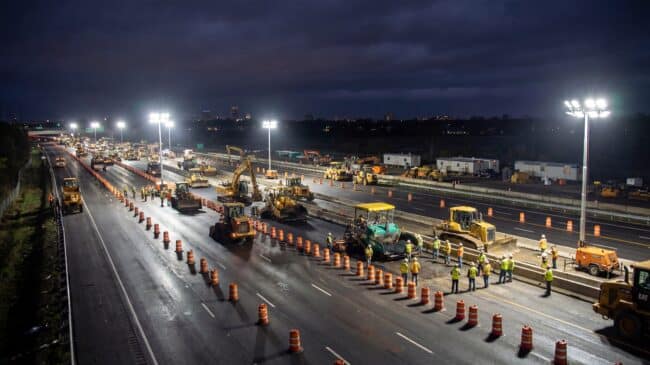
Preparing for the Last Surface Transportation Reauthorization Bill
As I have written previously, just about every surface transportation organization has big plans for the upcoming 2026 surface transportation reauthorization. Many still hope the reauthorization bill will at least equal the outsized funding of the Infrastructure Investment and Jobs Act (IIJA), a large fraction of which was borrowed from our grandchildren.
A traditional five-year transportation bill would run from 2027 to 2031. And that should be a serious warning sign, because the year after that is 2032, the year actuaries predict that Social Security will become insolvent. (And a few years later, the same fate is expected to arrive for a large portion of Medicare). The expected insolvency of Social Security will upset just about every applecart in the federal budget, and transportation will be no exception.
With that looming, the last thing Congress should do is authorize another huge, borrowed-money extravaganza of a surface transportation reauthorization bill. A far more responsible approach would be a bill that gets state and local governments ready for what may turn out to be the last gasp of the federal surface transportation program.
The most serious discussion I’ve seen on the future of the Highway Trust Fund (HTF) model is “Last Exit: Options for Fixing the Highway Trust Fund,” by Jeff Davis and Rebecca Higgins of the Eno Center for Transportation. In considerable detail, they walk the reader through an array of potential HTF fixes. These reforms include:
- Reduce spending to match user-tax revenue;
- Increase user-tax revenues to match the desired spending level; or,
- Continue annual general-fund transfers (increasing the national debt).
They analyze each of these in detail and find none realistic or feasible.
At this point, they add another option that will have to be considered before 2032, given Social Security’s looming insolvency. That option is to transfer responsibility for highways and transit to state departments of transportation (DOTs) and local agencies, respectively. Davis and Higgins treat this alternative seriously, I suspect, because their assessment of less-radical alternatives looks so unpromising. And they don’t apologize for including it, given the magnitude of the federal budget problems in the next decade with Social Security and Medicare insolvency. They note that even without the looming transportation funding crisis, there are negatives to the federal highway and transit programs, such as costly federal design standards, the high cost of regulations, including the Davis-Bacon Act and Section 13c labor protection provisions for transit workers. State DOTs have long noted that projects that don’t use federal funds can be built at a meaningfully lower cost.
As a long-time transportation policy researcher, I lived through a serious deliberation on devolution in the 1990s. I attended and spoke at conferences on the devolution of highways and transit. At the time, some serious academics were on board with the idea, including Alice Rivlin (Reviving the American Dream) and Harvard Kennedy School researcher David Luberoff. The American Association of State Highway and Transportation Officials (AASHTO) released a survey in 1995 on state transportation departments’ concerns over costly federal regulations. Also in 1995, the Republican Governors Association adopted the Williamsburg Resolve, supporting devolution of many functions from the federal government to state and local agencies.
The high point of this trend was the Sen. Connie Mack (R-FL) and Rep. John Kasich (R-OH) bill in 1996, which would have devolved both federal highway taxes and the highway and transit programs to state and local governments. After taking part in several conferences on devolution, I wrote a Reason Foundation policy study in 1996, outlining the mostly positive changes I thought devolution would bring about. I also served on California Gov. Pete Wilson’s special Commission on Transportation Investment (1995-96), which also recommended devolution.
The insolvency of Social Security in 2032 should be a wake-up call for all of us who want well-funded highway and transit systems. Rather than producing one last blow-out of borrowed money in a 2026 surface transportation reauthorization bill, the responsible thing to do is to craft a bill that gets state transportation departments and transit agencies ready for the coming future when federal aid will no longer exist. Waiting until the likely federal budget and debt chaos of 2032 would be irresponsible. Far better to begin the transition from ample federal funding to no federal funding. It won’t be easy, or pretty. But it’s the responsible thing to do.
Many years ago, the Bay Area Rapid Transit system, BART, was considered one of America’s best-run and least-subsidized transit systems. So I was shocked to see a March 14 Washington Post editorial called “The Death of Bay Area Public Transportation.” Could this possibly be true?
The editorial included a graph showing BART labor costs and average weekday ridership from 2014 to 2024. The graph shows that over this period, labor costs have increased by over 60%, while ridership by 2024 had only recovered to 40% of its 2013 level. Another graph compares fare revenue per trip with operating expense per trip. In 2014, those two were both below $5, but in 2019, that relationship changed dramatically. Operating expense per trip soared to over $35 in 2021, then leveled off at about $16 in 2024. But fare revenue remained stuck at about $4 per trip.
A normal business faced with a large decrease in customers would reduce its operating costs, and since labor is one of the highest operating costs of a transit system, that would be an obvious step. But even if its management wanted to do that, it would run up against a double-barreled protection of those jobs.
First is a union contract that makes it very difficult to downsize the labor force.
Second (or perhaps first, because it’s unchangeable by a transit agency) is a federal law best known as Section 13c. It came about via the Urban Mass Transportation Act of 1964. At that point in time, private transit systems were being taken over by local governments, and Congress wanted to ensure that collective bargaining agreements were preserved as these transitions took place. Section 13c requires transit agencies that receive federal funding to ensure that employees can have collective bargaining agreements. As my colleague Marc Scribner explained in a recent Reason Foundation policy brief, transit agencies are greatly constrained in enacting any operational change involving employees and collective bargaining.
Section 13c came about at a time when unionization affected only about 2% of state and local government jobs, unlike today. The perhaps-unintended consequence, Scribner notes, is that “Section 13c exists alongside federal, state, and local labor laws that apply to public-sector workers.” So essentially, “13c provides transit workers—and only transit workers—with special protections beyond those enjoyed by other government employees.”
Eliminating 13c would not upset transit worker collective bargaining; it would simply give those workers the same status as other unionized government employees. This would enable transit agencies to negotiate more flexible labor contracts in the future. Unless or until this change comes about, agencies like BART will continue to be on a death spiral, as the Washington Post editorial suggested.
Fitch Says Managed Lanes Are Poised for Growth
When I first proposed the idea of variably priced express lanes in a 1988 Reason Foundation policy study, many transportation experts were skeptical. And after the first such project opened in Dec. 1995 on SR-91 in Orange County, CA, despite its success, it took more than a decade for another such project (on I-495 in northern Virginia) to be developed. Today, however, variably priced managed lanes are a nationwide phenomenon. And their success is evident in the latest annual review from Fitch Ratings, titled “U.S. Managed Lanes Poised for Growth.”
The report notes that thanks to continued traffic growth, Fitch has upgraded or placed a Positive Outlook on eight managed lanes (MLs) over the past 13 months. Fitch also notes that it has reduced some of its prior conservatism in its previous years’ cash flow assumptions. It also explains that Fitch now has two separate teams analyzing managed lanes: Municipal (for government-run MLs) and Infra/PF (for privately financed MLs). The rating agency has revised some of its analytical approaches to explicitly take into account not only the value of time but also the value of reliability. The latter is called for by data showing that many people continue to use MLs even when there is little congestion in the general-purpose lanes.
Earlier in the ML era, there were concerns about debt service coverage for those MLs financed based on their toll revenue stream. The report notes that the debt service coverage ratio (DSCR) has become stronger over time, with the median DSCR increasing from 2.6X in 2021 to 4.3X in 2025. This improvement has led to upgrades of many ML ratings from BBB- in 2021 to BBB+ today.
In Fitch’s discussion of increasing public acceptance of MLs, one example is worth noting. “One state that had tried to stop a managed lanes project before its opening, due to political opposition, is now looking to expand it, given its strong track record.” (My guess is that this was a Florida project in the Miami area.)
The report spells out differences between municipal MLs and investor-financed MLs. The former generally prioritize vehicle throughput, while the latter prioritize revenue generation. It notes that, “Private developers have become extremely sophisticated at building revenue-maximizing facilities, incorporating design, pricing, and configuration expertise that delivers a world-class driving experience. These facilities often generate higher revenues per lane-mile than public ones.”
Fitch rates managed lanes operated by seven private issuers and six municipal issuers. For data mavens, the appendices of this report provide a wealth of information on the specifics of all 13 ML facilities.
Follow-up on Detroit Bridges Controversy
Last month’s article only scratched the surface of the special-interest opposition to the new Gordie Howe Bridge between Detroit and Windsor, Ontario. As you will recall, the owner of the existing Ambassador Bridge is the Maroun family, which has staunchly opposed the new bridge to protect its monopoly on heavy trucks between Detroit and Windsor (which are too large to use the Detroit-Windsor tunnel).
Not included in last month’s article was the fact that Maroun gave a million dollars to the MAGA PAC in the weeks before President Donald Trump’s verbal attack on the new bridge, as reported by major newspapers. The Maroun family owns more than just the Ambassador Bridge. It also owns Central Truck Lines, which specializes in U.S.-Canada trade. The gas station on the Detroit side of that bridge includes a duty-free store that sells untaxed gasoline and diesel fuel (including to Maroun trucks).
The Gordie Howe Bridge will be far superior for most trucks to use, not only due to lower tolls but also because trucks that reach Windsor via the Ambassador Bridge must endure Huron Church Road and its 13 signalized intersections. According to one Detroit source, Maroun’s trucks can operate around 500 miles from Detroit in both countries without paying fuel tax, thanks to the Ambassador fueling station.
Once Gordie Howe is open, it’s very likely that most truck traffic will shift to it, rather than paying the higher tolls and non-limited-access roads on the Windsor side of the Ambassador route. The Marouns increased the Ambassador’s toll rates on Jan. 1, aiming to get as much revenue as possible before Gordie Howe deprives them of the majority of their monopoly truck business.
Incidentally, in case anyone wonders, the Canadian government paid for the entire cost of Gordie Howe, as well as the I-75 interchange in Detroit. Needless to say, they will collect all the toll revenue to recoup their investment.
P.S.: On March 6, the mayor of Windsor, Drew Dilkens, called for a tax on trucks from the Ambassador Bridge that use (and beat up) Huron Church Road. “Taxpayers in my city are bearing the full cost of maintenance to get trucks to the Ambassador Bridge. . . .It’s millions of dollars annually in ongoing repairs.”
Reason Foundation’s 2026 Annual Highway Report Ranks States in Cost-Effectiveness, Performance
By Baruch Feigenbaum
Last month, Reason Foundation released the 29th Annual Highway Report. The annual product, Reason Foundation’s most-read study, evaluates state highway systems on 13 metrics. Four categories measure spending; four measure urban and rural pavement quality; four measure safety, with three of those four examining fatality rates and the other examining bridge condition. And the final metric examines urbanized traffic congestion delays.
For the transportation-focused readers of this newsletter: Each state’s score in a category is a percentage, not an absolute number. For example, if North Dakota has 2,500 bridges and 25 are structurally deficient, we calculate the state’s score using 1%, not 25. We convert this percentage into a ratio. We take each of these ratios and average them together to come up with a composite overall score.
Some states are perennial good performers in the Annual Highway Report’s overall rankings. Virginia, Georgia, South Carolina, North Carolina, and Ohio are this year’s top states. Each of these states routinely ranks in the top 10. Other states struggle in the overall rankings. Alaska, California, Washington, New York, and Louisiana are the bottom five states this year. Each of those states has ranked in the bottom 10 for the past five reports.
Numerous factors—terrain, climate, truck volumes, urbanization, system age, budget priorities, unit cost differences, state budget circumstances, and management/maintenance philosophies—all affect overall performance. But, while every state is different, there are five major factors in which the top five states do well and the bottom five struggle, and from which other states can learn.
The most important factor is having a well-designed quantitative cost-benefit selection process. North Carolina and Virginia have the two best systems. The North Carolina 2013 Strategic Transportation Investments Act allocates transportation project funding based on three key criteria: the needs of the state’s 14 transportation divisions (30 percent), regional impact (30 percent), and statewide impact (40 percent). Since implementing this process, North Carolina has been able to dedicate more resources to capital and bridge spending, while maintaining high rankings in pavement condition.
Similarly, in 2014, Virginia adopted the Prioritization Process for Project Selection, which instituted a method for quantitatively scoring the state’s proposed transportation projects before they are reviewed by the Commonwealth Transportation Board (CTB). Virginia House Bill 2 created “Smart Scale,” which uses 10 criteria to measure project effectiveness.
The reason these systems are so important is that they ensure that the state is focused on both system performance (such as roadway repaving or highway capacity) and cost containment. This helps a state in multiple categories of the report.
Another factor that the top five ranked states share is a dedicated maintenance approach for roadways and bridges. Georgia has a special unit that focuses on highway maintenance oversight. By determining when, on the pavement lifecycle curve, repaving is necessary, the state maximizes pavement quality while minimizing costs. (Waiting too long to repave a roadway increases costs.)
South Carolina is a pioneer on doing bridge inspections using drones. This method reduced manpower and the cost of the employees and, most importantly, allowed the department to see the sides and underside of the bridge humans could not access, providing information on when bridge repair was needed.
States that rank highly do so not because they excel in multiple categories but because they don’t have any bottom-10 category rankings. And they are trying to improve those categories. For example, the top states, Georgia and Virginia, have the weakest category in traffic congestion. Both have dedicated long-range transportation plans focused on reducing congestion. (They may not be excelling on this goal, but there is a focus.) North Carolina changed its project prioritization process to improve its bridge conditions, while Ohio is focused on improving urban arterial pavement conditions.
States that rank high also make heavy use of innovative delivery, including public-private partnerships (P3s). Georgia is one of the nation’s leaders in design-build, bundling the three separate previous design, bid, and build steps into one to save time and money. Virginia is the nation’s leader in public-private partnerships, building a regionwide express lanes network in Northern Virginia. P3s bring five advantages: delivery of needed infrastructure, ability to raise new sources of capital, shifting risk to investors, reducing political interference, and enabling innovation. Each of these reduces costs, increases quality, or both.
Finally, with the exception of South Carolina, each of these top-performing states is in the middle of the ideological political map. Virginia is a purple-leaning blue state, Georgia is a red-leaning purple state, North Carolina is a red-leaning purple state, and Ohio is a purple-leaning red state. Each has or has had someone from both major political parties elected statewide over the last two years. I’m not a political scientist, so I haven’t determined correlation or causation, but it seems to me that centrist leaders care more about transportation than populists or progressives. Infrastructure is not a sexy topic that is going to motivate primary voters at rallies. This is the one factor that state transportation officials and leaders cannot control.
The bottom five states in the overall rankings don’t have any of these success factors. The quantitative cost-benefit selection process, if the states have one, is often flawed. California and Washington have been cited by the Federal Highway Administration for measuring the wrong things. Maintenance costs in those two states are exorbitant, and the pavement quality in Alaska is awful.
Each of the bottom five states in the overall rankings has multiple bottom 10 rankings. California ranks in the bottom 10 in seven categories, more than half of the total. Mathematically, it doesn’t matter how good you are in some of the categories if you are a poor performer in more than half.
Similarly, none of these states uses innovative delivery practices regularly. California’s Department of Transportation’s employee unions have fought against some public-private partnerships. Louisiana’s politicians regularly interfere in their state’s P3 toll rates and contracts.
Finally, states like California, New York, and Washington are very blue, while Alaska is very red and Louisiana is currently controlled by Republicans. Making tangible, needed improvements to highways and infrastructure does not seem to be a top focus for many state political leaders.
You can find an overview of Reason Foundation’s Annual Highway Report and its rankings here, the executive summary here, the full study here (PDF), and detailed summary of each state’s rankings in each category here (PDF).
The Problems with CO2-based Tolling
By Marc Scribner
Last month, I attended a conference focused on European road usage charging (RUC) developments. Europe is in many ways more advanced on RUC than the United States on both distance-based (tolling) and time-based (vignette) charging, as well as on innovative procurement of toll roads through long-term concessions. U.S. politicians and road managers could learn much from the European experience, but one idea that has taken hold in Europe should not be imported: tolling based on carbon dioxide emissions. There is an inherent tension between structuring RUC as a tax on pollution and the central goal of RUCs to raise revenue to fund roadway capital and maintenance costs. But if the tax on pollution is successful, it should raise less revenue over time and eventually decline to zero revenue.
The idea to vary toll rates based on vehicle CO2 emissions is motivated by recognition that commercial trucks and buses make up about 2% of the vehicles on the road, yet contribute about 28% of road vehicle emissions. The shift toward emissions-based tolling was implemented by a 2022 amendment to the European Union’s 1999 Vignette Directive. The 1999 Directive limited emission-based charging to no more than 50% above the rate charged to vehicles meeting the strictest emissions standards.
The 2022 amendment authorized toll rate reductions above 50% and up to total exemption from payment responsibility. This exemption had been set to expire at the end of 2025, but a 2025 amendment extended the toll exemption for zero-emission trucks (ZETs) through June 2031. In 2025, just 4.7% of new trucks sold in the European Union were electric. Germany was the only member state above the European average, with 7.1% of trucks sold being electric, which accounted for a quarter of all electric trucks sold in Europe.
According to the advocacy group European Federation for Transport and Environment, Germany offers a 100% road charge discount for ZETs, Denmark an 85% discount, and Sweden a 75% discount. The Netherlands has authorized an 80% truck toll discount beginning in June 2026, and much of the Dutch truck toll revenue will be used to subsidize the purchase of ZETs and charging infrastructure.
The new European Union RUC goal of promoting the development of ZETs comes at the expense of the original 1999 goal of setting average toll rates based on “the costs of constructing, operating and developing the infrastructure network concerned.”
Despite paying lip service to incorporating both the “polluter-pays” and “user-pays” principles in this framework, there is undoubtedly a tension, because the costs of using road infrastructure have little to do with the powertrains of the vehicles. The exemptions from payment enjoyed by ZETs means all commercial highway users will not be paying properly allocated infrastructure costs if rates are adjusted to ensure full cost recovery. This tension will only be resolved if the toll exemptions prove to be temporary and road pricing revenues are then strictly focused on road use and infrastructure cost recovery, which recent history suggests will be politically challenging.
The decision by officials in Europe to undermine the value of truck tolling to support an incompatible policy goal is one they are likely to regret. Fortunately, there are alternatives available to those concerned about transportation emissions that are also compatible with the highway capital and operating cost recovery purpose of RUCs.
They could begin by applying an additional congestion pricing layer on top of the underlying RUC, which would improve road network performance while also reducing emissions. Analysis of real-world driving patterns and traffic conditions in Southern California found that mitigating congestion could reduce CO2 emissions by almost 20% by achieving stable traffic flows without the frequent acceleration and deceleration events that are disproportionately responsible for vehicle emissions.
Addressing congestion would not incentivize the adoption of electric vehicles, which is a central purpose of emissions-based RUCs, especially when these schemes are coupled with a revenue-recycling program to subsidize the purchase of zero-emission vehicles and associated charging infrastructure. Here, advocates would be better to focus on the source of their concern—in this case, the fuel that is consumed by internal combustion engines.
Taxing fuel directly to internalize the external costs of pollution has long been preferred by many economists in lieu of overly complex and less effective regulatory schemes. In the United States, corporate average fuel economy (CAFE) standards have been criticized for being highly inefficient, perversely raising the prices of new vehicles and thereby leading consumers to hold on to older, less fuel-efficient vehicles for longer. Unlike CAFE, increasing the price of gasoline through a Pigouvian pollution tax would properly align incentives by encouraging consumers to purchase more fuel-efficient or zero-emission vehicles.
A central problem with applying externality taxes to fuel taxes in the United States has been the fact that fuel taxes are principally used to fund highways. Much like Europe’s ZET exemption from road usage charging, a U.S. policy aimed at reducing fuel consumed per mile driven would undermine the central infrastructure cost-recovery goal of fuel taxes. However, shifting U.S. road-revenue dependence on per-gallon taxes to per-mile charges would free up the fuel tax as a better replacement of CAFE.
In Europe, fuel taxes are generally not structured as road user taxes like they are in the United States, so encouraging a less-polluting vehicle fleet through fuel taxation has great promise. Germany’s motor fuel “eco-tax” yielded substantial emissions reductions while directing the revenue to fund pensions. The revenue from Pigouvian taxation could be used for general government programs, but it would be most efficient to reduce taxes on “goods,” such as labor. However, if the tax on “bads” is successful at changing behavior and driving durable investments in preferred alternatives, the additional revenue may prove temporary.
The European experience with road usage charging should be closely examined by U.S. policymakers, including the mistakes that have been made. The design of any road pricing scheme needs to ensure that clear goals are being met and that follow-on policies do not undermine any of those goals. Ensuring compatibility between various policies should be a top priority for policymakers if they wish to demonstrate that their ideas can be successful.
Capacity Expansion and Induced Demand
By Rob Bain
The concept of induced demand is frequently invoked in transportation debates as an argument against expanding highway capacity. While induced demand is a well-established and uncontroversial economic phenomenon, its application in transportation is often oversimplified and argued as if additional travel is inherently frivolous or socially undesirable.
This characterization misrepresents both the nature of induced travel and its welfare implications. Induced travel reflects the release of suppressed demand for access to activities such as employment, education, healthcare, and social participation. The policy debate should therefore shift from questioning the value of induced demand to explicitly weighing the benefits of improved access against the associated externalities.
Induced demand arises when an increase in capacity reduces the generalized cost of consumption, leading to an increase in quantity demanded. For roads, added capacity lowers travel time, improves reliability, and reduces scheduling penalties. The resulting increase in travel is an entirely predictable behavioral response, analogous to increased use of health care following the expansion of hospital capacity or increased data consumption following broadband upgrades. The mechanism itself is value-neutral; it simply describes how users respond to lower costs.
Importantly, the existence of induced demand is not evidence of inefficiency or failure. On the contrary, it is often a necessary condition for realizing the benefits of infrastructure investment. If demand did not respond to improved conditions, the social value of capacity expansion would be limited, or nil.
In transportation debates, induced travel is frequently portrayed as discretionary or frivolous; implicitly likened to joyriding or unnecessary consumption. This framing is unsupported by empirical evidence. Induced travel typically comprises:
- Access to jobs, education, healthcare and services previously foregone due to excessive travel costs;
- Shifts from inferior routes, times or modes to more efficient ones;
- Expanded labor and consumer catchment areas for businesses; and,
- Long-term land-use and location decisions that improve household welfare.
These behaviors represent revealed preferences for activities whose benefits now exceed their costs. To dismiss such trips as inherently low-value is to ignore the foundational welfare principle that individuals are generally best placed to assess their own benefits, absent significant distortions.
A central logical flaw in simplistic induced-demand arguments is the implicit assumption that demand suppressed under constrained conditions must be socially undesirable. In reality, suppressed demand generally reflects binding constraints rather than low valuation. Congestion, unreliability, and excessive travel times exclude individuals from opportunities, imposing welfare losses that are largely invisible in ex post analysis.
A key issue is the fact that the visibility of congestion contrasts with the invisibility of foregone trips, unrealized employment opportunities, and unmade investments. This asymmetry biases policy narratives toward treating post-expansion traffic as a problem while neglecting the welfare costs of pre-expansion exclusion.
No comparable stigma attaches to induced demand in other infrastructure sectors. New hospitals are not criticized for inducing health care utilization; new schools are not faulted for inducing education; new bus services are not denounced for inducing transit usage, and digital infrastructure is not condemned for inducing data use. In these sectors, increased utilization is interpreted as a success—the successful revelation of unmet need.
The distinctive treatment of roads reflects not economic logic but the conflation of induced demand with broader concerns about emissions, urban form, and car dependence. These concerns are legitimate policy objectives, but they are external to the induced-demand mechanism itself and should be addressed directly rather than embedded implicitly within economic arguments.
Acknowledging the value of induced travel does not imply that all road expansion is optimal. Additional travel can increase congestion, emissions, and other externalities. However, this does not negate the benefits of improved access; it merely necessitates complementary policies. Pricing, demand management, vehicle technology, and land-use planning are appropriate tools for managing external costs without denying the underlying welfare gains from enhanced access.
The appropriate question is therefore not whether induced demand exists, but whether the net social benefits of capacity expansion—accounting for both access gains and external costs—are positive relative to alternatives.
Induced demand is best understood as a descriptive account of how infrastructure enables access and economic activity. Its frequent portrayal as evidence of waste or futility in road investment relies on an implicit yet unexamined assumption that newly generated travel is of low social value. This assumption is fundamentally inconsistent with welfare economics and with the treatment of induced demand in other sectors.
A more rigorous and transparent policy debate would recognize induced travel as a source of genuine benefit, while explicitly addressing the distributional and environmental trade-offs that accompany it.
Rob Bain is Senior Partner with CSRB Group, a UK/Canada transportation consulting firm.
NCDOT Offers Potential Changes to I-77 Express Lanes Extension
In response to community protests over its plans for adding express toll lanes to I-77 between Charlotte and the South Carolina border, NCDOT is considering design changes that might include tunnels rather than elevated express lanes. In early March, it announced a three-month delay in issuing a draft Request for Proposals from the four short-listed contractors. Concepts to be considered include lanes depressed below grade level (potentially covered by parks) or actual tunnels.
How Indiana Plans to Rebuild I-70 Across the State
Indiana DOT has released its application to the Federal Highway Administration (FHWA) seeking approval of its plan to toll-finance the reconstruction and widening of I-70 under the Interstate System Reconstruction & Rehabilitation Pilot Program (ISRRPP). An estimated 112 miles (out of 156 total miles) would be rebuilt and widened, financed via tolls estimated as 10 cents/mi. for passenger vehicles and 54 cents/mi. for heavy trucks. Indiana is the first state to make use of the ISRRPP and also the first state to plan toll-financed reconstruction and modernization of all its non-tolled Interstates.
AASHTO Working on Updated Bridge Protection Specifications
Politico Pro reported that the American Association of State Highway and Transportation Officials (AASHTO) is working on updated specifications for protecting major bridges over shipping waterways from vessel collisions. AASHTO’s Kevin Marshia said they would be working with FHWA on the new guidelines. AASHTO guidelines are not legally binding, but FHWA requires that new bridges built with federal funding must follow design specifications such as these.
Cape Fear Bridge Replacement Gets Unsolicited Proposal
Wilmington Biz reported that NCDOT has received a proposal for a toll-financed replacement of the aging Cape Fear Memorial Bridge in Wilmington. Delaware-based Delivering Bridges LLC submitted a design/build/finance/operate/maintain proposal to the Wilmington Urban Area MPO (WMPO) in late February. Its proposal calls for a six-lane bridge with 135 ft. vertical clearance and 400 ft. horizontal navigational clearance, at an estimated construction cost of $1.18 billion. Delivering Bridges is a spin-off of United Bridge Partners. NCDOT plans a June public hearing on bridge replacement options; an environmental assessment is underway.
Ten-Minute EV Recharging Proposed by BYD
Chinese EV producer BYD last month unveiled new EV charging stations and advanced batteries that can be recharged in 10 minutes. If this proves to be the case, existing gas stations could eventually become charging stations without having to be greatly expanded. BYD’s T-shaped charging towers are arranged like ordinary gas pumps. EVs powered by the company’s Blade 2.0 batteries can recharge to nearly full in under 10 minutes, BYD says.
IFM Urges U.S, Infrastructure Asset Recycling
Last month, IFM Investors, an infrastructure investor backed by 15 public pension funds, called for the U.S. government to consider an infrastructure asset recycling program similar to a successful program in Australia a decade ago. The basic idea is for existing revenue-generating assets to be long-term leased to investors, with the up-front proceeds then invested in needed new infrastructure. On March 8, as reported by Infralogic, IFM released a policy blueprint, “Revitalizing US Infrastructure: The Pension Capital Advantage,” which suggests several policy changes that could emulate Australia’s successful asset recycling experience.
Two Cities Win Free Boring Company Tunnels
In January, Elon Musk’s Boring Company announced its Tunnel Vision Challenge, in which municipal governments could submit their interest in a tunnel up to one mile long and with a 12-ft inner diameter, to be built at no charge. Proposals flocked in, and on March 26, two winners were announced: Dallas and New Orleans. The next phase will be discussions with officials and geotechnical studies to assess feasibility. Runners-up include Hendersonville, TN and San Antonio, TX. Among the disappointed applicants is Panama City, Panama, which wanted a pedestrian tunnel under the Panama Canal.
Fund or Finance Highways?
Legislators in Tennessee are troubled about TDOT’s $58 billion backlog of highway projects. Tennessee is a no-debt state, which means its government does not issue bonds for highway projects. While the Legislature has approved the idea of adding express toll lanes via P3 developers using revenue bonds and TIFIA loans, for ordinary highway projects, the rule is still no-bonding. But according to a story by Fox13 in Memphis, legislators such as Rep. Torrey Harris and Sen. London Lamar are open to toll-financed highway projects. Lamar was quoted as lauding states such as Colorado and Indiana that are improving major highways via toll financing. In P3 toll projects, the bonds are non-recourse, which would preserve the current Tennessee policy not to issue bonds itself.
Aurora Plans Driverless Truck Expansion in the Southwest
Aurora CEO Chris Urmson announced in February that the company plans a significant expansion of autonomous trucking in the southwestern states this year. Its new route between Fort Worth and Phoenix has attracted a national reefer company, Hirschbach Motor Lines, to this 1,000-mile route. With the addition of this new route, Aurora Innovation’s automated truck network includes 10 corridors. Aurora claims that its driverless trucks can cut transit times in half, thanks to not having to abide by federal driver hours-of-service regulations. It expects to have 200 driverless trucks in operation by the end of this year.
Budapest Airport to Get P3 Rail Link
ENR reported that the Hungarian government plans a $1.1 billion DBFOM concession to finance, develop, and operate a 27 km electrified double-track rail corridor, terminating in a “deep underground” airport station. Speed would range from 80 kph to 200 kph. The term of the P3 concession will be 35 years.
Brazil Plans $1.2 billion P3 Tunnel
ENR also reported that Sao Paulo state in Brazil is planning a $1.2 billion immersed-tube tunnel between the Port of Santos and Guaruja. The tunnel will have three traffic lanes in each direction. It is expected to cut travel time from an hour to less than five minutes. The project will be carried out under a 30-year P3 concession. Planned opening date is 2031.
Vinci Plans to Buy Macquarie’s India Toll Roads
Infralogic (March 26) reported that Vinci Highways has agreed to acquire Macquarie Asset Management’s portfolio of nine toll roads in India. The 700 km of toll roads are valued at $1.6 billion, and they are part of the national highway network. The toll roads are operated under concessions from the National Highway Authority of India, and their terms expire between 2048 and 2058.
I-69 Ohio River Bridge Toll Plans Agreed On
As a key link in I-69, America’s newest Interstate highway, the bridge across the Ohio River between Henderson, KY and Evansville, IN will be a toll bridge. Local media reported on March 4 that the newly formed ORX Tolling Body has defined initial toll rates anticipated to be charged starting Jan. 1, 2032. Initial rates for those with a prepaid account and transponder will be $3.14 for passenger vehicles, $7.79 for medium vehicles, and $15.49 for large (5 or more axle) vehicles. Toll rates will be adjusted annually for inflation, or by 2.5%, whichever is higher. These plans were developed jointly by Indiana and Kentucky transportation officials.
Federal Court Rules Trump Administration Can’t Veto NYC Congestion Pricing
The U.S. District Court for the Southern District of New York ruled on March 3 that FHWA’s attempt to block New York’s MTA from proceeding with Manhattan congestion pricing is legally flawed, noting that federal officials were “unable to identify a compelling legal argument to support [their] position.” The pending legal decision had not halted congestion pricing in Manhattan.
Good Reading on Permitting Reform
Alex Trembath of The Ecomodernist wrote a compelling case for the Senate to pass the SPEED Act, already passed last year by the House. That bipartisan bill calls for modest streamlining of the current, very costly and time-consuming EPA environmental review process. As I have written elsewhere, the only realistic approach for federal permitting reform is via bipartisan legislation.
Good Reading on the Harbor Maintenance Tax
My Reason colleague Jay Derr had an excellent commentary in the Journal of Commerce’s March 10 issue. Instead of the new fee on foreign-built vessels at U.S. ports, he makes a compelling case to reform the Harbor Maintenance Tax, instead.
“Managed lanes were a small segment of toll roads a decade ago, and today they are the fastest-growing sector in ground transportation. Their popularity stems from their effectiveness in addressing the nation’s need for congestion relief, funded by users, in a package that has become politically acceptable across the ideological spectrum.”
—Scott Monroe, Senior Director, Fitch Ratings, “U.S. Managed Lanes Poised for Growth,” March 2026
“Maryland certainly isn’t the first state to cancel a project with state or user fee funding and then turn around and request a federal grant for the same scope. In fact, those maneuvers have a pretty good track record in recent years. The Brent Spence bridge replacement project between Kentucky and Ohio was envisaged as a toll-funded P3 [public-private partnership], but local anti-toll opposition delayed and delayed the project for 17 years. The feds came in with $1.6 billion in grant funding in 2023. More recently, the I-83 bridge replacement project in Pennsylvania received $500 million in federal grant funding. The state originally planned to fund that project with tolls as part of the state’s Major Bridge P3 Initiative, which is still ongoing. However, in 2022 a lawsuit by anti-toll opponents stopped the project, and opposition in the state legislature effectively ended toll funding. The federal grant came a few years later.”
— Michael Bennon, “P3 Considered for American Legion Bridge, Again,” Public Works Financing, Jan. 2026